A UC Chile Physicist-led Experiment Allows Us to Unravel the Universe’s Mysteries from the Laboratory
A study, led by UC Chile researchers and in collaboration with Adolfo Ibáñez University, presents an unprecedented experiment, applying classical physics systems to recreate the conditions necessary to analyze phenomena such as the accelerated expansion of the Universe or dark energy, without the need for gigantic telescopes, but simply in a laboratory.
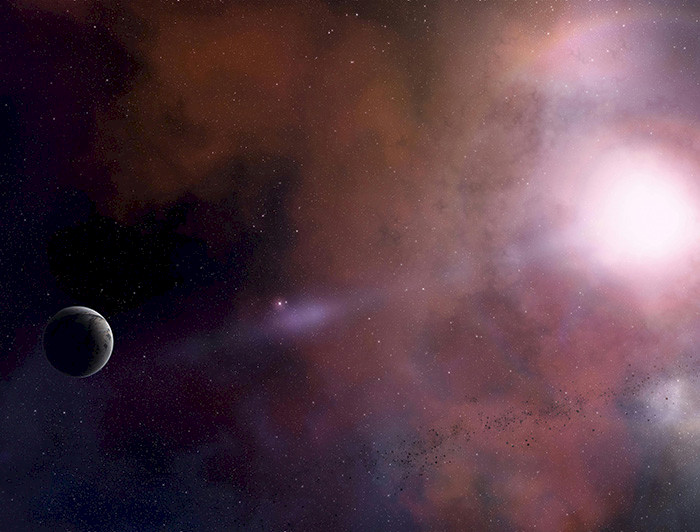
photo_camera This experimental approach complements astronomical observations, offering new possibilities for studying fundamental questions about the evolution of the Universe. (Photo credit: Pexels)
What if the mysteries of the Universe, such as its accelerated expansion or dark energy, could be explored in a laboratory rather than through gigantic telescopes? This is the challenge undertaken by a team of researchers from the UC Chile Institute of Physics, in collaboration with Adolfo Ibáñez University.
On that note, the researchers developed a pioneering experiment -with findings published in the journal Communications Physics, from the Nature group, where they use classical physical systems, based on plasmas and laser pulses, to reproduce some observations from modern cosmology, the branch of science that studies the origin, evolution, and future of our Universe.
“What we have developed is an experimental analogy: a classical physical system that reproduces certain astronomical-scale observations of the Universe,” explains Felipe Veloso, an academic at the UC Institute of Physics and co-author of the study. “This does not constitute a demonstration that the cosmological models are correct, but it does allow them to be explored in a controlled way using an analogous model available in our laboratory.”
Dark Energy and Accelerated Expansion of the Universe
One of the great challenges of modern physics is understanding the nature of dark energy, which makes up about 70% of the Universe. While its exact nature is still unknown, cosmological observations suggest its existence is due to the accelerated expansion of the Universe.
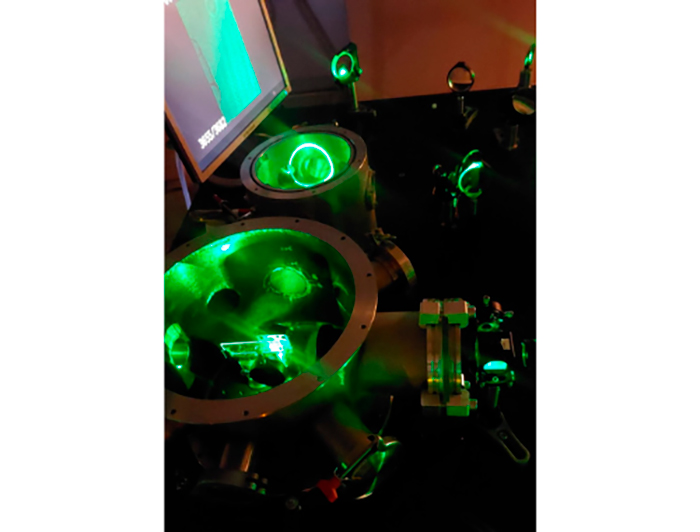
This is particularly significant because, in a laboratory setting, the team was able to generate plasma-induced ring-shaped shock waves using laser pulses, whose behavior resembles that of current cosmological models.
The study demonstrates that the expansion of these plasma-induced ring-shaped shock waves can mimic regimes dominated by radiation, matter, and even phenomena equivalent to dark energy. Furthermore, certain plasma disturbances exhibit analogous behavior similar to gravitational waves in a cosmological context.
This experiment does not replace astronomical observations, but it does complement them, providing a new method for testing the theory in a controlled and reproducible setting.
The contribution of the UC Chile team, led by Professors Felipe Veloso and Julio Valenzuela, played a key role in the development of the experiment and associated measurements, which complemented the theoretical insights of Felipe Asenjo, a Professor from Adolfo Ibáñez University.
“This type of research highlights the importance of collaboration between different areas of physics. Here, plasma physics, hydrodynamics, and cosmology converge, showing that highly complex problems can be addressed through a range of complementary experimental approaches,” says Professor Veloso.
This approach creates new possibilities for investigating fundamental questions about the evolution of the Universe, bridging observations with reproducible, analogous experiments at the UC Chile Faculty of Physics’ Optics and Plasma Laboratory.
Read the full article here


