“The Catholic identity must be the heart that animates the entire university body.”
In front of an audience that filled Fresno Hall, the Prefect of the Holy See’s Dicastery for Culture and Education delivered a keynote speech in which he addressed the role of Catholic universities in contemporary society. On this occasion, he called for “touching the hearts of the new generations,” and putting technology “at the service of the human person.” He also highlighted UC Chile’s new strategic plan and its deep sense of community spirit.
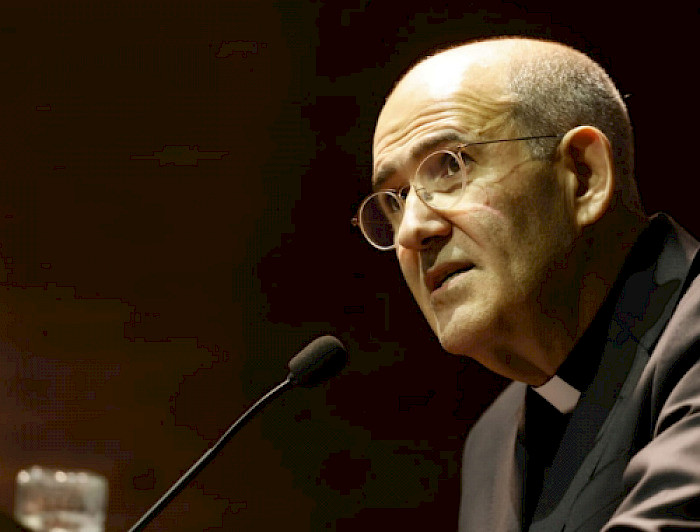
photo_camera One of the main themes Cardinal Tolentino addressed in his lecture was the role that Catholic universities play in today’s world, highlighting the Christian identity as a distinguishing feature. (Photo credit: Karina Fuenzalida)
Education is “an act of resistance and hope,” the University “a place to combat pessimism and nihilism,” and “technological progress is part of God’s plan for Creation.” These are some of the ideas posed by Cardinal José Tolentino de Mendonça, Prefect of the Dicastery for Culture and Education of the Holy See, during the lecture he delivered this Monday at UC Chile.
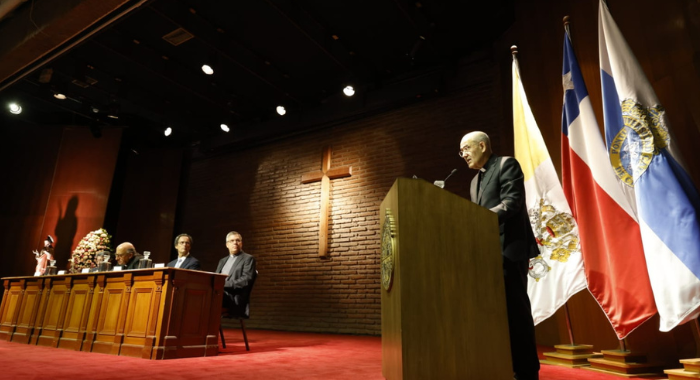
Considered one of the most influential figures in contemporary Catholic thought, the Cardinal delivered the lecture “Identity, Excellence, and Mission” in front of an audience that filled the Juan Francisco Fresno Hall at the Alameda Extension Center.
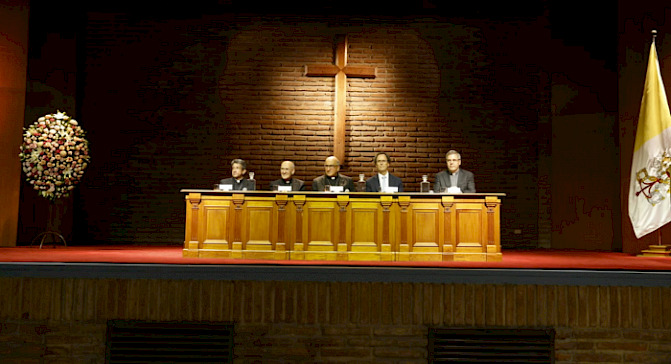
Among those in attendance were Cardinal Fernando Chomali, Archbishop of Santiago de Chile and Chancellor of UC Chile; the Apostolic Nuncio to Chile, Monsignor Kurian Mathew Vayalunkal; Father Osvaldo Fernández de Castro, Vice Chancellor of UC Chile; and UC Chile President Juan Carlos de la Llera; as well as representatives from all areas of the university community.
Catholic identity as the central focus
One of the main themes Cardinal Tolentino addressed in his lecture was the role that Catholic universities play in today’s world, highlighting the Christian identity as a distinguishing feature.
On this point, Tolentino recalled the words of Pope Leo, underscoring that the Catholic identity “is not merely an ornament,” but rather the core that gives meaning to the educational process. “The Catholic identity cannot be just another element among many. It must be the fundamental choice – the heart that animates the entire university body. It is something worth celebrating and, even more so, worth exploring in depth,” he remarked.
In this sense, he stated that the Apostolic Constitution Ex corde Ecclesiae continues to be a “lamp that illuminates” the work of Catholic universities, guiding their mission in the contemporary world.
Cardinal Tolentino also praised UC Chile’s new 2026-2030 Strategic Plan, highlighting that it places the educational project at the center, which—he stated—is a source of great joy, as it reflects a comprehensive understanding of university education. He also highlighted the community-driven process of developing the plan.
“Not long ago, this university community approved the Strategic Plan that will guide it during the next five years. This approval culminates a process that is admirable both for its technical rigor and, above all, for its community-wide scope,” he highlighted.
Along those lines, he emphasized that this journey reflects a community that engages in dialogue, listens, and builds together, highlighting especially the participation of young people. “This is synodality put in practice – that synodality so dear to Pope Francis and now reaffirmed and strengthened by Pope Leo. Congratulations, then, on this milestone,” he remarked.
Holistic education and service
The Cardinal elaborated on the idea that the university should not only impart knowledge, but also offer a comprehensive educational experience capable of forming individuals of integrity who are committed to the common good.
In this context, he stressed that service is not a secondary element of the educational process: “Education is not limited to the transmission of knowledge but rather finds its fullness in the act of serving. To educate, in fact, means to introduce students to responsibility, to generosity, and to care for our shared future. Its primary task is to form individuals of integrity, authenticity, and critical thinking – minds that think and hearts that believe, with a commitment to social justice.”
He also noted that UC Chile has clearly identified current threats: “You have not closed your eyes to reality and the uncertainty that it generates. Rather, you have chosen to embrace it as a starting point for institutional creativity,” he stated.
Youth, dialogue, and community
One aspect particularly valued by Cardinal Tolentino was the prominent role of young people in the university process. He mentioned that listening to their voices and giving them space is fundamental to building an authentic university community in which decisions are made collaboratively.
In this sense, he stressed the importance of dialogue as a constitutive dimension of university life: “Dialogue is essential. We need to listen. We have to practice the grammar of dialogue. Questions must not be silenced,” he stated, highlighting that the university must be a space where critical thinking and the search for truth are developed within community.
“A Pontifical University must be capable of speaking to and touching the hearts of new generations,” he asserted, adding that “a university is a place to combat pessimism and nihilism, and to build ideas and paradigms of hope for the future of humanity.”
“Do not fear technology”
In his reflection, the Cardinal also addressed the dichotomy between tradition and innovation, pointing out that both dimensions are indispensable for university development. He explained that tradition offers a solid foundation and identity, while innovation allows us to connect with new generations and to respond to the challenges of the present.
Regarding new technologies, he emphasized that they are part of contemporary life and must not be rejected, but rather understood and directed toward serving the person. “Our universities must not fear technology; we must understand it, make use of it and, above all, humanize it, putting it at the service of the human person. […] Artificial intelligence may be able to generate answers and offer solutions, but only we can and must give them meaning,” he stated.
“That is why we must be clear about our objective and, certainly, our attitude towards technology should never be hostile or dismissive, because ‘technological progress is part of God’s plan for Creation,’” he remarked.
Education, equity, and social commitment
In the final part of his address, Cardinal Tolentino called for placing the person at the center of university life.
He invited everyone to “open their hearts” and to remember that everyone has an inalienable right to education, emphasizing the responsibility to include the most marginalized in particular. He stressed that the education of the poor is not a favor but a duty, and that losing them means losing the very essence of the institution.
In this sense, he emphasized the historical role of Catholic education as a driving force for social transformation, calling for the continued building of institutions that promote equity and the common good.
“The path you have charted takes on special significance given the current situation in the country. Without claiming to understand in depth all the complexities of the Chilean reality, it is perhaps not too bold to suggest that Catholic universities can – and, indeed, must – play a decisive role as spaces for gathering, dialogue, and the shared pursuit of the common good among legitimate differences,” he commented.
Acknowledgements and closing remarks
During the event, UC Chile Chancellor Monsignor Fernando Chomalí and UC Chile President Juan Carlos de la Llera presented Cardinal Tolentino with the UC Chile Centennial Silver Medal.
In his closing remarks, the cardinal praised the path laid out by the university, pointing out that it is particularly significant for the country’s current situation and a sign of hope.
Likewise, he highlighted that UC Chile is not afraid to face uncertainty head on, but rather embraces it as a source of institutional creativity. Finally, he expressed: “Congratulations to all; may the Sacred Heart of Jesus continue to forge your identity, guiding it along the path of excellence and sustaining it in its mission.”
He concluded his address with a quote by Gabriela Mistral: “Grant me, Lord, the perseverance of the waves of the sea, which make of each setback a starting point for new progress.”


