
New Instrument in Chile Captures the Hidden Heart of the Milky Way
The Multi-Object Optical and Near-infrared Spectrograph (MOONS), which is capable of collecting data from 1,000 objects simultaneously, achieved its “first light” after being successfully installed on the Very Large Telescope (VLT) of the European Southern Observatory (ESO). In its first observation, it provided an unprecedented spectroscopic view of one of the most densely populated regions of our galaxy.

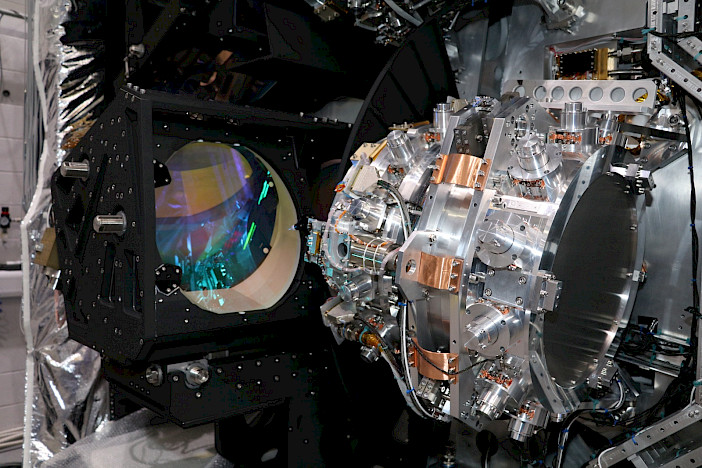
photo_camera The mission of this new instrument is to collect spectra from stars at the center of the Milky Way and from distant galaxies
In astronomy, “first light” is the moment when a new telescope or instrument successfully observes an astronomical object in the sky for the first time. This has just happened with the Multi-Object Optical and Near-infrared Spectrograph (MOONS), which has achieved its first light after being installed on the Very Large Telescope (VLT) of the European Southern Observatory (ESO), located at the Paranal Observatory in northern Chile.
It is a powerful, next-generation spectrograph built by an international consortium led by the UK Astronomy Technology Centre (UK ATC) in Edinburgh—part of the UK’s Science and Technology Facilities Council (STFC) —, which involved collaboration among partners from the United Kingdom, Italy, France, Portugal, Switzerland, ESO, and Chile, through the UC Chile Center for Astroengineering.
With this first observation, MOONS demonstrated its transformative potential by capturing the heart of the Milky Way in an entirely new way. Thanks to its sensitivity to near-infrared light, it managed to see through the dust that obscures this region, providing an unprecedented spectroscopic view of one of the most densely populated regions of our galaxy.
This milestone marks the beginning of a new era in cosmic exploration, as this innovative instrument will make it possible to study millions of stars and galaxies, and reveal how the Universe has evolved over billions of years.
“MOONS will offer to astronomers a completely new way to explore the Universe, allowing us to make observations that were simply beyond our reach until now,” states Doctor Oscar González, main researcher at MOONS in the United Kingdom, and Head of Project Science and Strategy at UK ATC.
He highlights that “this is the result of an extraordinary international effort. For years, our scientists, engineers, and technicians have worked together to overcome major technological challenges and build an instrument with exceptional capacities. For me, first light is a celebration of their experience, dedication, and perseverance. It marks the exact moment when our years of work are transformed into discovery.”
The Key Role of Chilean Astronomers and Engineers
The UC Chile Center for Astroengineering was instrumental in this achievement, as it developed the software that controls each part of the instrument. This was done in collaboration with the company BlueShadows, led by the Chilean engineer Tzu-Chiang Shen.
“The first light of MOONS is a huge achievement for our institution, since it is the first instrument with this level of complexity for an 8-meter-diameter telescope in which we participated,” notes Manuela Zoccali, faculty member of the UC Chile Institute for Astrophysics, and MOONS Project Manager in Chile.
“Over the years, there has been no shortage of difficulties and moments of panic, precisely because the Chilean system is not designed to fund projects of this magnitude, with the long-term continuity they require. However, today we are very happy that MOONS is finally out to see the stars,” she adds.
The researcher also highlights the impact this project has had on training new generations of astronomers and technicians: “For me in particular, the pride is twofold, since I had the honor of supervising the first steps in research of Oscar González, MOONS’ UK Principal Investigator, a Chilean and alumnus of our undergrad program. His brilliant career in the development of astronomical instrumentation, his lifelong dream, demonstrates that at UC Chile we have the capacity to propel young talent to the world’s elite.”
Exploring the stars at the center of the Milky Way
MOONS is a spectrograph, so it does not take photographs. Instead, it divides the light coming from stars and galaxies into detailed spectra. By analyzing these spectra, astronomers can determine properties such as an object’s chemical composition, temperature, motion, and distance.
Its key advantages over other instruments are that it has 1,000 independently moving fibers, allowing it to observe 1,000 different objects simultaneously. This same near-infrared sensibility that enabled it to see through the dust in the center of the Milky Way also allowed it to detect distant galaxies, whose light is redshifted due to the expansion of the Universe.
Additionally, for each object, it gathers spectra in three different spectral regions simultaneously. These capabilities are enhanced by ESO’s 8-meter VLT mirror, making MOONS one of the most powerful spectroscopic facilities ever built.
A single observation can gather this information for nearly a thousand objects at the same time. This is the first time such a large amount of data is obtained in only one observation.
The main scientific objectives that guided its development were the exploration of millions of stars in the hidden heart of the Milky Way and of distant galaxies.
By collecting and analyzing the light of millions of objects over its lifetime, astronomers will be able to address some of the most important questions in astronomy, from understanding the formation and evolution of the Milky Way, to tracing the growth of galaxies across billions of years in cosmic history.
For their participation in its construction, the astronomers from UC Chile will have privileged access to MOONS’s observations for the next five years.
Extraordinary Engineering That Enables Operation at Cryogenic Temperatures
The performance achieved during the startup phase demonstrates the extraordinary capabilities of its state-of-the-art optical systems, cryogenic systems, and advanced control systems.
At the heart of MOONS lies a remarkable feat of engineering. Installed at more than 2,600 meters above sea level, on a mountaintop in Chile, the instrument operates at cryogenic temperatures. Its optics and mechanisms are maintained at 130 Kelvin (-140°C), while its detectors function at nearly 40 Kelvin (-230°C), ensuring the stability and sensitivity needed for detecting the faint light from distant stars and galaxies.
To achieve this, MOONS uses a massive cryostat that is considered one of the largest ever built for a ground-based astronomical telescope.
Equally impressive is its robotic optical fiber positioning system, a masterpiece of precision engineering that aligns 1,000 optical fibers with its celestial targets with micrometer-level precision, allowing us to study the sky on a scale and with an efficiency never before achieved.
A New Era of Discoveries
MOONS is expected to become a fundamental tool for the Very Large Telescope, located 130 kilometers south of Antofagasta, generating enormous volumes of spectroscopic data that will complement observations made by installations such as the Gaia mission of the European Space Agency (ESA), the Vera C. Rubin Observatory, and future space missions.
With the first light now achieved, the team will continue the startup and calibration activities before starting regular scientific operations. These initial observations already demonstrate the enormous potential of this state-of-the-art instrument, and mark the beginning of an exciting new chapter in astronomical exploration.


