The Push for Natural Fibers, Clay, and Seaweed in the Architecture of the Future
Thanks to a collaboration between Denmark’s Center for Industrialized Architecture (CINARK), the UC Chile Faculty of Architecture, Design, and Urban Studies—through the efforts of Professor Pedro Alonso—and the Atacama Desert Research Station, researchers are exploring the use of natural fibers, clay, and seaweed to create sustainable façades that are thermally insulated and fire-resistant. This innovation will be tested in an experimental module at the Atacama Desert Research Station, thanks to funding from the Avanza UC research competition.
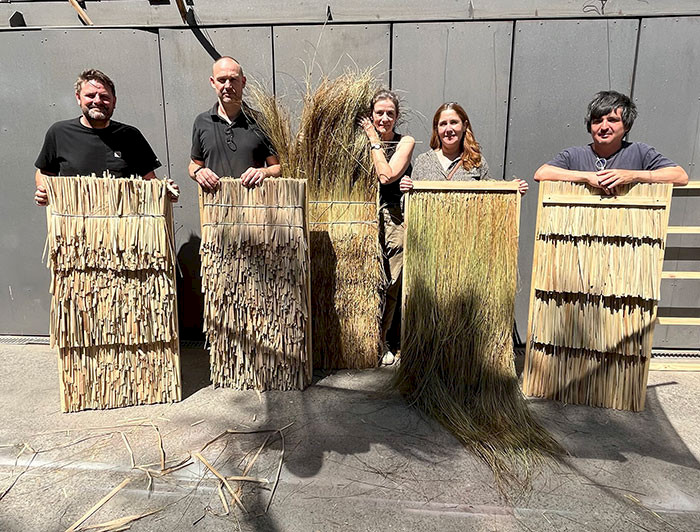
photo_camera The CINARK research team, alongside Professor Pedro Alonso and curator Pamela Prado (first and second from the right). (Photo credit: Pedro Alonso)
Contemporary architecture faces an unavoidable challenge: reducing its carbon footprint by using sustainable and energy-efficient methods and materials.
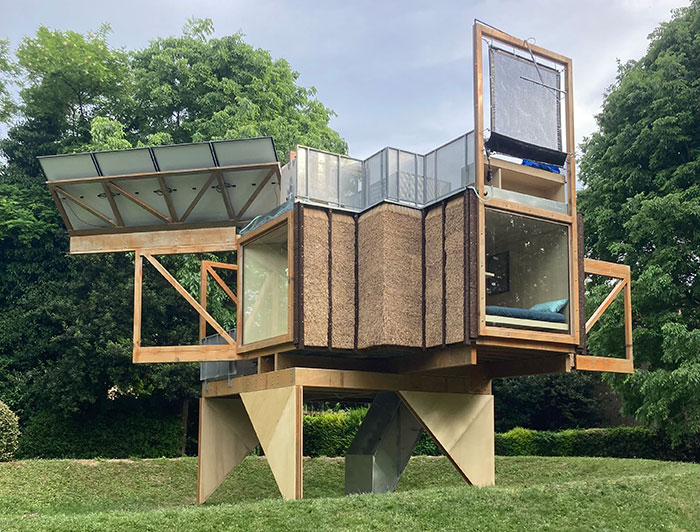
That was precisely the challenge that Pedro Alonso, a professor at the School of Architecture and director of the Doctoral program at the UC Chile School of Architecture, Design, and Urban Studies, sought to address with his minimum dwelling prototype, Deserta Ecofolie, at the 19th Venice Architecture Biennale in 2025—in collaboration with the curator Pamela Prado, and in partnership with the Schools of Engineering, Agronomy and Natural Systems, School of Geography, History, and Political Science, and the Portuguese company ArtWorks. The project incorporated sustainable elements such as a fog catcher for water generation, as well as solar panels, and a biogenic façade.
The latter, built using materials such as mud and straw, was developed in collaboration with the Center for Industrialised Architecture (CINARK) from the Royal Danish Academy in Copenhagen, Denmark. The solution provides sustainable fire protection and temperature control.
A Return to Roots
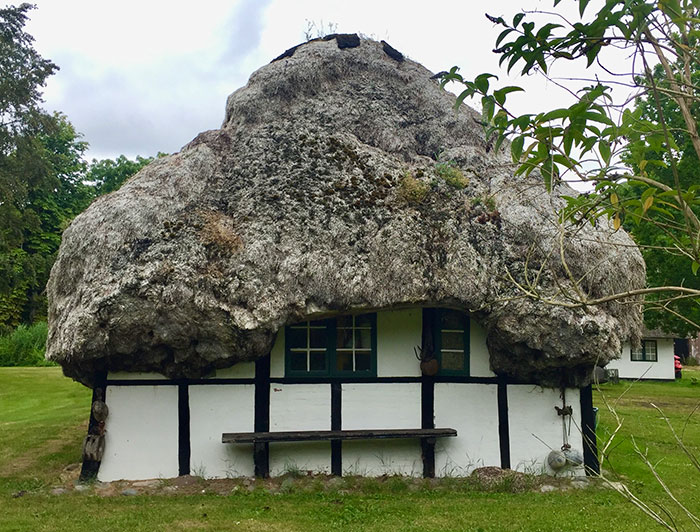
The scarcity of wood in the Nordic countries led its inhabitants, several centuries ago, to build their homes using materials such as clay, straw, and manure, a mixture that provided excellent thermal and structural insulation.
That is why researchers at CINARK began studying these techniques and are currently developing “biogenic” prefabricated panels that use materials such as straw, clay, and seaweed, providing not only thermal insulation but also fire-resistant properties.
As CINARK Director, Anne Beim, explains “In our project in Denmark, we mix seaweed with clay and use it exclusively to fill critical gaps between different structural elements and within the construction itself. This has proven to be highly effective for testing fire-resistant properties, partly because seaweed contains a high percentage of salt, and when combined with clay, it simply stops or prevents the fire from spreading.”
From Denmark to the Atacama Desert
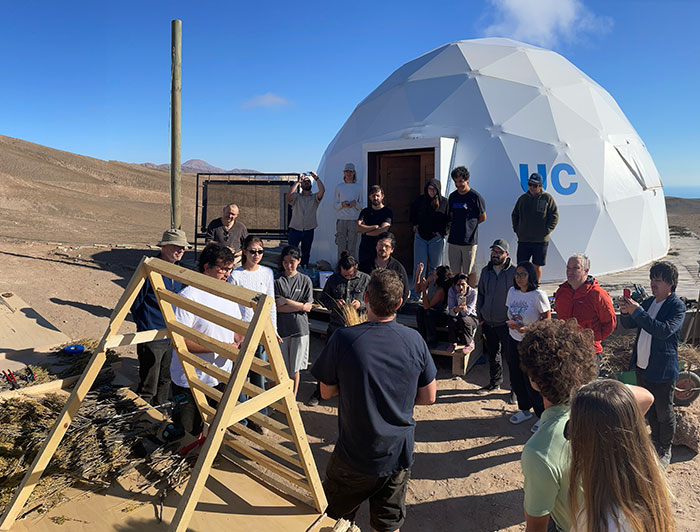
The collaboration on the Venice Biennale project paved the way for a visit by a team of researchers from CINARK—led by its director, Anne Beim, and scholars Johannes Schotanus and Thomas Gerner—to the Atacama Desert Research Station, as part of the international workshop “Deserta Ecofolie,” led by Professor Alonso and held at the Atacama Desert Research Station.
For the Danish researchers, the visit to the heart of the desert in the Tarapacá Region was a life-changing experience. “I have never experienced anything like this... It is both fascinating and terrifying to think about what we will do if large parts of the world turn into desert,” reflects Anne Beim on the impact of climate change and the importance of transitioning towards more sustainable ways of building and living.
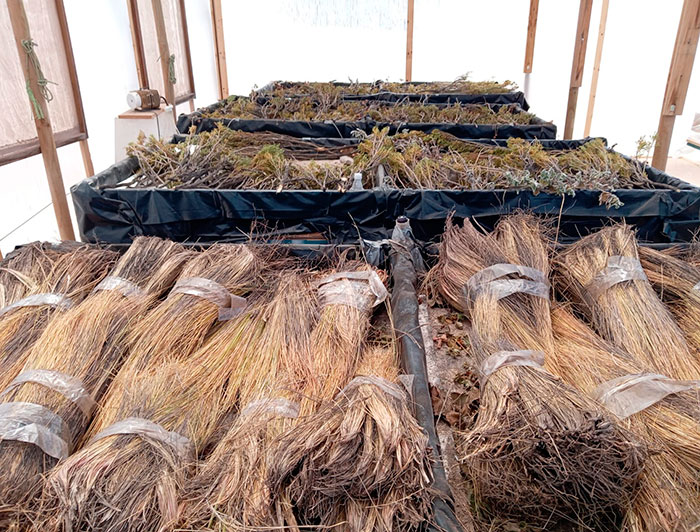
The goal was to collect local materials from the Atacama Desert and the Altiplano to create new versions of the biogenic panels. To this end, the team, together with Pablo Osses, director of the Atacama Desert Research Station; Milton Avilés, UC Chile regional coordinator; and professors from the UC Chile School of Architecture Pedro Alonso, Francisco Chateau, Germán Guzmán, and Francisco Salas, curator Pamela Prado and Alberto Prado of University Arturo Prat, visited the villages of Chusmiza, Cariquima, Huara, and Enquelga. There, they collected plant fibers such as tola, tar, and totora, as well as different types of local seaweed, including Macrocystis pyrifera, Lessonia trabeculata, and Lessonia berteorana.
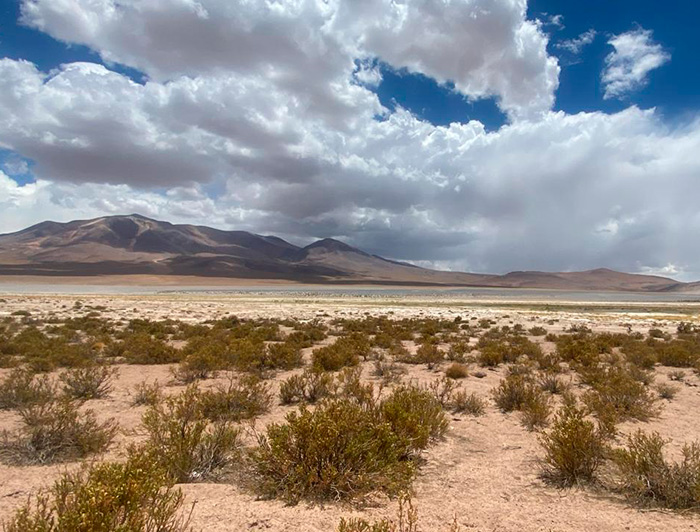
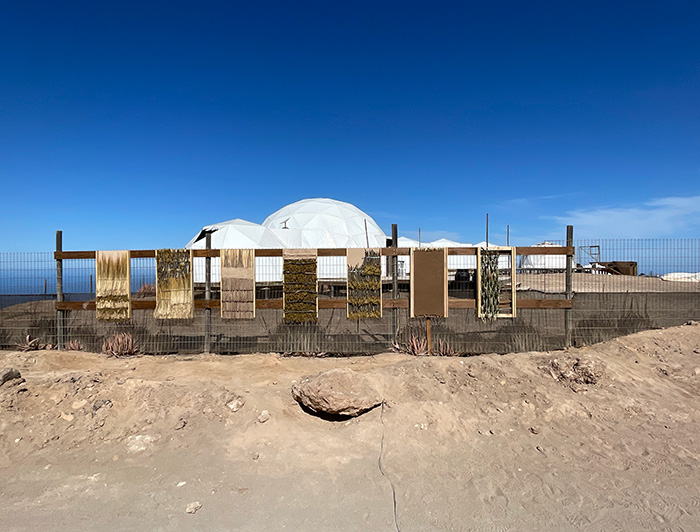
The researchers are seeking to adapt Nordic techniques to local fibers, which has been a challenge. As Anne Beim explains, “It has been fascinating to experiment with these materials. The harder ones, like tar, or shrubby ones like tola, are comparable to those we find in Denmark; but totora is quite different—it is a very delicate and refined material to work with.” That is why the researchers had to try different techniques and even combine them. The results of these tests were displayed in an outdoor exhibition at the Station.
As Pablo Osses, a researcher at the Institute of Geography, explains, “All of this has been tremendously interesting, because it brings together ancient traditions and modern technologies, and at the same time reestablishes the Atacama Desert Research Station within the international research community as a premier platform for innovation in various fields.”
The fieldwork led to a reflection on how extreme climatic conditions—fog, high solar radiation, and sudden temperature fluctuations between day and night—determine construction methods in the desert.
A More Human Architecture
CINARK’s participation in the Deserta Ecofolie prototype at the Venice Biennale marked a major breakthrough: moving from the on-site construction of biogenic façades to the development of prefabricated panels, making it possible to consider “industrializing” the process.
In fact, researchers have already begun working on designs for apartment buildings up to five stories tall, where these panels function as curtain walls, assembled on wooden or even concrete structures.
The goal is for architecture to not only be more sustainable, but also more “humane.” “When we have straw, everyone wants to touch it and feel it. It speaks to something deep inside us; it is comforting, and it feels familiar, unlike a concrete façade,” explains the researchers at CINARK.
The Vision of Avanza UC
Moreover, the collaboration between UC Chile and CINARK is focused firmly on the future. The project will continue with the creation of the Ecofolie Lab: a self-sufficient modular laboratory for interdisciplinary research in desert environments, which will be located at the Atacama Desert Research Station and serve as a facility for the study of strategies for livability, energy, and natural resource management under extreme conditions.
This new structure, which will be funded through the Avanza UC grant, will be equipped with integrated systems for fog harvesting, as well as solar and wind power generation, passive thermal management, and graywater recycling. It will also feature the biogenic façades incorporating elements harvested from the Atacama Desert.
“The laboratory will serve as a platform to support the work of different researchers, from botanists to artists,” explains Professor Pedro Alonso, who is leading the project together with the Atacama Desert Research Station.
However, beyond serving as a privileged space for multidisciplinary research, it will also be an experimental prototype itself. As the professor notes, “the project is conceived as a living lab that will measure the module’s environmental and operational variables in real time, generating an open dataset for academic and scientific use.”
The academic partnership with CINARK thus reaffirms UC Chile’s commitment to sustainable innovation and the internationalization of research, demonstrating that solutions to global challenges can be found at the intersection of traditional techniques and innovative science, making it a global benchmark.


