UC Chile alumni who invented tumor detector accepted into joint Harvard-MIT PhD program
Maximiliano Mariné—who studied medicine and engineering concurrently at UC Chile—is one of 20 students, selected from a total of 900 applicants worldwide, who were accepted into the prestigious PhD program in Health Science and Technology at Harvard and MIT. His journey reflects not only academic excellence, but also a clear conviction: that is it possible to conduct research with global reach from Chile.
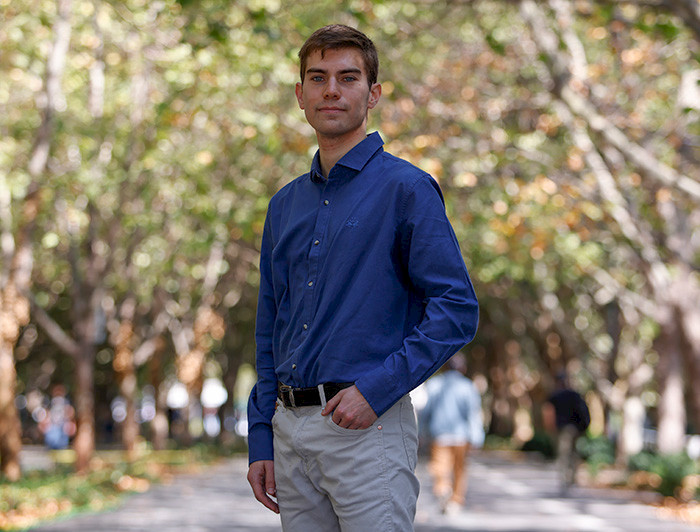
photo_camera Maximiliano Mariné enrolled at UC Chile in 2020 to study medicine and, a year later, enrolled to study engineering in parallel. (Photo credit: Karina Fuenzalida)
Maximiliano Mariné enrolled in 2020 to study medicine at UC Chile and, a year later, decided to study engineering as well, motivated by a question that had been with him from an early age: how to use technology to overcome the limitations faced by medicine.
As a UC Chile student, this question led him to conduct research on breast cancer detection and head the creation of SNIFF, a device that enables the identification of tumor margins in real time, with the potential to improve treatment and reduce the recurrence of this disease. This biomedical development received significant recognition last year.
Today, at age 24, Maximiliano Mariné has just achieved a new milestone in his career: he was accepted into the PhD program in Health Sciences and Technology offered by Harvard University and the Massachusetts Institute of Technology (MIT), a joint program between the two institutions.
This opportunity not only represents a recognition of his talent, but also the possibility of joining one of the world’s most advanced ecosystems of biomedical innovation. “It is an environment where everybody works to bring about real change”, mentions Mariné, who emphasizes his interest in collaborating and learning in a highly dynamic setting.
“There’s a belief that opportunities such as Harvard-MIT are impossible, but in reality, they’re not, and the first step to being selected is to apply”, he comments, and highlights the importance of having the courage to pursue an international career.
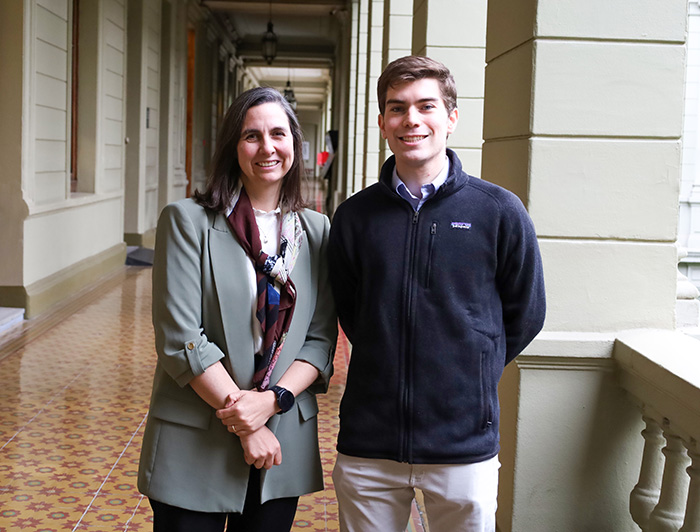
Following the announcement, UC Chile Vice President for International Affairs, Maria Montt Strabucchi, met with Maximiliano Mariné, to learn firsthand about his distinguished career, to congratulate him, and to explore how his experience can serve as an example and as an ambassador for UC Chile Global Talent at an international level.
A mechanism from the textile industry used to create device that detects tumors
As an undergraduate student, Maximiliano took part in courses in innovation, research, and entrepreneurship that led to his first projects. One of them, focused on the textile industry, was aimed at optimizing the sorting of materials for recycling by analyzing the gases emitted during their combustion. Although this project did not succeed, the experience marked a turning point in his career.
This project gave him the opportunity to do an internship in Boston and work within an innovation ecosystem. He also completed three other research internships in the Wellman Center for Photomedicine at Massachusetts General Hospital. These international experiences led him to constantly reflect on how to refocus his research to give it meaning and direct it toward solving real problems in the Chilean context.
It was a year later, during one of his rotations in oncological surgery, that Maximiliano noticed one detail in the operating room: the smoke emanating from the tissue as the surgeon worked with an electrosurgical knife. It occurred to him that, just as with textiles, this emission of gases could carry relevant information.
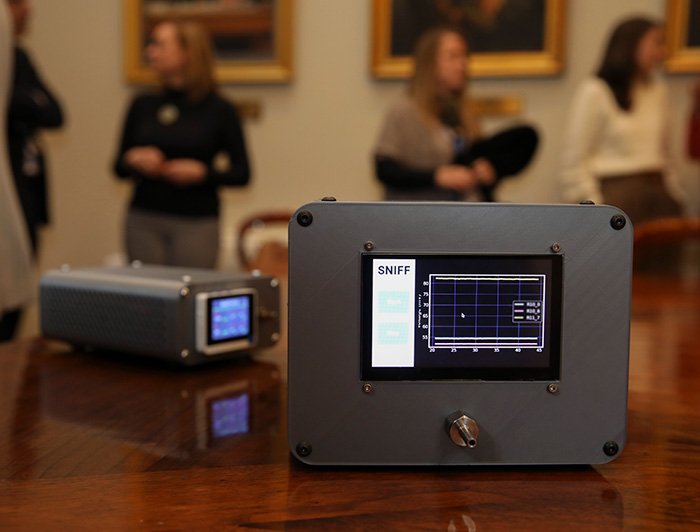
With this idea, Maximiliano led a group of engineering and health sciences students, consisting of Felipe Andrade, Ignacio Moscoso, Rosario Willatt, and Javier Castro. After months of work and research, the first of three prototypes of a device they would name SNIFF (Intraoperative detection of breast cancer margins by electrosurgical gas analysis and artificial intelligence) was created.
The biomedical device provides the surgeon with precise information during operations, enabling real-teal decision taking, minimizing incomplete tumor resections, and reducing the need for additional surgeries.
“SNIFF can detect, though the volatile organic compounds (smoke and gases) emitted from tissue being treated with an electrosurgical knife, whether there are any tumor margins in the breasts. This streamlines the detection of breast cancer as well as its treatment and recurrence”, explains Maximiliano.
His motivation stems from personal reasons: the death of his grandmother from breast cancer following a recurrence associated with limitations in detection.
His projects, including SNIFF, have earned him recognition at national and international competitions, such as the Novartis Cancer Challenge, BRAIN Chile, and the Harvard Health Systems Innovation Hackathon Global Stage, among others. His academic record, the connection with his mentors, his leadership in projects, and his commitment to developing accessible solutions relevant to the local context, led him to look abroad for an opportunity to continue growing and making an impact.
One in 900
Throughout his time at UC Chile, Maximiliano has been guided by teachers who not only educated him but also inspired him. Professor Vicente Parot, faculty member of the UC Chile Institute for Biological and Medical Engineering, has closely followed his development as a research mentor and professor during his training. “He is a student who has achieved exceptional results”, he states, highlighting his abilities as well as his commitment.
In 2025, Maximiliano visited the EducationUSA offices on the UC Chile San Joaquín Campus, inspired as well by the experience of his teacher Vicente Parot, who earned his doctoral degree in Boston. Seeking a program that would meet his needs, meet his expectations for conducting research and align with his educational interests, he discovered the PhD program at the MIT School of Engineering, the institution with the highest global ranking in the 2026 QS World University Ranking, and Havard Medical School, which ranks 5th in the same ranking.
The PhD program in Health Sciences and Technology is known for its high standards, both in the admissions process as well as in its academic programs. According to Hannah Stewart, EducationUSA advisor who assisted Maximiliano Mariné with his application, the UC Chile graduate is the fourth Chilean to be accepted. Each year, the program receives more than 900 applications from students around the world, of which only 20 are accepted.
Professor Vicente Parot describes Boston as a hub of biomedical innovation where cutting-edge research is conducted. “He will be exposed to a wide variety of research topics that are being pursued at the most advanced level globally. It will be an excellent opportunity to participate in dynamic and fast-paced collaborations, with a great deal of interaction among scientists, which makes it a very stimulating environment for his doctoral training”, explains the academic.
The program provides full funding for the first year and, subsequently, continued funding through participation in research and academic programs. Maximilano is eagerly awaiting September to begin the program. “In the United States, I would like to continue developing technologies that are also designed to be cost-effective, given that, just because a solution works, it doesn’t necessarily mean it will be applicable in all contexts”, he explains, highlighting the importance of generating innovation that is relevant to contexts such as Chile’s.


