UC Chile Student Represents Chile in Shanghai Playing Weiqi (Go)
Gustavo Gibbons, a student from the Statistics program at the Faculty of Mathematics, discovered his passion for the traditional Chinese game after watching a documentary in 2018. Since then, he has spent years perfecting his skills in this ancient game, considered one of the traditional Four Arts of the Chinese Scholar and a symbol of wisdom, strategy, and philosophy. Today, that journey has led him to represent our country in the World Collegiate Weiqi Championship in Shanghai.
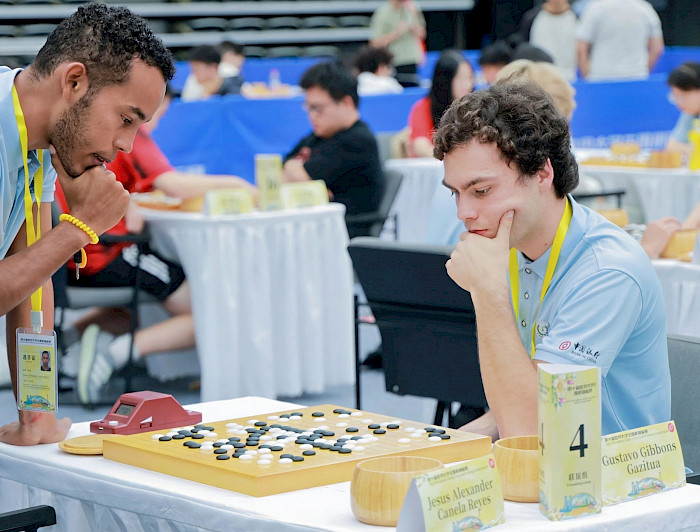
photo_camera During the tournament, the student faced competitors from China and other parts of the world. Photo credit: The 10th Annual World Collegiate Weiqi Championship.
In 2018, more than 19,000 kilometers away from Shanghai, in his hometown of Punta Arenas, at the southern tip of Chile, Gustavo Gibbons watched the documentary AlphaGo (2017) for the first time The film narrates the historic showdown between the artificial intelligence of the same name—developed by Google DeepMind—and the renowned South Korean Go player Lee Sedol in March 2016.
That was his first introduction to Weiqi, a game that piqued his curiosity and, over the years, became a true passion. Since then, the current student of Statistics at the UC Chile Faculty of Mathematics has devoted countless hours to studying and perfecting his skills.
Gustavo explains the benefits of this game and how, over the years he has been playing it, it has contributed to his personal and professional growth. “The greatest impact this game has had on me is helping me learn from my mistakes. This is why it is often said that Go imparts wisdom (…) The game teaches you that it’s very easy to make mistakes on impulse and teaches you to be more disciplined and to think,” explains the UC Chile student.
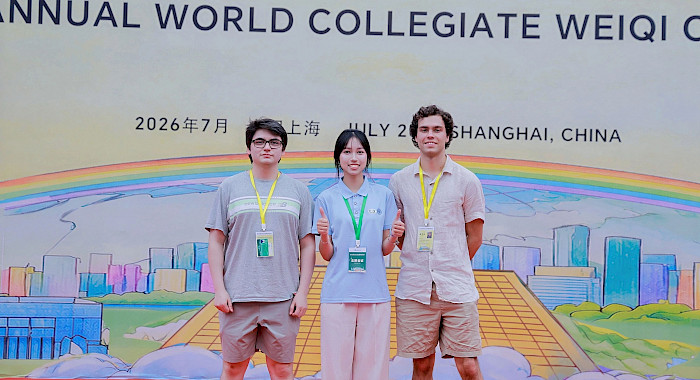
Our Representative in the World Collegiate Championship
The student arrived in China on July 7th to compete in the World Collegiate Weiqi Championship, which concluded on July 10th. In his category, he competed against 26 players from different countries and finished in 14th place, giving an outstanding performance in his international debut.
“It has been a unique experience, because I got to meet and talk with people not only from China, but from all over the world, and this was only possible because of this opportunity,” says Gustavo about what he took away from his time in Shanghai.
There are two ways to qualify for the World Collegiate Championship: by obtaining a regional spot, or by representing one’s home country. Gustavo earned the latter by winning the national qualifiers, becoming the Chilean representative along with Benjamín Mimiza, who qualified through the regional spot.
Much more than a board game
The players compete through the kyu and dan ranking system. The participants progress through the various kyu levels until they reach the dan ranks, which distinguish the most experienced players.
Weiqi (围棋)—known internationally as Go, and as Baduk in Korea—originated more than 2,500 years ago in China. It is a strategy game that involves placing white and black pieces on a grid lined board with the goal of capturing the as much territory as possible.
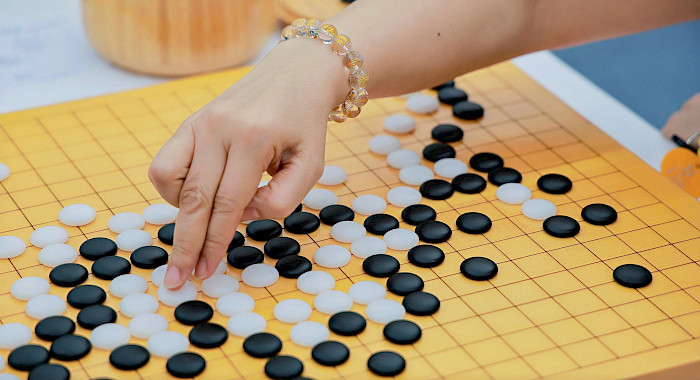
Hongmei Shen, professor of Chinese language and Culture at UC Chile Confucius Institute, explains that Weiqi is more than just a board game. It is part of China’s cultural heritage and is one of the Four Arts of the Chinese Scholar, along with Qin, the art of playing the Guqin (a traditional Chinese zither); Shū, calligraphy; and Huà, traditional brush and ink painting. In this set of disciplines, Qi is included as the art of the game, represented by Weiqi.
According to the academic, playing Weiqi is linked to the development of critical thinking, patience, and the ability to analyze different scenarios before taking action. Its influence extends beyond the board and is part of daily life and Chinese popular culture.
“Weiqi symbolizes strategy, wisdom, and philosophy. It has been featured in film, television, and literature, and even in sayings such as ‘Go is like life: once a piece is moved, there is no turning back’,” explains the teacher.
It is a game for all ages, explains Shen. Many professional players start as children and reach a high level of skill during their teenage years. For many senior adults, it becomes a recreational activity that stimulates the mind, helps preserve cognitive abilities, and fosters socialization in parks and public squares, where it is common to see older people gathered around a game board.
The academic highlights the presence of the game in audiovisual productions such as the documentary AlphaGo, which piqued Gustavo’s curiosity and has also connected with a new wave of players outside Asia, bringing this ancient game to young players around the world. “This is a very positive trend. Weiqi embodies a profound Eastern philosophy: balance, a holistic perspective, and the art of knowing how to choose among different options. Its internationalization not only promotes intellectual sport but also fosters intercultural exchange,” she adds.
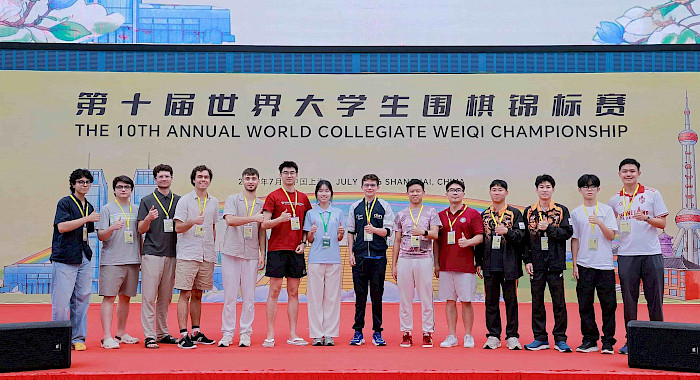
This international expansion was also evident to Gustavo during the World Collegiate Championship. In addition to competing against players from different countries, he had the opportunity to spend time with young people who, like him, found in Weiqi a passion that transcends borders. “It’s been so much fun to meet people from all over the world: kind, curious, and intelligent. This has been a unique experience to take part in a true cultural exchange,” he concludes.


