UC Chile’s Villarrica Campus Releases Trilingual Children’s Book That Invites Children to Learn About Nature in Spanish, English, and Mapudungun
With fine illustrations and pop-up features, La tierra nos quiere contar (The Earth Wants to Tell Us, in English) invites children to discover the changes in nature throughout the year, through an experience that reinforces the early connection between language and cultural richness.
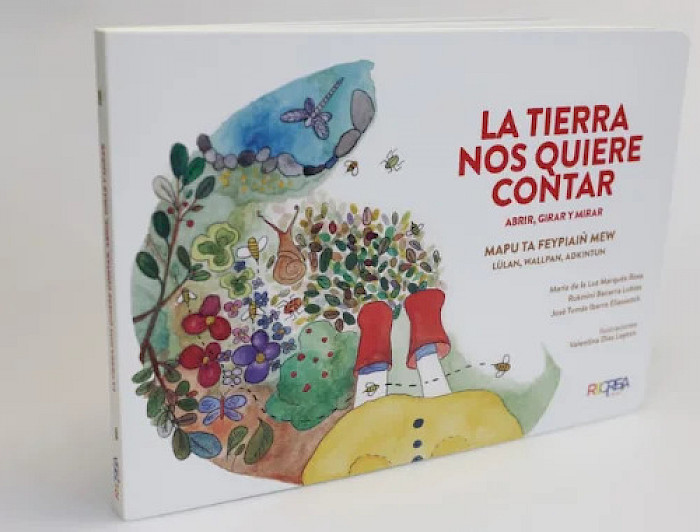
photo_camera The book is written in Spanish, English, and Mapudungun and offers a sensory experience that combines reading, movement, and listening.
Blooming flowers, falling leaves, droplets heralding rain, and bees dancing around a circular tree adorn the pages of the book La tierra nos quiere contar. Created by María de la Luz Marqués, Rukmini Becerra, and Tomás Ibarra, from UC Chile’s Villarrica Campus, the book creates a landscape in motion, where colors, seasons, and small details invite readers to open, turn, and observe closely what is happening in nature.
The book, illustrated by Valentina Díaz Leyton, presents an interactive experience designed for children to explore the Earth’s changes as it travels around the sun. Through images that transform and mechanisms that require the reader’s active participation, the book demonstrates how the natural environment changes throughout the year, visually connecting spring, summer, fall, and winter.
“When the Earth wants to tell us something, all we have to do is dare to open, turn, and look,” say the book’s authors, who present it as a direct invitation to the experience. The reading experience is neither linear nor passive: each page invites readers to discover something new through movement and observation.
A book to experience with the senses
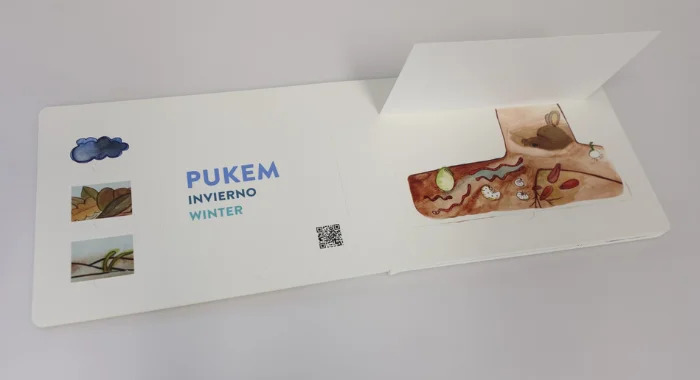
One of the central features of La tierra nos quiere contar is that it is trilingual. The texts are written in Spanish, Mapudungun, and English, which broadens the possibilities for listening and reading, and reinforces the connection between language, culture, and nature from early age.
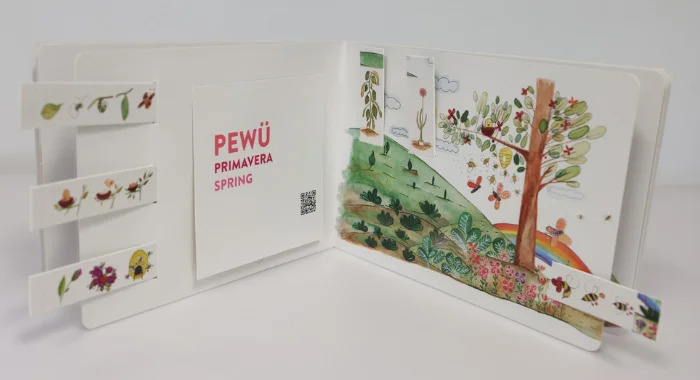
Its pages include flaps and sliding elements which add depth and movement to the text and the pictures, enhancing a sensory experience that engages the hands, eyes, and ears. The journey through the seasons is also supported by audio resources. The book features QR codes that allow readers to hear the story in three languages, adding an auditory dimension to the narrative and broadening the ways to engage with the story.
Nature, language, and shared experience
“As you explore this book, you will discover the changes the Earth experiences on its journey around the sun,” note the authors. The Earth is portrayed as a voice that observes, waits, transforms, and welcomes, in a narrative that is lived as a continuous cycle.
The illustrations reinforce this idea of circularity. A tree encircling the page, clouds bringing rain, fruits ripening, and leaves falling create a clear picture of the passage of time and the relationship between living beings and their environment.
The book is presented as a space for exploration and family conversation. The authors suggest observing, asking questions, and connecting what happens in the book to everyday experiences, reinforcing the book’s educational nature without separating play from learning.


