Dialogue and Community: The Keys to Civic Education Promoted by UC Chile
What is citizenship today? Beyond the right to vote, citizenship means understanding that we are part of an increasingly diverse community, where, in addition to exercising our rights, we must assume responsibilities such as participating in public affairs, respecting those who think differently, and building consensus through dialogue. This is precisely the foundation of Voces UC, a course that invites students to become full citizens, with all that this entails.
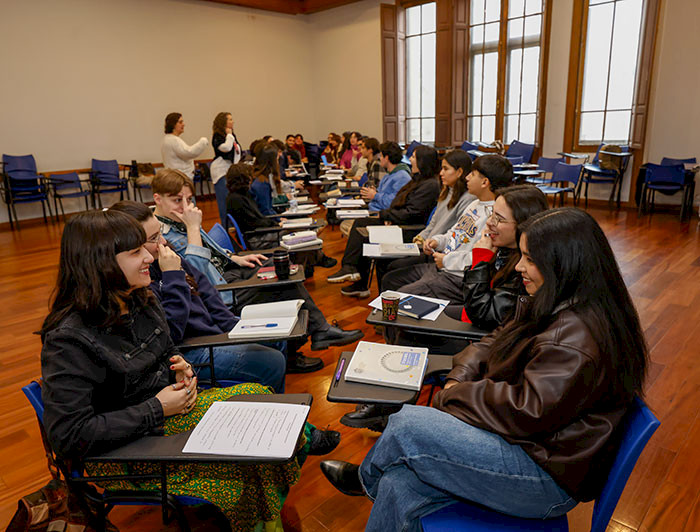
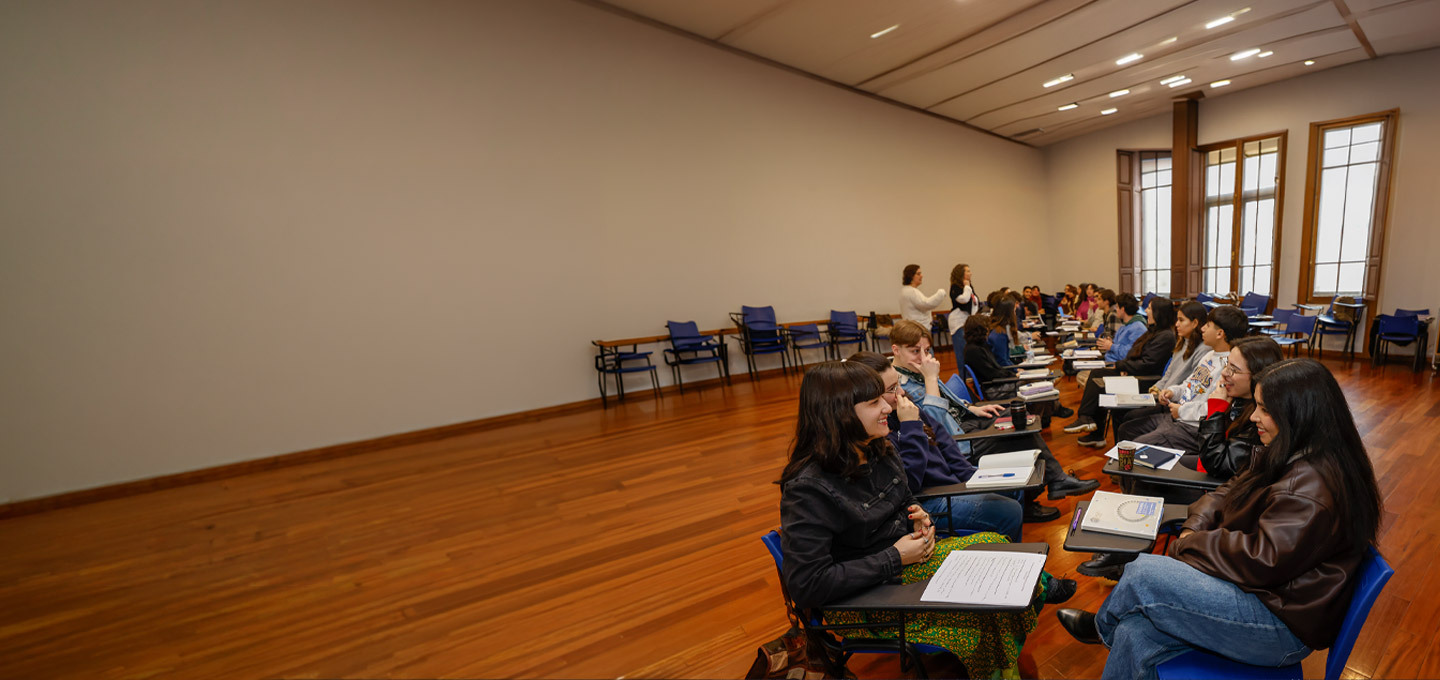
photo_camera In the Voces UC course, students learn tools to strengthen respectful dialogue, coexist in disagreement, reinforce responsibility toward the community, understand societal complexity, and develop their own critical thinking. (Photo credit: Karina Fuenzalida)
Speaking about citizenship in present-day Chile requires acknowledging a scenario marked by fragmentation, mistrust, and the weakening of traditional spaces for encounter. We live in a society where political polarization and digital interactions have replaced dialogue and social coexistence.
The UC National Bicentennial Survey has warned about deep tensions across the country, highlighting a climate dominated by institutional mistrust and the perception of latent social conflict. While the population perceives high levels of conflict—between the left and the right, Chileans and immigrants, the Mapuche people and the State—trust in institutions such as the Government, Congress, political parties, and law courts has remained below 20% (according to the 2025 survey).
On the other hand, Chilean society has also become more diverse. Currently, 1.6 million foreign nationals live in the country, equivalent to 8% of the total population according to the National Migration Service; this also represents a source of conflicts, prejudice, and confrontation between different worldviews.
“Being a good citizen in Chile today means much more than having the right to vote and participating in elections. It means understanding that we are part of a community that is increasingly diverse in political, moral, religious, cultural, and everyday lifestyle terms, among other aspects,” states Patricio Bernedo, Director of the UC Chile Center for Dialogue and Peace, and professor of the Institute of History.
He adds: “Building upon that diversity, a good citizen must be willing to exercise their rights, but also to assume responsibilities: participating in public life and contributing to safeguarding democracy through respect for those who are different, listening to those who think differently, and being willing to build consensus through democratic dialogue. It also means respecting human rights globally and rejecting violence in all spheres of life, including political life.”
"It is important to emphasize that there are dimensions—which we can view as steps toward full citizenship—starting with civic citizenship, and progressing toward political and social citizenship," adds Valeria Palanza, Dean of the Faculty of History, Geography, and Political Science, who adds: "Exercising citizenship responsibly requires combining knowledge of democratic rights and duties with dialogue skills and empathy."
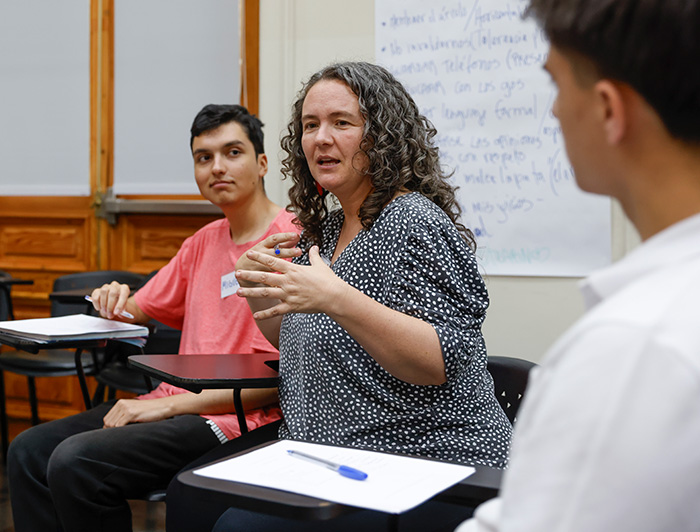
Above all, dialogue represents an essential path to building citizenship: “It is a form of communication that offers the time and space for people to bring forward the complexity of their respective realities. Without dialogue, we are left somewhat orphaned, and I believe that the polarization many talk about could be reduced if we had spaces for encounter,” states Alfredo Zamudio, former director of the Nansen Center for Peace and Dialogue in Norway, and visiting professor at UC Chile, Villarrica campus.
Faced with this diagnosis, higher education institutions share an unavoidable responsibility. It is no longer enough to train technically competent professionals; the country's true challenge demands preparing citizens capable of active listening, peacefully managing differences, and committing to the common good.
As Alfredo Zamudio expresses, “the university is a meeting point for memories, understanding, and also ways of life and thinking that are not our own. There, one learns to disagree, with arguments, with curiosity, and hopefully, without destroying those who think differently.” He asks: “Is knowledge all that counts, or is it also our duty to repair relationships with those who do not think like us? And if we need others, how do we build a more dialogic society?”
Voces UC: Living Citizenship
Faced with this challenge, within the framework of the 2026–2030 Strategic Plan, UC Chile created “Voces UC: Civic Dialogue and the Common Good”, a civic education course grounded in dialogue and encounter. It invites students not only to learn concepts, but to discover themselves as citizens and to actively influence our shared destiny on the basis of respect.
As Patricio Bernedo, who is also a professor in the course, explains: “Voces delivers basic concepts and values from the perspective of Catholic Social Teaching, such as respect, human dignity, subsidiarity, solidarity, and the common good, which are discussed by students through active and empathetic listening, which is key to the proper functioning of a pluralistic society.”
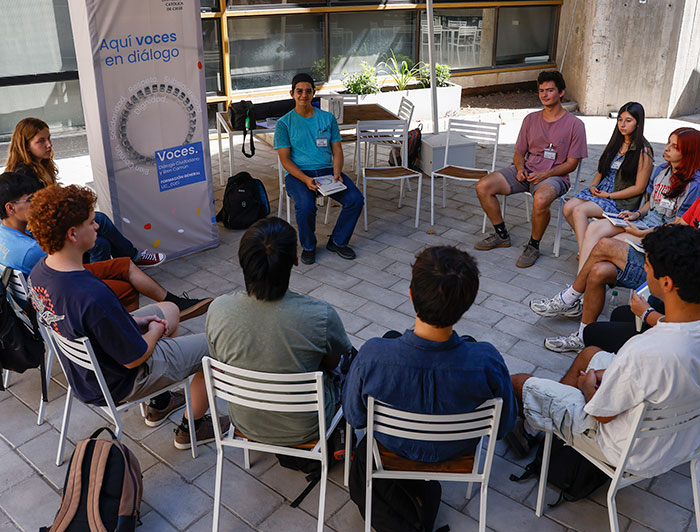
The experience also represents an academic innovation. The course's methodology breaks away from the traditional lecture format: students organize into small groups of fifteen in open spaces free of electronic devices. But “the most interesting part”, in the academic's words, is that weekly dialogue sessions are conducted: “these are guided by other students who serve as dialogue facilitators and are trained for this role using the methodology of the Nansen Center for Peace and Dialogue.”
An interdisciplinary team led by the Office of the Secretary General designed the course, in collaboration with the Nansen Center for Peace and Dialogue and the UC Chile Center for Dialogue and Peace. During its first semester, as a pilot, the course brought together 121 students from seventeen disciplines; in the second semester, 610 students enrolled, expanding to four campuses. In the future, the University aims to progressively scale this experience to the entire student body.
Building Upon Differences
“Disagreement is not necessarily a threat to democracy; it can be a constitutive part of it when there is respect for common rules and human dignity,” Patricio Bernedo maintains.
“Many of today’s problems stem from the cost of changing one's mind. For instance, how easy is it to tell your group, your party, or your boss that you have changed your mind?” says Alfredo Zamudio, who has a career spanning over thirty years in human rights, humanitarian emergencies, and conflict transformation. He adds: "Young people are builders because they have an advantage: they still dare to try new ideas".
This is why students learn tools aimed at strengthening respectful dialogue, coexisting in disagreement, reinforcing responsibility toward the community, understanding societal complexity, and exercising independent critical thinking, identifying arguments, contrasting sources, and formulating well-founded and respectful judgments.
As Nicolás Moscoso, a Civil Construction student and Voces participant, states: “I take away the experience of having learned new things, understanding different opinions, and realizing the importance of listening to others.” A similar perspective is shared by Antonia Cárcamo, a Nursing student, who highlights that the methodology invites reflection on everyday issues: “You learn a lot by doing. Dialogue allows you to immediately apply what you reflect on.” For his part, Vicente Ravest, a Law student, emphasizes that incorporating active listening provided him with essential tools for his future: “Learning arguments that I probably would have never heard outside this space is something that will stay with me forever.”
As Dean Valeria Palanza adds: "UC Chile graduates contribute in such diverse and outstanding ways to Chilean and regional society that training them to exercise their civic rights with a full commitment to democratic coexistence is among the University's highest priorities."
In short, the course not only builds community, but also forms individuals capable of transforming their daily environment through mutual understanding. As Patricio Bernedo concludes, “In Voces, we teach how to listen, ask questions, understand, argue, disagree, build together, not be afraid of differing opinions, build upon differences, and create community by peacefully resolving our disagreements. Democracy does not require us to all think alike, but it does require that those of us who think differently be capable of sharing a common space.”


