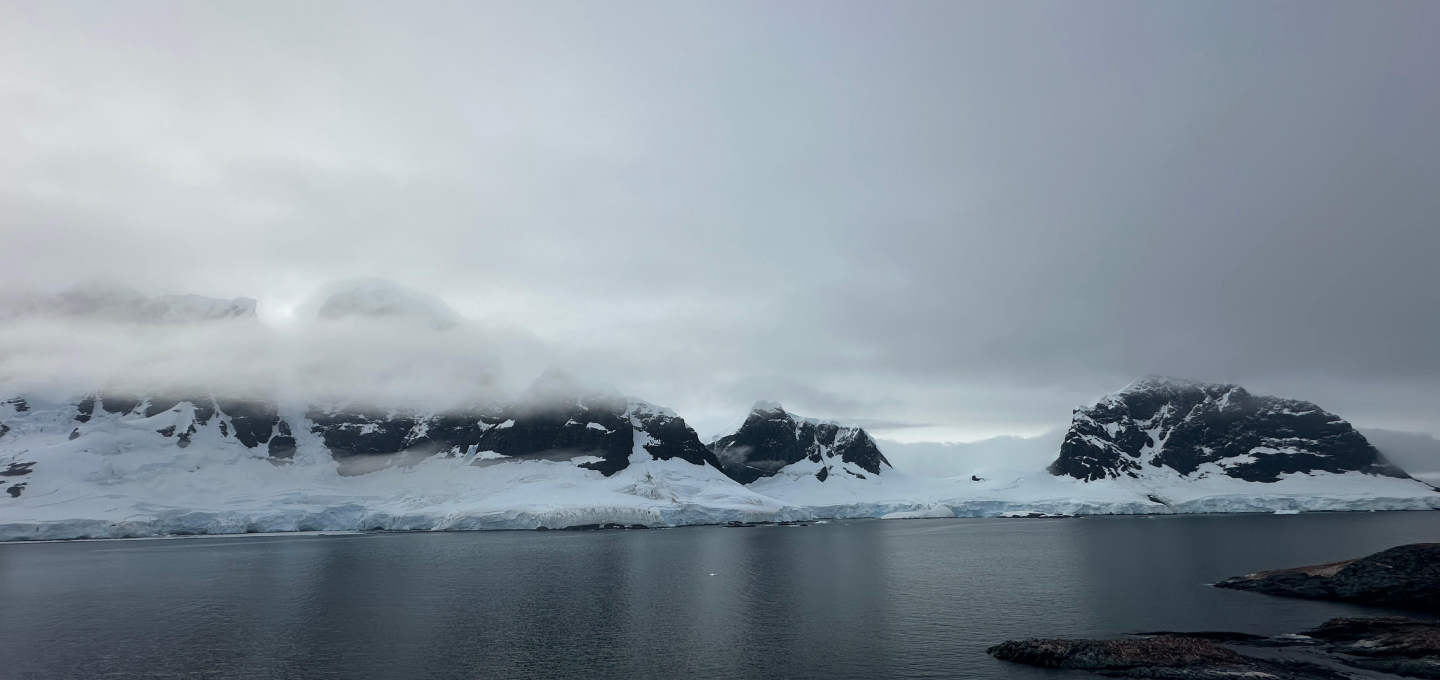
From Antarctica: UC Chile connects key microbial and evolutionary processes of Earth
Based on research funded by the Chilean Antarctic Institute (INACH, as per its initials in Spanish), doctoral students from UC Chile are providing evidence, from complementary scales, on how microbial and evolutionary processes can influence the global climate system.
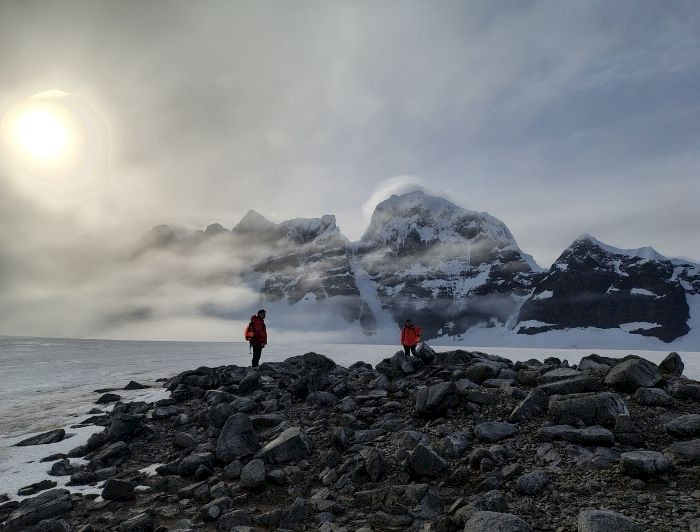
Carolina Paz Márquez Gajardo, from the doctoral program in Biological Sciences with Major in Ecology, and Ignacio Felipe Carlos Gutiérrez Cortés, from the doctoral program in Biological Sciences with Major in Molecular Genetics and Microbiology, are conducting their thesis research in this extreme environment, which offers unique conditions to observe phenomena and gather data with a level of resolution that is difficult to replicate in other research contexts.
Where science adapts to the environment
In Antarctica, the generation of scientific knowledge is strongly influenced by the extreme climate, the operational limitations, and the unique characteristics of the environment.
In this context, both doctoral students have moved their research from the laboratory to the field, conducting their studies under challenging real-world conditions, thanks to funding from the Chilean Antarctic Institute (INACH). This funding was awarded in 2025 through a nationwide competitive grant program focused on strengthening scientific research in Chile and promoting the development of projects in the Antarctic region.
For doctoral projects, this grants provides funding of up to 7 million Chilean pesos annually for fieldwork and 6 million Chilean pesos for laboratory-based projects (analytical or experimental work conducted outside of the field), in addition to logistical support and access to scientific expeditions—conditions that make it possible to conduct research in a highly complex environment.
Thanks to this initiative, field research not only becomes viable, but also generates key evidence for understanding fundamental dynamics at a global scale.
Microscopic life in Antarctica and its impact
Although Antarctica may appear to be a stable system on a macroscopic scale, processes that are fundamental to the planet's functioning occur at the microscopic level.
This is the focus of the research of Ignacio Gutiérrez, who studies how microbial communities living in soil (edaphic) and inside rocks (endolithic) on the Antarctic Peninsula respond to climate change. In simple terms, his work seeks to understand how environmental conditions will impact both the diversity as well as the functionality of these microscopic ecosystems.
“My work helps to reveal how anthropogenic effects reach even the most pristine environments on Earth. Although Antarctica is usually perceived as a desolate place due to the low presence of plants and animals, in reality, it is an ecosystem dominated by microorganisms that we are gradually altering. Understanding these impacts is vital for predicting the ecological consequences on a global scale,” he explains.
Understanding these transformations is essential, given the role microorganisms play on ecological balances and key processes of the Earth system. In this context, Gutiérrez’s work has required expanding the scope of the sampling, having access to remote areas, and overcoming major logistical and technical challenges.
In this scenario, access to funding and logistical support is crucial for sustaining this type of field research.
“Support from INACH has been a crucial pillar for my doctoral research. Beyond providing the funding essential for carrying out the project, it allowed me to significantly expand my sampling range. Being able to participate in the ECA 62 expedition was key to collecting samples across a wide range of latitudes, which is essential for meeting the objectives of my thesis,” Gutiérrez explained.
Evolution at the extremes
In parallel, Carolina Márquez’s research falls on another area: the analysis of how historical, tectonic, and climate processes have shaped genetic diversity, population structure, and evolutionary history of species, particularly sea urchins of the genus Abatus, which are endemic to the Southern Ocean.
Through a comparative analysis of populations in Antarctica, Patagonia, and sub-Antarctic regions such as the Kerguelen islands, her work examines how different environments have left their mark on the genetic structure and the adaptive processes of these species.
One of the main contributions of her research has been the development of methodologies for genomic studies in non-model species, that is, organisms that have rarely been studied.
“Genomics allows us to study an organism’s entire DNA, and to do so, a reference genome is generally used, which serves as a ‘map’ for analyzing genetic information. However, such tools do not exist for sea urchins of the genus Abatus, so it has been necessary to start building one from scratch, which is the process I am currently engaged in,” Márquez stated.
Her research is conducted in a context directly shaped by the specific features of the environment in which it takes place.
“Conditions can change rapidly, and factors such as the weather often prevent us from reaching the sampling sites. Even the presence of fauna, such as leopard seals, may limit diving operations. All this means constantly adapting and taking decisions in scenarios that change from day to day,” she emphasized.
In the face of these challenges, the INACH grant has been key for her research.
“The support provided by INACH has been fundamental for the development of my project, because it enabled a month of fieldwork at Professor Julio Escudero Base, located on King George Island in Antarctica. This funding made it possible to collect samples under natural conditions, a key aspect for addressing the study’s objectives from a genomic perspective,” she noted.
In this context, Márquez’s research helps expand our understanding of how life evolves in one of the most extreme environments on the planet: the Southern Ocean. Through genomics, that is, analysis of the complete DNA, she aims to offer a new perspective on marine invertebrates, a group still largely unexplored but is fundamental for understanding the functioning and evolution of these ecosystems.
From Antarctica to global questions
Although they start from different scales, the microbial and the genomic, both areas of research converge at the same point: the need to gather knowledge and evidence from extreme systems to understand global processes.
At this intersection – between the microscopic, the evolutionary, and the climactic – lies the contribution of these doctoral students: producing evidence from the frontiers to understand a system that, although global, begins to be defined at its margins.
In this sense, Antarctica works as one of the largest natural laboratories on the planet: a place where small environmental variations allow us to observe and predict larger-scale transformations, and where various forms of life provide key information for understanding the dynamics of the global climate system and its interactions with biological and geological processes.


