
Leo XIV and Artificial Intelligence: An Encyclical that Challenges the Academic World
Magnifica Humanitas, the first encyclical of Pope Leo XIV’s pontificate, proposes evaluating technological development from the perspective of the human person rather than through the perspective of power or the market. Experts from UC Chile particularly value its call for an education that is critical, in-person, and profoundly human. With references to the social teaching of the Church and the challenges of the digital revolution, the encyclical invites universities to engage in interdisciplinary reflection on the ethical use of artificial intelligence and its impact on contemporary society.
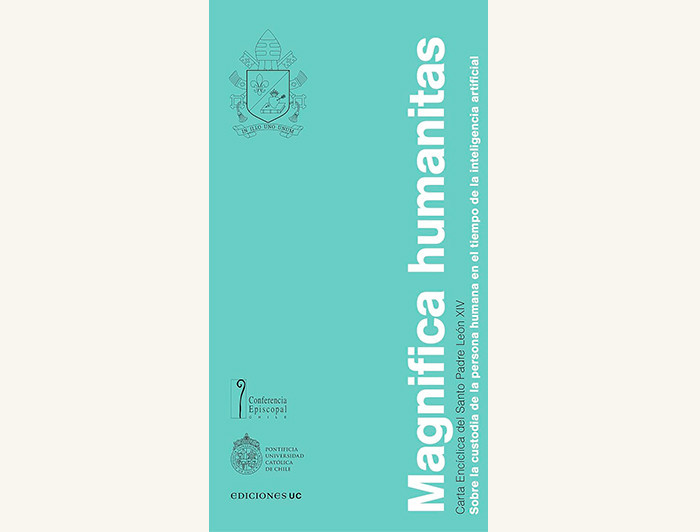
photo_camera The encyclical Magnifica Humanitas was published in Chile by UC Chile University Publishing Press in Spanish and can be downloaded free of charge. Link at the end of the article. (Picture: Ediciones UC)
“…[O]urs is the pressing duty to remain profoundly human,” states Pope Leo XIV in Magnifica Humanitas, his first encyclical, published on May 25 at the Holy See. The document discusses the impact of artificial intelligence on contemporary society, and raises ethical, educational, and social challenges that UC Chile experts consider fundamental to the future of education and university life.
This text is the first major doctrinal document of his pontificate and seeks to position the Catholic Church within the global debate on the development and regulation of new technologies. The encyclical addresses issues such as labor, education, inequality, the use of data, and the responsibility of institutions in the face of advancing algorithms. Divided into five chapters, in addition to an introduction and a conclusion, it argues that technology is not inherently evil, but warns that it is never neutral, as it reflects the decisions, interests, and perspectives of those who create it and use it.
As UC Chile President Juan Carlos de la Llera and the Vice President for Digital Intelligence Paula Aguirre state in a column published in the newspaper El Mercurio, “Leo XIV calls on the educational community to develop a new awareness, in which the critical and responsible use of technologies dialogues with knowledge capable of interpreting the complexity of the contemporary world. The discussion goes beyond the introduction of courses on the ethics of AI. What is a stake is the university’s mission to uphold a humanistic culture that directs technological progress toward human dignity and community life , not as an accidental result of the market, but as a feature of its design. Not as an external constraint on innovation, but as a constitutive characteristic.”

Prudence and Critical Thinking
For Eduardo Valenzuela, a professor at the UC Chile’s Institute of Sociology and director of Humanitas magazine, one of the central themes of the text is the call to maintain a critical and reflective attitude toward artificial intelligence and its effects on human life and education.
“Pope Leo XIV celebrates the progress that artificial intelligence represents. Yet, he also calls for prudence and for approaching this with a certain degree of caution. Even to slow down a bit, not to get overly excited. Above all, not to think that artificial intelligence can solve all problems. So, it is a strong call for caution and for not losing a critical and reflective attitude toward what he considers one of the most important technological revolutions in human history,” states Eduardo Valenzuela.
The professor also highlights that the encyclical warns about the risks that artificial intelligence can pose to educational and learning processes. “Artificial intelligence can get us used to quick responses and to the idea that questions can be answered quickly. However, learning often requires a slow response, precisely in order to learn,” he states.
In addition to this, he emphasizes that the document addresses the apparent objectivity of algorithms and the need to educate individuals who are capable of critically evaluating information. “We must adopt a critical attitude towards the content provided by AI and ask ourselves why it replied in this way. Could its answer be biased? Could there be a different perspective on it? We must adopt a reflective, critical attitude toward what AI offers,” he reflects.

A Challenge for Universities
With regard to universities, the encyclical assigns them a role related to AI. Eduardo Valenzuela explains: “We cannot leave this solely to these large corporations that specialize in developing artificial intelligence software. This requires the involvement of society and institutions. This is where universities play a truly key role.”
From Diálogos magazine, published by UC Chile Campus Ministry, its director Carmen Elena Villa highlights the encyclical’s reflection on education and university teaching. “I like how it presents the intellectual and philosophical challenge posed by artificial intelligence, stating that we cannot allow an educational system to emerge that lacks a love for the truth and simply provides information rather than education,” she explains.
Along these lines, she highlights that the encyclical directly challenges the educational world: “Artificial intelligence provides information or helps to organize it, but knowledge, intellect, and research remain purely human endeavors. Reflection and discernment are done by the person, not the algorithm.”
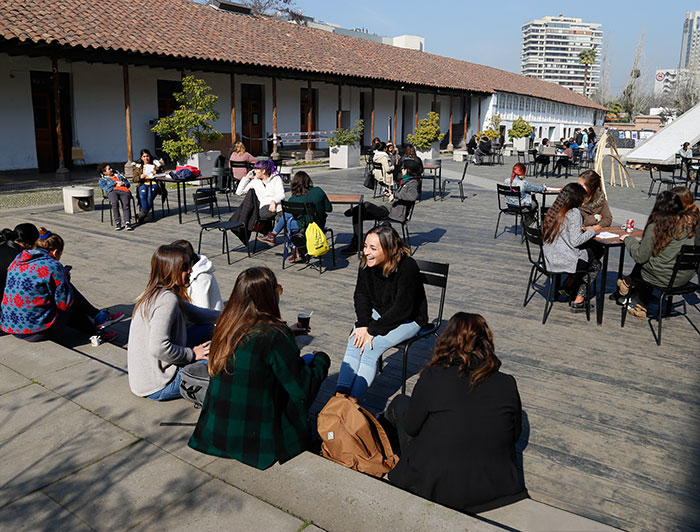
Carmen Villa also underscores the importance the encyclical places on in-person education and human bonds within university life. “It speaks of time spent together learning and of trustworthy relationships. Great ideas, as well as great friendships and professional relationships, can often emerge in cafés or during conversations in the hallways.”
Understanding the Digital Revolution
From UC Chile’s Faculty of Theology, Professor Heriberto Cabrera commends Magnifica Humanitas for offering a balanced perspective on technological development, avoiding both uncritical enthusiasm and outright rejection. “One of the most significant contributions of Magnifica Humanitas is that it encourages us to recognize the real possibilities of technology. The encyclical states that technology can heal, connect, educate, and care for our common home, although it also warns that it can divide, marginalize, and create new injustices when it is not oriented toward the common good,” he warns.
In this sense, he adds that the encyclical presents a challenge: it invites us to think about innovation from the perspective of human dignity, the common good, social justice, holistic education, and a culture of encounter. It is not only about regulating artificial intelligence, but about training individuals capable of using it with responsibility, creativity, a critical sense, and openness toward others.
Cabrera also highlights the historical and pastoral dimension of the document by symbolically relating it to Rerum Novarum, Pope Leo XIII’s encyclical on labor rights and social justice. “Just as Leo XIII addressed the human and social challenges of the Industrial Revolution, Leo XIV now invites us to pastorally discern the challenges of the Digital Revolution,” he states.
Using Technology for the Common Good
For Cristián Núñez, also member of the Faculty of Theology, one of the document’s most innovative contributions is precisely the dialogue between the social teaching of the Church and the ethical challenges posed by artificial intelligence.
“What is interesting and novel about this document is that the Pope brings together in dialogue the social teaching of the Church and the challenges posed today by the use of a tool as significant as artificial intelligence. The Pope confronts us with the moral and ethical challenges posed , for example, by the abuse of power by many companies and the indiscriminate use of data,” he explains.

Professor Núñez adds that Leo XIV expands the discussion on the care of creation into the digital realm. “He speaks of the relationship with the digital ecosystem. That is to say, how human beings interact with these tools in an ethical manner, with discernment, knowing how to use them for the common good and not for the detriment of society,” he mentions.
For UC Chile, this document represents and invitation to read, study, and reflect on artificial intelligence across all faculties and communities. Its reception can open up spaces for interdisciplinary dialogue, research, ethical formation, pastoral reflection, and digital evangelization, so that technology may always be at the service of the human person, the common good, and a more just, fraternal, and hopeful coexistence.
The Spanish Edition of this document can be downloaded free of charge from UC Chile University Press via this Amazon link.


