Researchers Develop Tablet-Based Test to Assess Executive Functioning in Children
Researchers at UC Chile CEDETi aim for the tool to become the international standard for measuring cognitive abilities that enable planning, organizing, inhibiting impulses, adapting to change, and self-regulating emotions, among other things. This has led them to assemble a team of experts from three continents and present their work in Thailand.
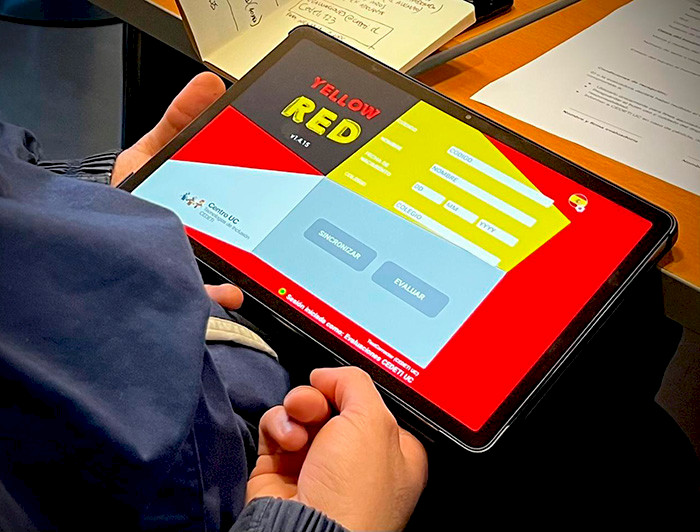
photo_camera The Yellow-Red tool assesses various components of executive functioning through tablet games. (Photo credit: CEDETi)
Executive functions are high-level cognitive skills localized in the prefrontal cortex of the brain. They act as the “conductor of the orchestra”, enabling us to plan, maintain or inhibit certain behaviors, thoughts, or emotions in pursuit of a set goal.
Assessing these functions is the objective of Yellow-Red, a set of tests developed by the UC Chile Center for the Development of Inclusion Technologies (CEDETi UC as per its acronym in Spanish). It consists of a series of six tests presented through different tablet-based games designed to appeal to children ages 6 to 11.
This tool assesses various components of executive functioning. The “Cat-Dog” test evaluates the executive functions in general, the “Arrows” test assesses cognitive inhibition, “Flies” is aimed at assessing delayed gratification, “Farm” assesses auditory and visual working memory, “Connections” focuses on assessing associative pairs, and the “Trios” test aims to assess cognitive flexibility. Additionally, an overall executive function index is calculated that takes all subtests into account.
From UC Chile CEDETi, researchers seek to promote the use of Yellow-Red as the international standard for assessing executive functioning. This is within the framework of the Fondecyt project “Trajectories of Executive Function Development: Intercultural (In)Stability and Impact of Socioeconomic Factors.”
This study brings together a team of researchers from three continents, and countries such as Chile, Brazil, Bosnia, Germany, China, and Thailand, and involves a sample of approximately 3,600 children.
“We are developing a test that seeks to be the world’s gold standard for assessing executive functioning, and to achieve this we need coordinated research groups to ensure consistent versions across different languages”, explains Ricardo Rosas, faculty member from the School of Psychology and Director of UC Chile CEDETi.

Intercultural model
The results will help advance toward the development of an intercultural model of executive functions, deepening our understanding of their relationship with variables such as socioeconomic status, intelligence, and socio-emotional development. In addition, the project includes the publication of scientific articles, teaching postgraduate students, and the organization of activities open to the scientific and educational community.
“For this research, it is essential to work with teams from different countries, because we are assessing whether the predictors of executive function development are the same or different regardless of culture. The key part is that our Yellow-Red test does allow us to assess these functions in different countries, and generates the same structure based on its three basic components, which is very important for validating this test at the international level,” explains Victoria Espinoza, Research Director at UC Chile CEDETi.
She adds: “We’ve succeeded in motivating researchers from different places, with large sample sizes in Germany, Thailand, and China, and more and more researchers are coming forward to be part of this research. Yellow-Red is very easy to translate and to administer.”
International experience
One of the objectives that took UC Chile researchers Ricardo Rosas, Victoria Espinoza, and José Pablo Escobar to Thailand was to present the scientific bases and the accumulated evidence regarding Yellow-Red at the international seminar “Direct Assessment of Executive Functions in Early Childhood,” organized at the University of the Thai Chamber of Commerce (UTCC), in Bangkok.
The presentations addressed the theoretical framework of Yellow-Red, comparative results obtained in different countries, and the challenges of directly assessing these cognitive skills in early childhood.
The trip also included a visit to educational institutions, with practical demonstrations of the tool and an exchange of experiences with researchers and professionals in the Thai education sector.
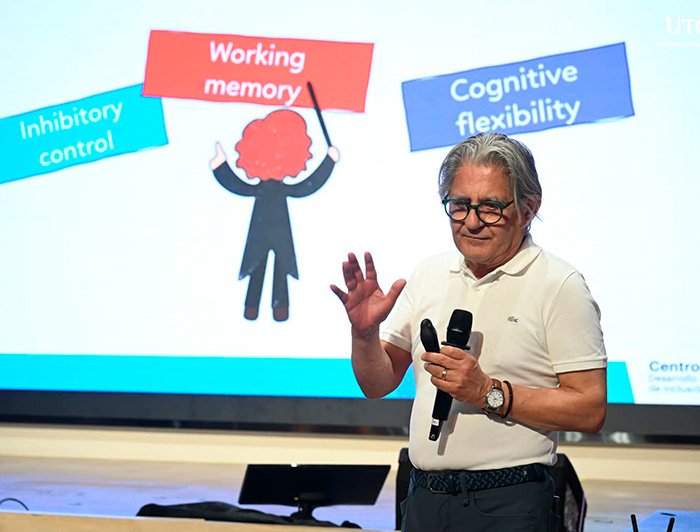
“At the UC Chile School of Psychology we are at the forefront of research on the relationship between executive functioning and reading comprehension. Having an easily adaptable tool for diverse cultural and linguistic contexts provides fertile ground for future research that will allow us to answer big questions such as, for example, what is the real effect of culture and linguistic and educational characteristics on both executive functions and reading?” explains the faculty member of the School of Psychology and researcher at UC Chile CEDETi José Pablo Escobar.
Through participation in this conference in Thailand, UC Chile CEDETi continues to strengthen international networks of collaboration and contribute scientific evidence for the development of innovative tools that promote more accurate assessment and an increasingly inclusive education.


