Study Shows How “Megaglacier” That Covered the Andes Changed the Climate During the Ice Age
The study, conducted by researchers from the UC Chile Institute of Geography and published in Nature, concludes that the gigantic ice mass that completely covered the mountain range from the Bíobio region to the south 21,000 years ago actively influenced the climate, generating rainfall in the Chilean territory and aridity in the Argentinian territory.
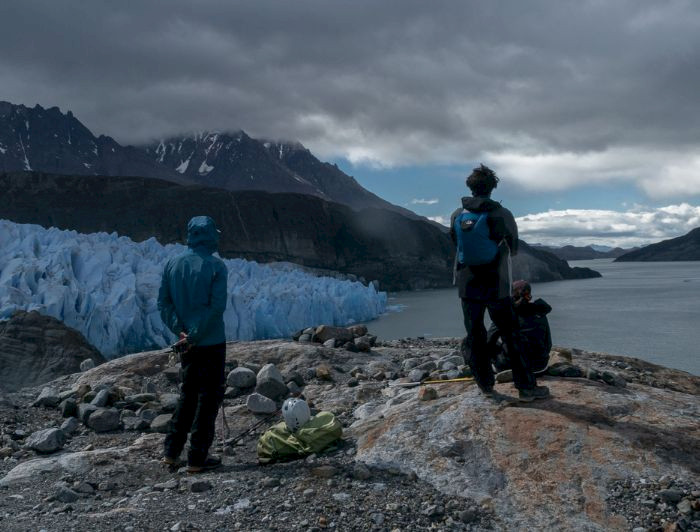
photo_camera Patagonia is the largest land mass in the southern hemisphere, that blocks the westward winds that carry humidity around Antarctica.
Around 21,000 years ago, during the period known as the Last Glacial Maximum, global temperatures were 6°C lower than today, and the Earth was populated by megafauna. Species such as mylodons, gomphotheriums, and hippidions adapted to survive in an environment of frozen waters and large expanses of ice masses.
In the territory now shared by Argentina and Chile, a “megaglacier” known as the Patagonian Ice Sheet extended for more than 2,000 kilometers along the Andes, between 38°S and 56°S, that is, from just south of Los Ángeles, in the Bíobio Region, to the southernmost point of the continent.
This “megaglacier” and its impact on the climate 21,000 years ago is the focus of UC Chile research published in Nature magazine. The article is titled “Patagonian Ice Sheet Shaped Regional Climate during the Last Glacial Maximum,” and written by Fabián Riquelme, doctorate student in the UC Chile Institute of Geography, together with a group of researchers.
This research examines the impact that the thickness of the Patagonian Ice Sheet had on Patagonia’s climate during the Last Glacial Maximum.
“Twenty-one thousand years ago, the Earth was a completely different planet. The global temperature was approximately 6°C colder. In fact, the movie Ice Age is set in this period. The movie is not real, but the environment is based on the Last Glacial Maximum,” explains Fabián Riquelme, co-author of the study alongside María José Puentes, a UC Chile Geography student; and Fabrice Lambert and Esteban Sagredo, both faculty members of the UC Chile Institute of Geography.
“The natural system was very different. There was megafauna and, in Patagonia, the Patagonian Ice Sheet extended for over 2,000 kilometers along the Andes. Although some authors theorized that there was a climatic influence on the Patagonian Ice Sheet during the Last Glacial Maximum, this had never been quantified,” mentioned Riquelme.
Patagonia is the largest land mass in the southern hemisphere that blocks the westward winds, a belt of wind that carries humidity around Antarctica, as explained by the researcher. He adds that “when these winds collide with the topography of the Andes, they release moisture as they rise, generating precipitation in Chilean territory and, as they descend into Argentinian territory, with little to no humidity, they generate aridity. So, our study addressed the question, how did Patagonia’s climate change 21,000 years ago with a gigantic mass of ice covering the Andes?”
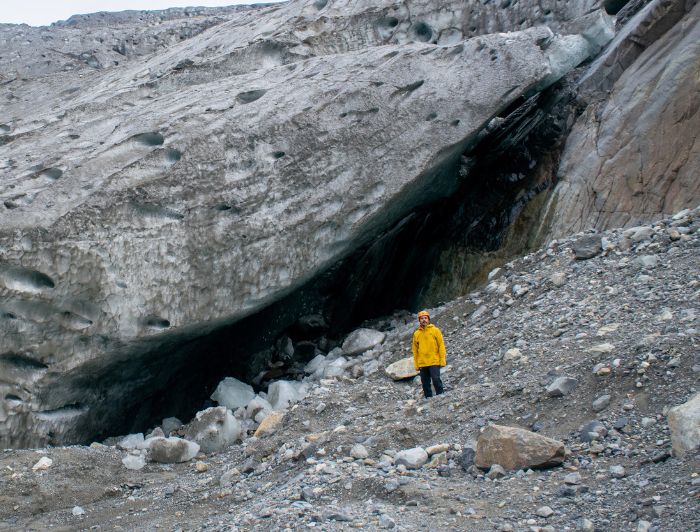
Implications of the article
Fabián Riquelme highlights that the main conclusion of the article is that “the Patagonian Ice Sheet not only responds to the climate but also actively changed it.” He states that “although it is a simple conclusion, this allows to answer some scientific questions that until now had no explanation.”
For example, UC Chile faculty members Esteban Sagredo and Juan Luis García, among other researchers, have identified that the largest extension of the Patagonian Ice Sheet to the east was reached several thousand years before the Last Glacial Maximum.
“This is counterintuitive, because it was during the Last Glacial Maximum that there was more ice on the continents. However, our results show that an increase in the thickness of the Ice Sheet increases the precipitation gradient that exists today. In other words, there was more precipitation on the western margin, in present-day Chile, and greater aridity in the eastern margin, in present-day Argentina. The progressive increase in aridity on the eastern margin of the Ice Sheet would have impacted its mass balance, causing it to lose volume and recede,” he explains.
In addition, this study could allow for improved computational reconstructions of the Patagonian Ice Sheet. “Today, we have reconstructions that show differences of over 1,000 meters in thickness, and extensions of many thousands of square kilometers. These studies did not account for the fact that the increase in thickness actively modified the climate. This is the reason why we expect that our research contributes to the understanding of the Patagonian Ice Sheet’s geometry,” he added.
An innovative methodology
To carry out this study, the researchers used a coupled model with modules representing the natural atmospheric, marine, and continental ice systems, among others, through which they estimated the impact of the thickness of the Patagonian Ice Sheet on the Patagonian climate.
Fabián Riquelme, Álvaro Gómez, and Nicolás Cosentino, coauthors of the study, led the installation of the model. It took the researchers 18 months to install the model at the “National Laboratory for High Performing Computing”, Chile’s supercomputer.
“We used the Community Earth System Model 2.1.3. This type of model is used, among other things, to estimate the impact of current climate change,” mentioned Riquelme. CESM 2.1.3 is a highly versatile coupled model from the National Center for Atmospheric Research (NCAR), a research center in the United States. Jiang Zhu, coauthor of the article, developed specific modifications to optimally represent the climate of the Last Glacial Maximum.
“This optimization allowed us to represent the climate of Patagonia during the Last Glacial Maximum with different thicknesses of the Patagonian Ice Sheet. Summer Rupper, from the University of Utah and coauthor of the article, was a key player in representing how changes in thickness influenced the climate,” explains the researcher.
You can read the article in Nature magazine Communications Earth & Environment.


