The Work of UC Chile Faculty Members Teaching in a Mobile School and Empowering Women in Chad
In January and February, academics from the Faculty of Education supported the work of the Tchoubouk School, which serves more than 60 children, from ages 5 to 12. They also launched a workshop focused on burlap crafts, aimed at empowering women. “'I feel a personal commitment to them. Once you look into their faces, you think: ‘Wow, you can transform their lives,’” reflects academic Maili Ow.
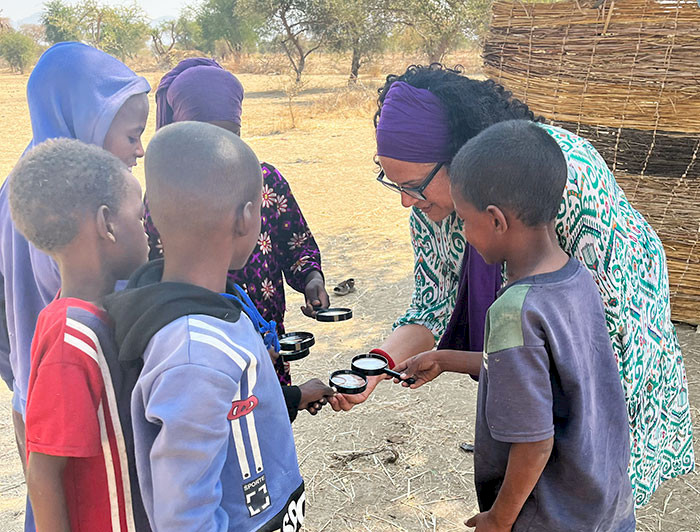
photo_camera Cecilia Ramírez, Maili Ow, and Daniela Cobos traveled to Chad during January and February 2026, as part of the project “Strengthening Cooperation Ties with Chad: Education and Empowerment of Women in Guera.” (Photo credit: Maili Ow and Cecilia Ramírez)
“Un, deux, trois (...),” Cecilia Ramírez, an academic at the Faculty of Education, listens attentively to a student who recites and constantly seeks her out to show her how much she has learned.
While this may sound like a routine interaction, the context is far from ordinary: it occurs more than 10,000 kilometers away from Chile, in the province of Guera, near the city of Mongo, in the Republic of Chad, in Africa.
Surrounded by goats and cows, the classes take place in a mobile school in Tchoubouk. There are roughly 60 students aged 5 to 12, divided into two levels. Their classrooms consist of rugs spread across the ground, under the shade of a tree, next to a chalkboard, which the community packs up and sets up once again whenever they settle into a new place.
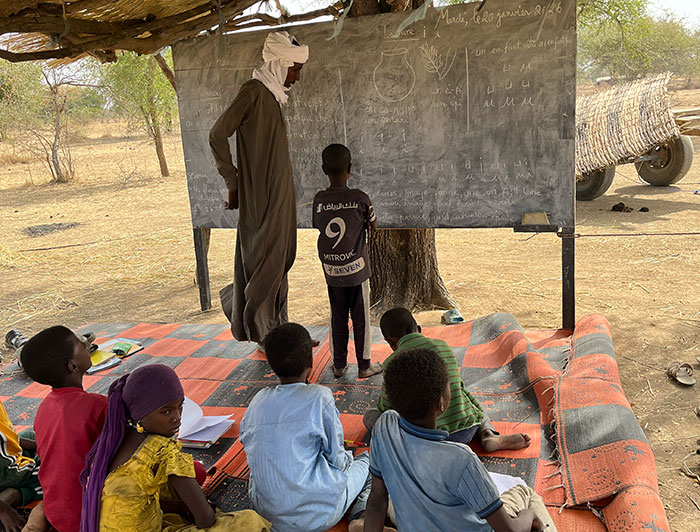
The UC Chile Faculty of Education academics Cecilia Ramírez and Maili Ow, along with Daniela Cobos, a postgraduate professor at the UC Chile School of Arts and Anthropology and at University of Chile, traveled to Chad in January and February of this year as part of the project “Strengthening Ties of Cooperation with Chad: Education and Empowerment of Women in Guera,” funded by mobility scholarships from the UC Chile Office of the Vice President for International Affairs and Banco Santander.
During their four weeks in and around Mongo, the academics not only monitored the mobile school of Tchoubouk but also launched a pilot workshop in the art of making burlap crafts, a project linked with the libraries supported by Caritas-Mongo in Guera Province.
While this marked the first trip of Cecilia and Daniela, Maili has been working with the Chadian communities since 2020. This was her seventh trip to the region, where she has spearheaded various initiatives, such as donating sewing machines to four communities of women; setting up the crèche at Francisco Xavier in Abéché; running teacher-training workshops; and launching the mobile school in Tchoubouk. She has also accompanied UC Chile School of Education Majors who travelled to Chad in order to carry out curricular activities through these collaborative programs.
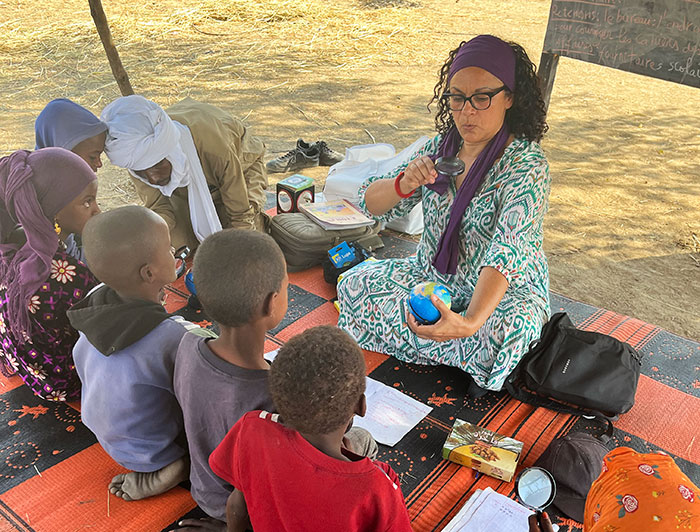
This latest trip aimed to ensure the continuity of the mobile school project launched in 2023, by improving the quality of teaching, fostering community engagement, and motivating the children and young people who attend the school.
“I feel a personal commitment to them. Once you look into their faces, you think: ‘Wow, you can transform their lives,’” reflects academic Maili Ow. “It is a heavy burden, because you ask yourself: ‘Are we doing a good job? Is it appropriate to show these children a world that they will probably never be able to experience? Because for them, their entire world is contained within their clan,” reflects Maili Ow.
Empowering Women, One Stitch at a Time
In the sewing workshops, the academics set a single rule: participation was reserved exclusively for women. In Chad, women experience little autonomy; all major decisions are generally influenced by male figures, whether they are their fathers, brothers, or husbands.
“Culturally, we pushed some boundaries because introducing a space exclusively for women was a condition rooted in our Western perspective. Because if we are going to hang out as friends, it will be just us. But for them, that is simply not normal,” explains Cecilia Ramírez, a member of the UC Chile Center of Cultural Heritage and the Gender Affairs Office of the School of Education.
Due to a lack of independence, women have few opportunities to pursue education. While access to schooling is a challenge for both genders; according to UNESCO, in 2021, only 38% of girls completed their primary school education compared to 49% of boys.
This gap widens in secondary education, where a mere 14.1% of girls complete this level, compared with 24.2% of boys. And it has become even more pronounced in the case of women, who are affected by situations such as forced marriage and early motherhood, making it difficult for them to continue their education.
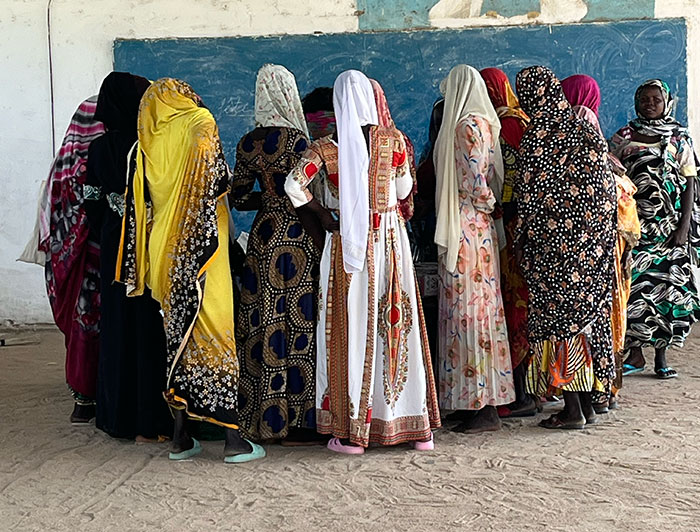
Cecilia Ramírez believed that the burlap crafts could serve as a tool to help them narrate their lives, obtain a source of income, and attain greater independence, as well as an opportunity to learn literacy through art.
“I suggested: ‘Why not teach them how to make burlap crafts, which allows them to express what they can’t put into words through an artistic creation?’ We were sure they could share their stories,” explains Cecilia Ramírez.
In order to transport the art of burlap crafts from Chile to Chad, the teachers established a connection with the Casa de la Mujer de Huamachuco in Renca—which has a long tradition dating back to the early days of the dictatorship—and the Guera workshops.
They also reached out to Elena Alfaro, director of the UC Chile Crafts Program, who arranged for a group of students from the UC Chile School of Design to prepare materials and instructions, under the guidance of the Huamachuco Women’s Center.
At the same time, both teachers learned how to make burlap crafts with the help of the academic and textile artist Daniela Cobos. “We would get together on the weekends before heading out to make burlap. And at night we would spend our time sewing,” says Cecilia, holding up a laptop sleeve that Maili made during the trip.
They conducted two workshops in rural libraries, in partnership with Caritas-Mongo, in Moukoulou and Dadouar, where more than 100 women participated. The faculty members provided them with materials and instructions prepared by the Design students, as well as supplies such as scissors, fabric, thread, pins, and buttons, so they could sew their burlaps.
“We thought they would take more time to pick it up, but they were really fast. They showed up having done all the work assigned, because they wanted to learn,” says Maili Ow.
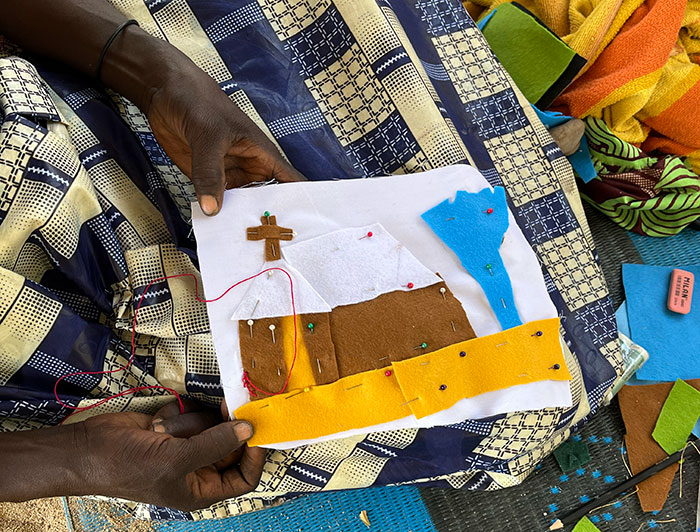
The participants ranged in age from 16 to 50 (life expectancy in Chad is under 55), and many were accompanied by their children. Even in places like Dadouar, women had to walk 15 kilometers to attend the workshop, and many stayed overnight.
You could see their life reflected in their work: children, houses, water, and even kitchen tools like a mortar.
“I sensed that, in both places, even though their lives are very hard, there is no suffering. They are eager for more—to move forward, to make plans, to do things, and to have us come back and teach them more. I felt that they were doing well, that they were women who had empowered themselves; it was a space they had fought for, and they had earned it,” Cecilia reflects.
The Relationship Between UC Chile and Chad
The relationship between Chad and UC Chile spans more than 15 years, under the wing of the Faculty of Medicine.
Rodrigo López, an anesthesiologist and academic, designed a training program for healthcare professionals in Chad, encouraged by Leopoldo Labrín, a Jesuit priest and Chilean doctor who has resided in that country since 1992.
This is how the partnership between UC Chile, the University of Chile, and the Buen Samaritano University Hospital Complex (CHU-BS) began.
In 2021, UC Chile signed a memorandum agreement with Caritas-AURA with the aim of expanding the scope of collaboration from healthcare to education, sustainable agriculture, and religious dialogue, among other fields.


