UC Chile Academics Join a New Era of Astronomical Observation
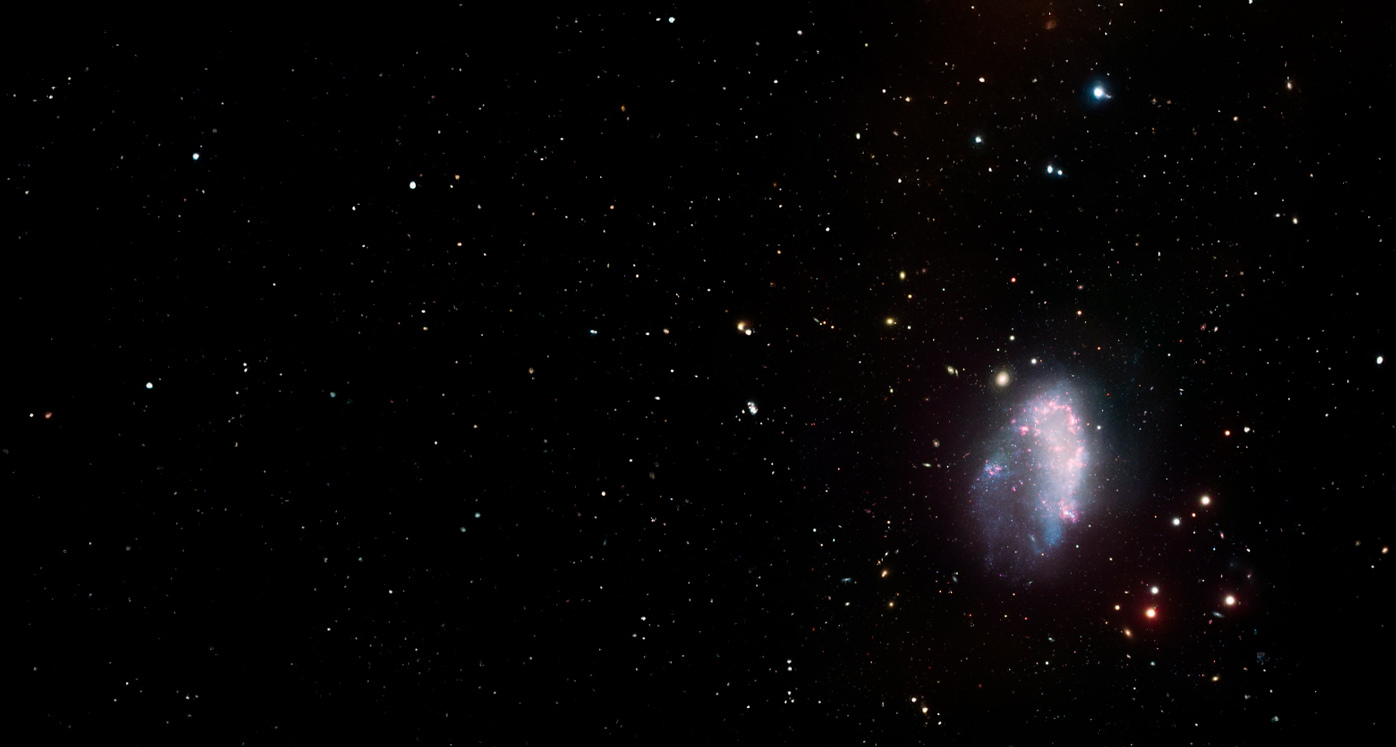
The 4MOST instrument, installed on the VISTA telescope at the European Southern Observatory’s (ESO) Paranal Observatory, has obtained its first astronomical observations, revolutionizing the way we observe the Universe with its cutting-edge technology. Its program includes the CHANGES and CHANCES projects, both involving researchers from the Center of Excellence in Astrophysics and Related Technologies (CATA) and from various Chilean universities, including the UC Chile Institute of Astrophysics.
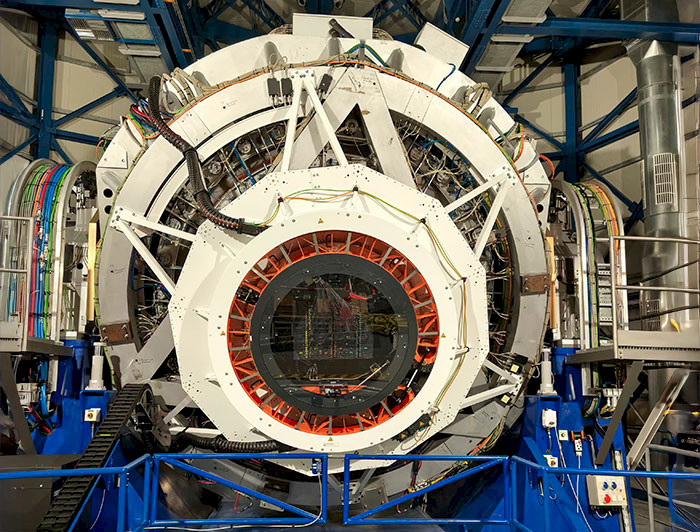
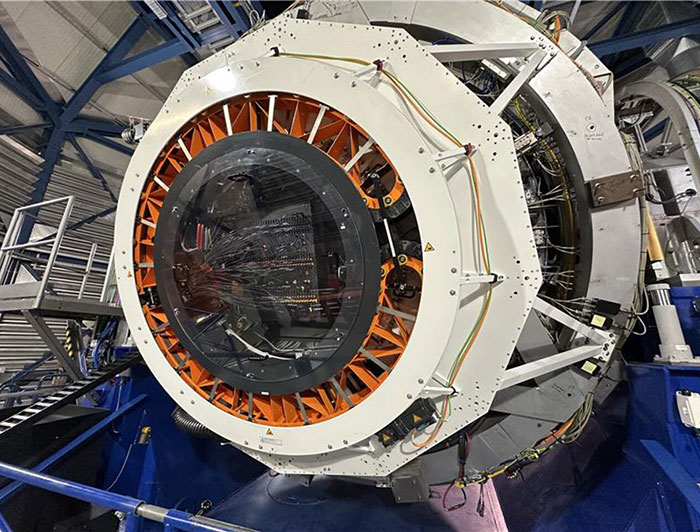
photo_camera Equipped with over 2,400 optical fibers, each with the thickness of a human hair, 4MOST is now the largest multi-object spectroscopic installment in the southern hemisphere. (Photo credit: ESO)
The 4MOST (4-metre Multi-Object Spectroscopic Telescope) instrument, installed on the VISTA telescope at the European Southern Observatory’s (ESO) Paranal observatory, achieved first light, marking the beginning of a new era in astronomy. This milestone, the result of more than a decade of international development, further consolidates Chile as the epicenter of global astronomy.
Designed to observe up to 2,400 objects simultaneously, 4MOST breaks down the light from stars and galaxies into thousands of colors, revealing their chemical composition, temperature, velocity, and age. Equipped with over 2,400 optical fibers, each with the thickness of a human hair, it is now the largest multi-object spectroscopic installment in the southern hemisphere.
As stated by the Director of the UC Chile Institute of Astrophysics and main researcher at the Center of Excellence in Astrophysics and Related Technologies (CATA), Felipe Barrientos, “the 4MOST instrument opens up many new opportunities and, in particular, allows us to study some of the most extreme objects in the universe, such as galaxy clusters and galaxies with active nuclei. Researchers from Chile and from CATA will have the opportunity to study the evolution of galactic clusters and how they interact with their environment.”
“The first light from 4MOST represents a major milestone for astronomy. It is a truly unique instrument that changes the way we observe the skies and marks the beginning of a new era in observing the Universe from Chile,” says Ignacio del Moral-Castro, a postdoctoral researcher at CATA and UC Chile.
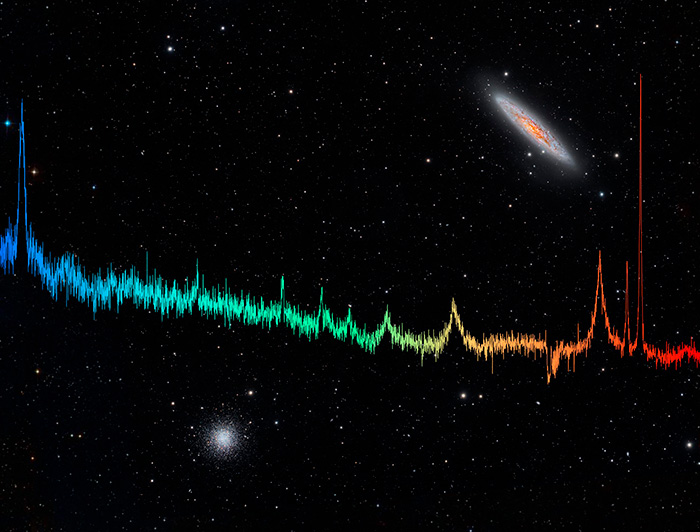
He adds: “Until now, when you observed with an instrument, only one scientific program could be seen at a time. However, 4MOST is designed to capture light from thousands of objects simultaneously, and is expected to capture light from more than 25 million different objects during its first five years of operation, enabling several scientific programs to be carried out at once.”
This achievement has been the result of a major international collaboration, led by the Leibniz-Institut für Astrophysik Potsdam (AIP), bringing together 30 scientific institutions from Europe, Australia, and Chile, including several universities and CATA. Scientific operations are conducted from ESO’s Paranal Observatory, under one of the clearest skies on the planet.
The scientific contribution of Chilean universities is key, leading two scientific programs: CHANCES (CHileAN Cluster Galaxy Evolution Survey) and CHANGES (CHilean Active Galactic Nuclei and Galaxy Evolution Survey). Both projects involve the participation of astronomers from CATA (ANID Base Center) and the UC Chile Institute of Astrophysics. In its first stage, 4MOST will carry out a total of 25 scientific programs.
CHANGES: Mapping Black Holes
CHANGES (CHilean Active Galactic Nuclei and Galaxy Evolution Survey), led by Franz Bauer, Associate Researcher at CATA, faculty member at University of Tarapacá, and one of the principal investigators of this survey along with Paulina Lira, constitutes about 7.5% of 4MOST’s total observation time.
Using this new ESO instrument, in conjunction with the Large Synoptic Survey Telescope (LSST) from the Vera C. Rubin Observatory, the project will obtain spectra and light curves from over a million active galactic nuclei (AGNs) and their host galaxies.
In the words of Franz Bauer, researcher from CATA and survey leader, “the CHANGES project will explore how supermassive black holes grow and how they influence the evolution of their host galaxies, by observing hundreds of thousands of active nuclei across the southern hemisphere sky with 4MOST. By combining these observations with data from LSST, the project will allow us to study the variability, environment, and history of these objects over cosmic time. In addition, CHANGES will identify rare and extreme phenomena, such as black hole tidal disruption events and quasars in the early Universe, offering a new window into the growth of black holes since the origins of the cosmos.”
As UC Chile academic Felipe Barrientos adds, “many of the studies of black holes at the centers of galaxies require a large sample in order to characterize that population. 4MOST will provide observations of these objects, some of the most luminous in the Universe.”
“For a long time, we have known that there is a co-evolution between the supermassive black holes that live in the center of galaxies and their host galaxies. However, many questions remain unanswered regarding how these black holes grow, how they influence their galaxies, and how this co-evolution unfolds,” explains researcher Ignacio del Moral-Castro. “The CHANGES project is designed to explore these questions by using the revolutionary features of 4MOST, opening a new window into the study of the Universe. We are very excited about the major milestone represented by the instrument’s first light, and all the data that will be obtained in the coming years.”
The team from CATA participating in CHANGES include the Center’s principal investigators: Roberto Assef (Diego Portales University), Ezequiel Treister (University of Tarapacá), and Felipe Barrientos (UC Chile); and associate researchers Chiara Mazzucchelli (Diego Portales University) and Timo Anguita (Andrés Bello University), and Ignacio del Moral (UC Chile postdoctoral fellow), who participated in the installation and implementation of the instrument at the Paranal Observatory.
CHANCES: Evolution of Galaxies in Extreme Environments
The CHilean Cluster Galaxy Evolution Survey (CHANCES) aims to understand how dense environments, such as galactic clusters and superclusters, transform the structure and evolution of galaxies. Through spectroscopic observations of more than 300,000 galaxies, the team will be able to trace how the environment affects their morphology, composition, and ability to form stars.
“The first light from 4MOST marks a milestone for a state-of-the-art instrument that involves hundreds of astronomers and engineers from around the world. Personally, I’m excited to see the first spectra after working on the preparation of our project CHANCES for almost five years. Soon we will begin collecting data, and there will undoubtedly be many scientific discoveries,” states Yara Jaffé, associate researcher at CATA, alternate director of MINGAL (Millenium Nucleus of Galaxies), and academic from Federico Santa María Technical University.
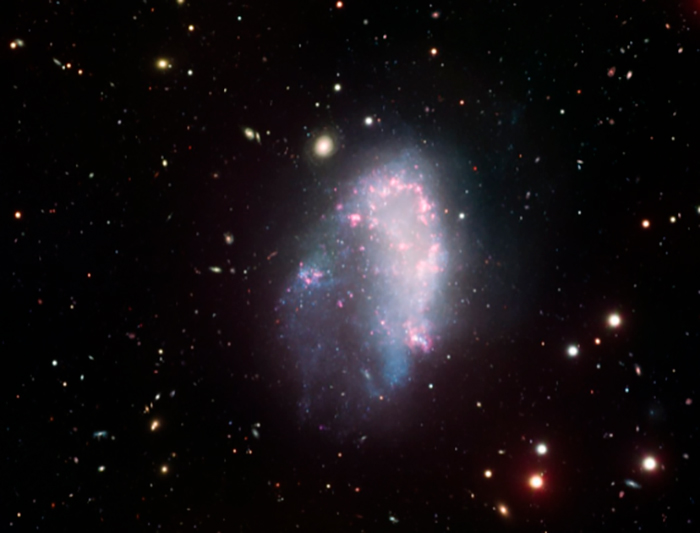
“CHANCES will obtain spectra from approximately 300,000 galaxies, enabling us to understand how dense structures transform galaxies, modifying their morphology and even promoting bursts of star formation,” adds Hugo Méndez Hernández, associate researcher from CATA and post doctorate student from University of La Serena, who participated in 4MOST’s first light observations at the Paranal Observatory and the initial tests of the instrument.
Antonela Monachesi, main researcher from CATA and faculty member at University of La Serena, points out that “4MOST is a unique instrument in the Southern Hemisphere due to its enormous field of view and its ability to observe thousands of objects simultaneously. The CHANCES observations, which will continue for five years, will allow us to answer key questions on how galaxies evolve in dense environments and how the most massive structures in the Universe grow.”
Also participating in the CHANCES survey are CATA researchers Cristóbal Sifón (Pontifical Catholic University of Valparaíso); Ricardo Demarco (Andrés Bello University), Ciria Lima-Dias and Simón Véliz (both from University of La Serena), and Franco Piraino and Raúl Baier Soto (both from Federico Santa María Technical University).


