UC Chile Atacama Station Alto Patache Serves as a Base of Operations for a Space Exploration Prototype
With no wheels or fuel, yet capable of reaching 57 kilometers per hour: this is how the prototype developed by the Tumbleweed Mars team works, which underwent testing at the university’s research station, located in the heart of the coastal desert south of Iquique, offering undergraduate students the opportunity to participate in international research.
photo_camera The UC Chile Atacama Station was the base of operations for Tumbleweed Mars, an international project developing a prototype that seeks to revolutionize space exploration, thanks to its lightweight structure powered by wind energy, and its equipment that allows for collecting a vast array of data.
An expansive field of dunes stretches out before us, nothing but sand and rocks. There is no sign of life, not even lichens. It could well be Mars or the Moon, but it is Chile, in the heart of the Tarapacá Region, in what is known as the “absolute desert,” the hyper-arid core of the Atacama Desert.
This was the site chosen for the first field test of Tumbleweed Mars. It is a prototype — known as a “rover”— that seeks to revolutionize space exploration, thanks to its lightweight structure powered by wind energy, and its equipment that allows for collecting a vast array of data, at a lower cost than other types of extraplanetary missions.
The project began ten years ago, driven by an international team made up of over 80 researchers from different countries, led by scientists from Delft University of Technology (TU Delft), in the Netherlands, supported by the European Space Agency (ESA) and the Europlanet Society, among other institutions. After several designs and tests in places such as the Negev deserts in Israel and Oman, the team contacted Pablo Osses, director of the UC Chile Atacama Station and professor at the Institute of Geography, to test their latest prototype in the most Mars-like conditions on Earth.
Why the Atacama Desert? Because the winds here are very similar to those on Mars, peaking in the afternoons and then dying down at night and in the mornings. In such an environment, we can test how the prototype works autonomously,” explains James Kingsnorth, lead researcher for Tumbleweed Mars. “This is truly a survival test for the rover,” he adds.
What Is It and How Does It Work?
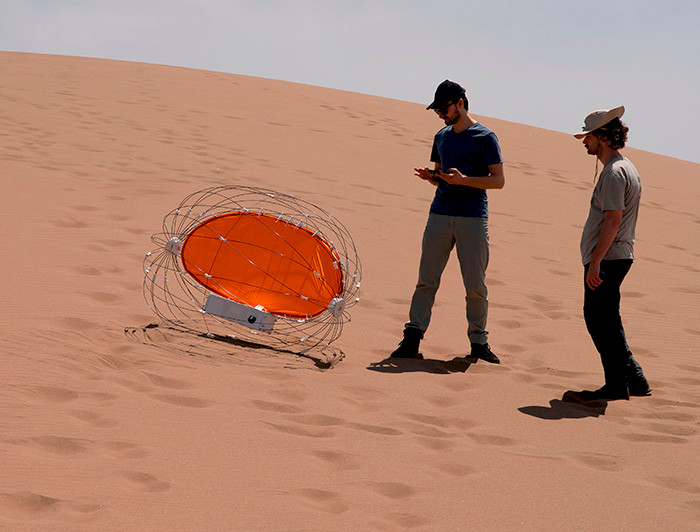
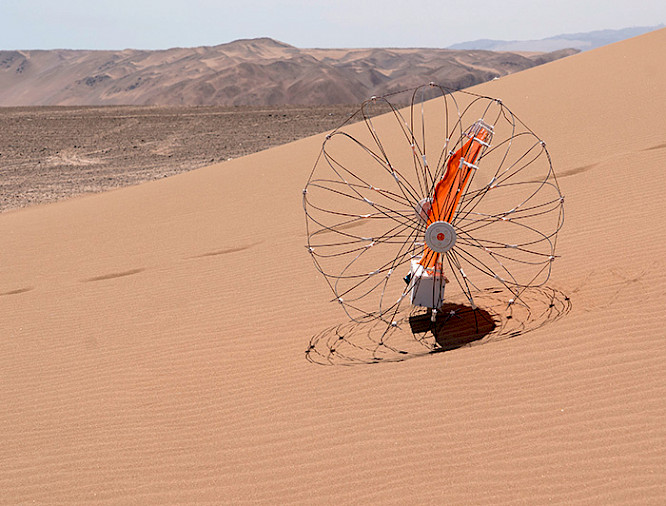
Its name, which comes from English, alludes to "tumbleweeds," plants characteristic of arid climates and steppes. It does not require fuel to move, or even wheels. Elliptical in shape, it has a very lightweight design, weighing just 3.5 kg; its structure is made of carbon fiber cables that allow it to harness wind energy.
Much like a sailboat—in fact, it is even equipped with a sail—it moves freely across the surface, propelled solely by the wind. It is designed to reach speeds of up to 15.9 meters per second (approximately 57 kilometers per hour), cover vast distances, and navigate different terrains, such as sand, rocks, and clay, with a high level of autonomy.
Inside lies its “brain,” a box containing a camera, a microphone, a GPS, a gamma-ray spectrometer, a magnetometer, and sensors that collect a vast array of data: temperature, atmospheric pressure, humidity, wind and ultraviolet radiation, among others.
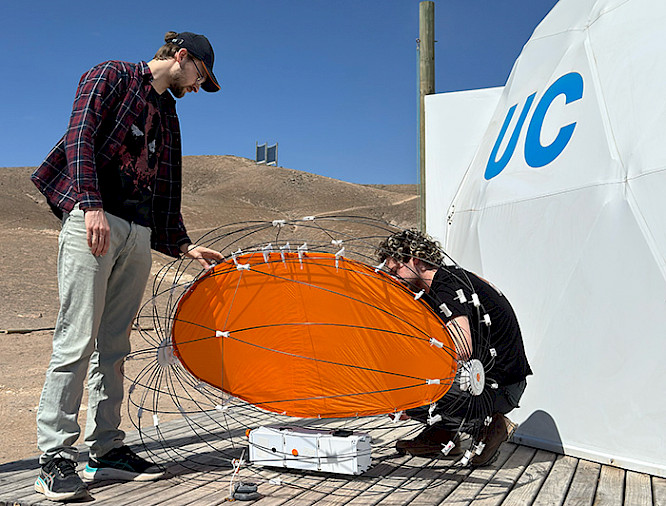
"The carbon fibers proved to be very durable after the initial field tests. It is designed so that as the rover rolls, the box containing the sensors remains upright. The idea is that as it moves, it captures a large amount of data from the Martian soil, which is then transmitted to the Mars Weather Station—something never done before over such a long period of time,” explains Moritz Itzerott, physicist and project scientist.
The Desert Campaign
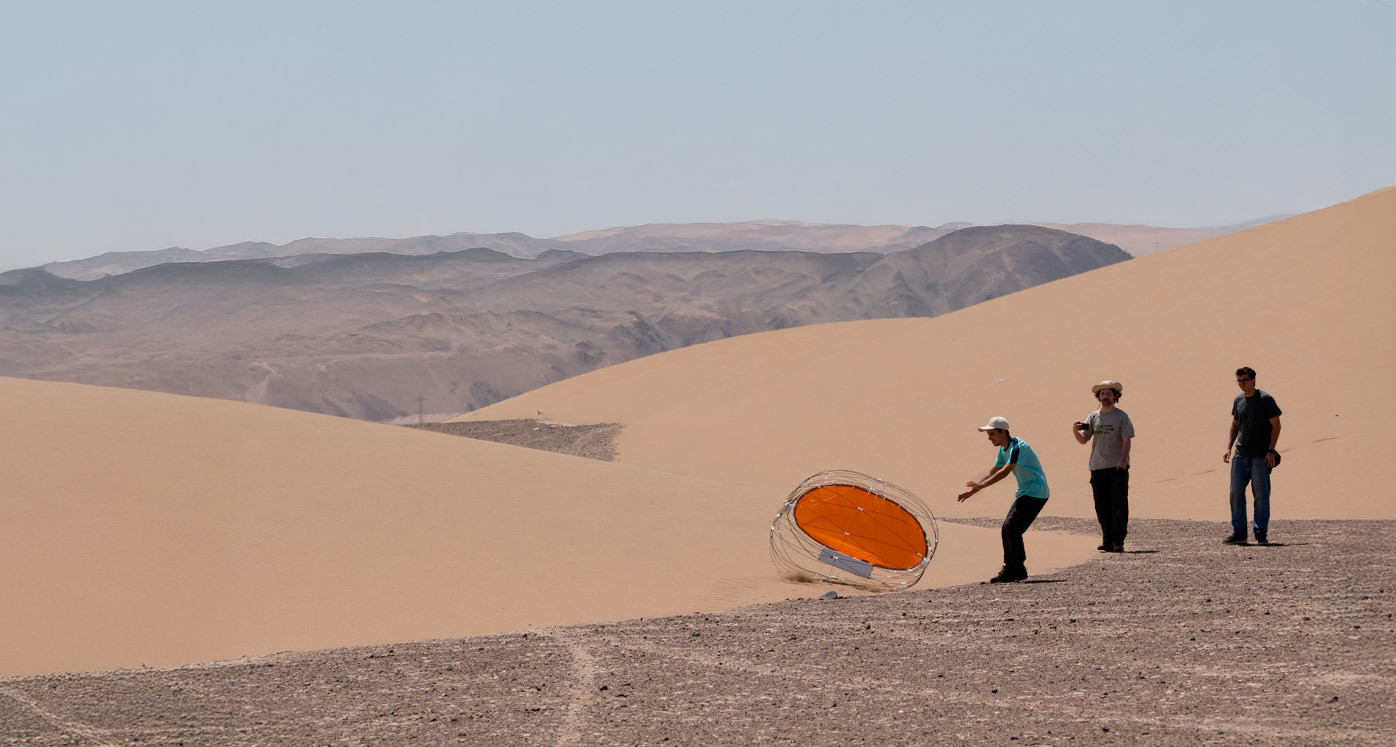
We find ourselves in an area of dunes known as “barjanes”—so-called as a result of their crescent shapes—in the coastal desert south of Iquique. The team carefully unloads the rover, fully wrapped, from a pickup truck and sets it down on the hard, rocky desert floor.
James and Moritz make the final adjustments to the rover. One, two, three: the researchers release the prototype for the first time, and it begins to roll, propelled by the wind—slowly at first, then picking up speed—until it comes to rest on the slope of a dune. The test is repeated several times, bumping into stones and moving erratically, before coming to a stop on its own.
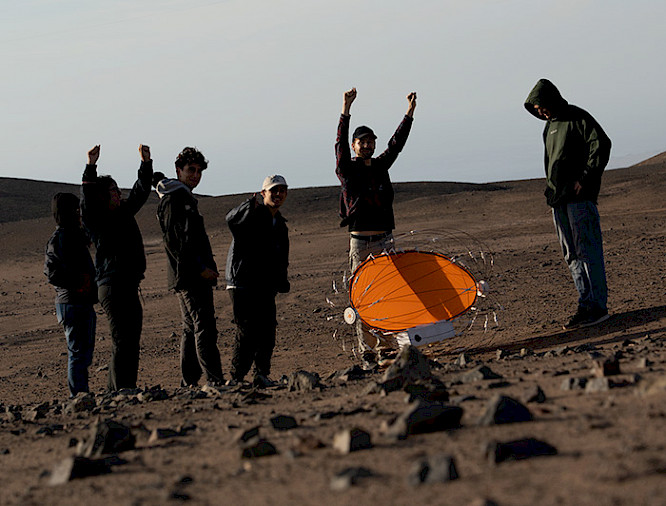
The scientists smile. The rover has successfully navigated the first of ten days of testing in the desert. The achievement is celebrated by the group that accompanies them, made up of Pablo Osses; Milton Avilés, the regional coordinator of the UC Chile Network of Regional Centers and Stations, and five students from the Institute of Astrophysics.
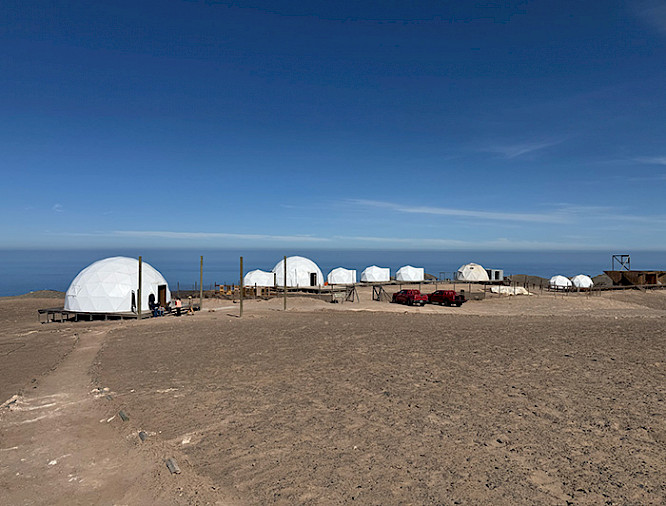
After a few hours, the team returns to the UC Chile Atacama Station Alto Patache, located on a coastal cliff 65 km to the south of Iquique and about 800 meters above sea level. It serves as a good “hub” both as a point for traveling to various locations—from dunes to salt lakes—and as a base of operations for fine-tuning the rover and testing it.
In fact, the second day of testing took place at the Station. Challenged by rockier terrain, the rover had to face several larger stones. “This helps us to see what failures or complications the rover might have on Mars,” says James Kingsnorth. “Can it climb obstacles like rocks or mounds? How well does it handle in windy conditions? Can it handle an incline? We want to answer these types of questions,’’ he adds.
The researchers are also looking to test the ability to obtain data from the environment and transmit it in real time. As well as the strength and durability of the components, during long journeys in extreme conditions.
Platform for Research
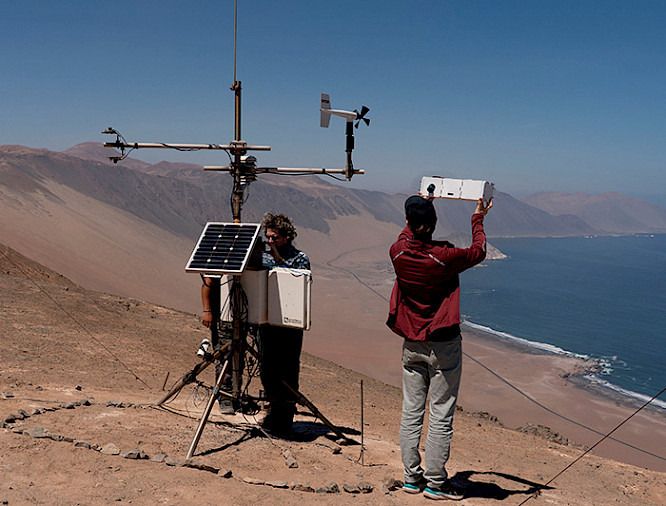
The UC Chile Atacama Station Alto Patache is not only an ideal location for field research in a wide variety of disciplines—thanks to its domes, which provide facilities for sleeping and working—but it also boasts a valuable dataset spanning more than 20 years of uninterrupted observations of fog and other atmospheric conditions.
“Hosting an international team at the forefront of space exploration here at the Station not only implies that they are pushing the boundaries in terms of technology and engineering development; it also opens us up to new questions about magnetism, geological composition, and climatology, among other things. And this is happening right here in our desert, showing us that it is more extreme or unique than we ever imagined,” says Pablo Osses, director of the UC Chile Atacama Station.
Precisely, the Station seeks to generate new questions, expanding the frontiers of research. Hence, thanks to a collaboration with the Institute of Astrophysics, five undergraduate students had the opportunity to participate in the tests: Diego Mella, Florencia González, Jacqueline Carrasco, Thomas Klerman, and Gianfranco Antonucci.
“It has been incredible to visit the station, observe the desert, learn how people survive in such a hostile environment, gaze at the night sky, and learn about all the research being done here. Being able to talk with the scientists and learn completely new things has been a wonderful experience,” says Jacqueline Carrasco, a fourth-year Astronomy student.
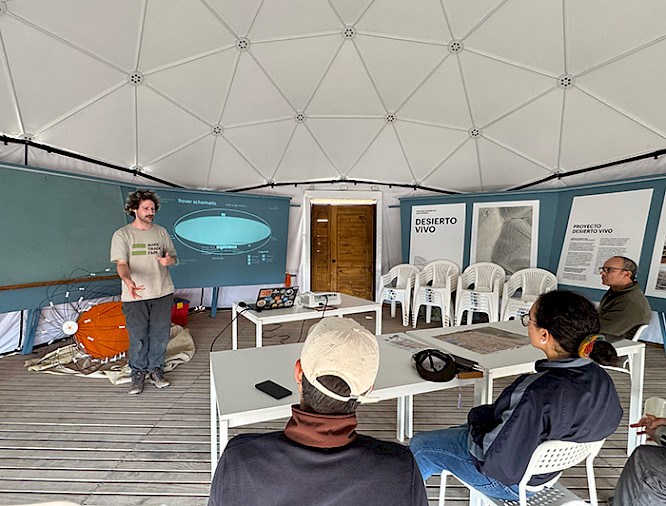
“It has been a really great experience, especially because of the variety of disciplines you see at the Station. What we have learned here is not really related to astronomy, but it has been very interesting to interact with a wide variety of people, such as the Tumbleweed researchers, who come from other countries—which is interesting in itself—to talk with them, help them out with whatever they need, and see how the tests are conducted in real life, especially in an environment such as this,” adds Gianfranco Antonucci, a student pursuing a double major in Astronomy and Engineering.
“Our students enroll in the program fascinated by the stars, but then they spend years studying a lot of math and physics, with far too few opportunities to look up at the sky that inspires them so much. I hope that spending a few days in the desert, participating in a field research project, and working with a high-level international team (whose goal is ultimately to explore Mars) has helped to strengthen their motivation. It is important, every now and then, to remember exactly why we study so much math,” says Manuela Zocalli, a researcher at the Institute of Astrophysics.
The goal is to offer students a unique opportunity to experience an international project up close and see first-hand exactly how science is conducted in the field, complete with all the real-world challenges it entails.
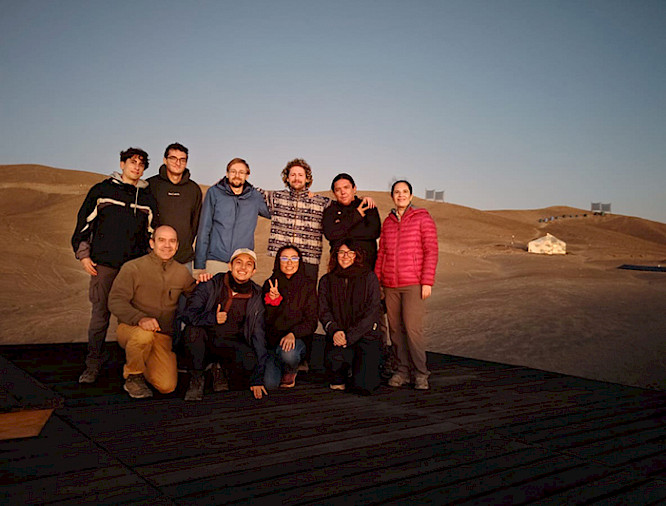
Through this initiative, the Station aims to position itself as a platform for research, a place where the university community can connect with both researchers from around the world and those across Chile. In doing so, it encourages engagement with new disciplines, ideas, and ways of thinking, ultimately fostering cutting-edge research and innovation.


