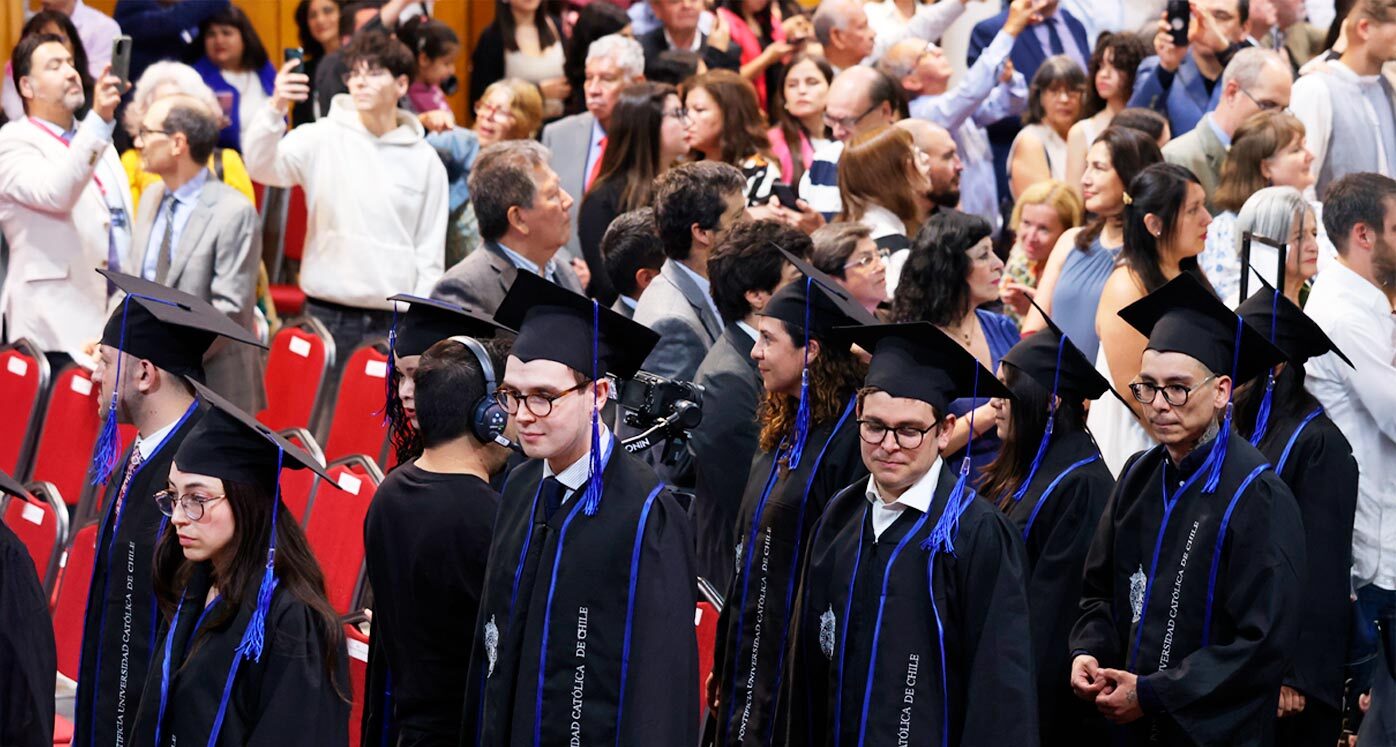
UC Chile awards doctoral degrees to 267 graduates, a national record
The specialists, from various fields of knowledge, will contribute to addressing complex challenges through impactful research and creativity.
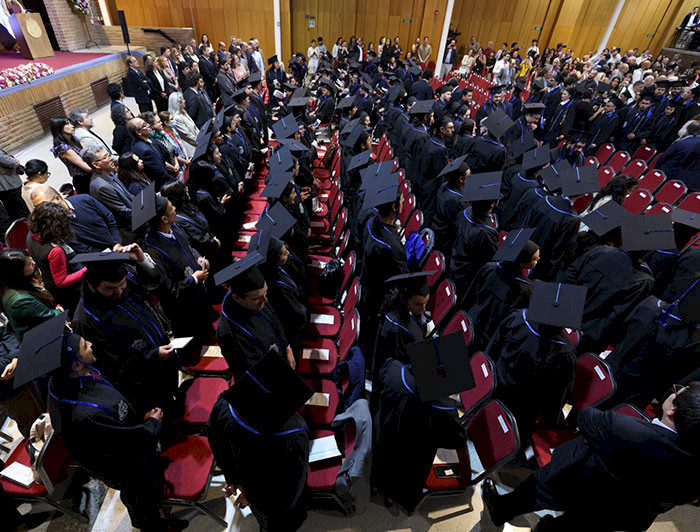
photo_camera A total of 26 of new doctors graduated in different disciplines. (Photo credit: César Dellepiane)
At a ceremony held at Casa Central, UC Chile awarded 267 doctoral degrees to students in different academic disciplines. This cohort has completed their formative process in a particularly significant context: in 2025, UC Chile commemorates 90 years since the creation of the first doctoral program taught in Chile (by the Faculty of Theology.)
The ceremony, organized by the UC Chile Graduate School from the Office of the Vice President for Research and Graduate Studies, brought together UC Chile President Juan Carlos de la Llera, university authorities, ambassadors, and representatives from the national system of science and technology.
This is the largest annual cohort of doctoral graduates from UC Chile, which is also a milestone at a national level.
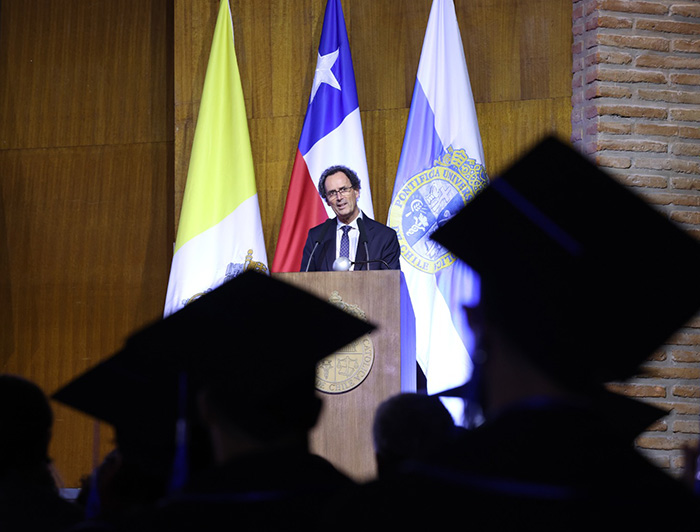
“Today, you receive an academic degree that represents excellence, but also an ethical commitment,” said Silvia Díaz Acosta, president of the Nacional Council of Science, Technology, Knowledge, and Innovation for Development (CTCI, as per its initials in Spanish), and the first woman to lead Chile’s Ministry of Science, during the keynote speech of the ceremony held at Salón Fresno at the Centro de Extensión. “The country needs you: in laboratories, classrooms, businesses, territories, public services, and social organizations; in spaces where decisions are made; in public debate, in cultural creation, in technological innovation, and in building bridges between different fields of knowledge.”
For María Angélica Fellenberg, Vice President for Research and Graduate Studies, “educating doctoral students means training leaders capable of transforming reality and providing solutions that impact society through science, technology, the humanities, and the arts.”
New Doctors for Chile and the world
The 267 graduates come from 39 doctoral programs that cover various fields of knowledge: from medical science and engineering to the humanities, the arts, education, philosophy, and the social sciences. A range that reflects the diversity of education and research that takes place at UC Chile.
Among them are 66 international students who chose UC Chile for their education, from countries including Argentina, Bolivia, Brazil, Colombia, Croatia, Cuba, Ecuador, Iran, Mexico, Nicaragua, Paraguay, Peru, Portugal, the United Kingdom, and Venezuela. This international presence underscores the global character of the UC Chile’s postgraduate ecosystem.
Education with global impact
Over the last ten years, UC Chile has consolidated its leadership in internationalization, with 162 joint doctoral degrees leading to dual degrees, which allow students to take part in research networks at universities of excellence. In 2025 alone, 12 joint doctoral programs were finalized with institutions such as King’s College London, Politécnico di Milano, the University of Edinburgh, the Autonomous University of Barcelona, University of Valle, and the University of Technology SydneyUniversity of Technology Sydney, among others.
“These alliances strengthen scientific exchange and position UC Chile doctoral students as researchers capable of contributing to academic communities on different continents,” said UC Chile Vice President, María Angélica Fellenberg. “Today, UC Chile has a solid and well-established doctoral ecosystem, which demonstrates its academic maturity and international projection.”
The University has 1,478 doctorate students, 42% women and 58% men, more than 90% of whom study with full scholarship, granted mainly by the National Agency of Development and Research (ANID, as per its acronym in Spanish), along with the internal funding provided by the UC Chile Office of the Vice President for Research and Graduate Studies. The international profile becomes stronger with 25% of international students, which confirms the growing global appeal of the institution.
Since the creation of the first doctoral program in 1935, UC Chile has trained 3,500 doctors. Moreover, 100% of the programs are accredited by the National Accreditation Commission of Chile (CNA, as per its acronym in Spanish), with an average of six years, one of the highest in the country, and it has over 60 international agreements that enrich advanced training. “This set of achievements consolidates UC Chile as a national benchmark in doctoral education and as one of the most active Latin American universities in high-impact scientific and humanistic research and artistic creation,” stated UC Chile Vice President for Research and Graduate Studies.
Awards for Excellence
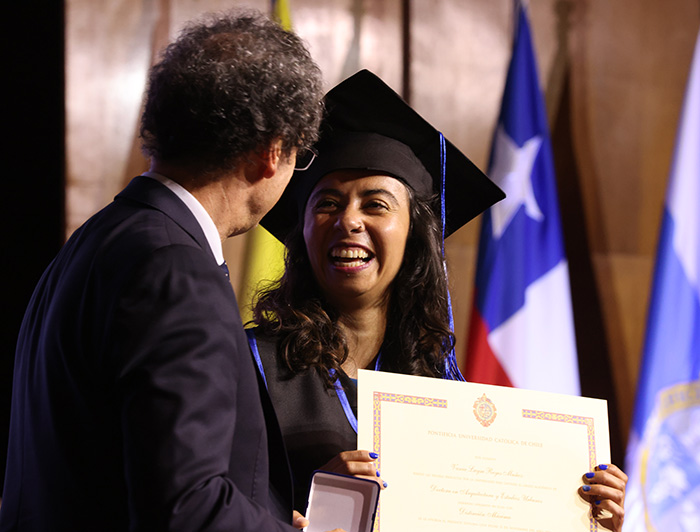
Five UC Chile graduates were recognized for the substantial contribution their research makes to the advancement of knowledge in the major disciplinary areas. The awards went to María Isabel Zapata (Architecture and Urban Studies), recognized in Arts and Humanities; Pablo Poblete (Engineering Sciences, Electrical Engineering); Juan Espinoza (Astrophysics), in Chemical, Physics and Mathematical Sciences; María de los Ángeles Spencer (Epidemiology) in Biology and Health Sciences; and Cristian Felipe Parra Bravo (Communication Sciences), in Social Sciences. The award-winning theses stand out for their rigor, originality, and for having a significant contribution to the scientific, humanistic, and technological development of the country.
The ceremony also highlighted the work of two distinguished academics in the third edition of the Excellence in Doctoral Thesis Supervision Award: Patricio Cumsille, professor in the Doctoral Program in Psychology and the Doctoral Program in Psychotherapy, and Gloria Montenegro, professor in the Doctoral Program in Agriculture and Natural Science. Their work is reflected in the training of independent researchers, the application of good practices that guarantee the academic progress of their students, and the construction of solid and healthy working relationships with their thesis candidates and the graduate community.
In addition to this was the Cardinal Newman Honor, which recognizes theses that articulate academic discipline with the Christian faith. This year’s recipients were Lili Almási-Szabó, from the Doctoral Program in Sociology, and Juan Pablo Sepúlveda, from the Doctoral Program in Theology.
One of the most emotional moments of the day was the presentation of the Posthumous Doctoral Diploma to Camilo Ignacio Lagos, from the Doctoral Program in Engineering Sciences, in recognition of his academic contribution in the area of Civil Engineering. The ceremony concluded with a speech by one of the graduates, Cristián Parra, from the Doctorate Program in Communication Sciences, who, in representation of his cohort, highlighted the lessons learned, challenges faced, and commitments made that marked their doctoral journey.
Ninety Years of Research
The ceremony also celebrated a historic milestone: 90 years since the creation of the country’s first doctoral program, founded at UC Chile in 1935. Since then, higher education in UC Chile has consolidated a tradition of academic excellence, rigorous research, and international projection.
Over these nine decades, UC Chile’s doctoral programs have trained researchers and leaders who promote science, innovation, and culture; contribute to public policy design; integrate international networks; and lead projects in technology, health, education, and the arts, with an impact that transcends national borders.
“Doctoral training at UC Chile has established itself as a strategic pillar for the country’s development, preparing specialists capable of expanding the limits of knowledge, driving scientific advances, and contributing to evidence-based decision-making,” states Diego Cosmelli, Director of the UC Chile Graduate School. “This work is based on a model that prioritizes academic excellence, methodological rigor, and a strong commitment to Chile’s development.”


