UC Chile Strengthens Global Networks and Continental Collaboration
UC Chile’s participation in the SACRU and HUC summits, held in Brazil and Colombia, paved the way for new opportunities for academic collaboration and addressed global challenges such as the climate crisis, food security, and the impact of new technologies. This international agenda is part of the strategy “UC Chile Connected to the World,” which currently comprises 71 networks, alliances, and agreements with more than 500 universities.
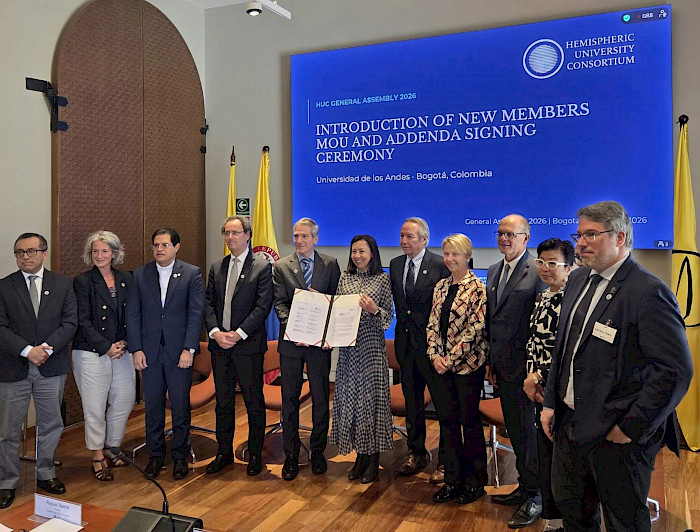
photo_camera The 2026 HUC General Assembly celebrated the addition of the University of California, Los Angeles, and the University of Montreal, Canada, to the consortium.
From August 27th to 31st, a UC Chile delegation led by UC Chile President Juan Carlos de la Llera, and Vice Chancellor Priest Osvaldo Fernández de Castro, visited universities in Brazil and Colombia that are part of the global networks Hemisphertic University Consortium (HUC), and the Strategic Alliance of Catholic Research Universities (SACRU).
HUC coordinates universities in the Americas around the development of joint initiatives in research and education. SACRU gathers Catholic universities around the globe to address global challenges from a perspective inspired by shared values, through excellence in research and dialogue.
UC Chile’s collaboration with these networks helps expand opportunities for academic cooperation and contributes from various perspectives to addressing challenges that transcend borders. “The challenges we face in different countries are remarkably similar and the skills required are immense. Establishing alliances such as these allows us to address these issues in a much more integrated way,” highlighted UC Chile President Juan Carlos de la Llera during his visit to Bogota, Colombia.
SACRU: Seeking harmony between the human and the artificial
The Pontifical Catholic University of Rio de Janeiro (PUC-Rio) was the host institution of this meeting of university authorities and academics from the nine universities belonging to SACRU, which took place on August 28th and 29th. The event was preceded by the opening Catholic Universities Art Triennial of the Holy See, in its version in Brazil.
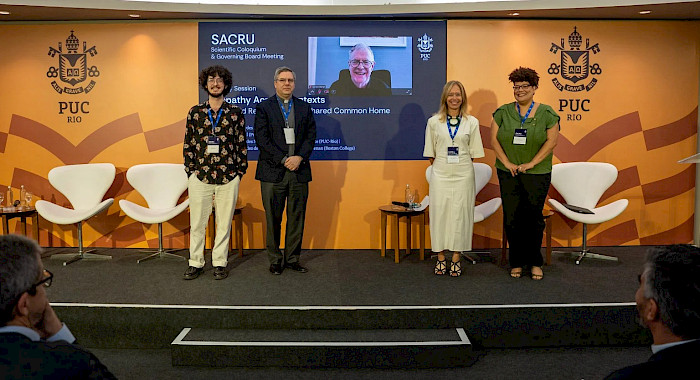
The main event of the summit’s first day was the scientific colloquium “Empathy Across Contexts,” where Father Osvaldo Fernández de Castro served on the plenary session panel along with representatives from PUC-Rio, Boston College, and the Catholic University of Portugal.
Empathy and awareness of different realities were the focus of the panel discussion “Empathy Across Contexts: Hope and Recognition in a Shared Common Home,” which invited participants to reflect on the importance of understanding the experiences of different cultures and contexts in order to build relationships based on respect and collaboration. The conversation highlighted the importance of hope and the recognition of others as key elements to progress towards a society that is more inclusive and more committed to caring for our common home.
UC Chile Provost Mariane Krause took part in the panel discussion “Food Insecurities and Sustainable Development,” where she shared key insights from her field on how to address the global challenges of food security and sustainability, and the university’s role in coordinating efforts with other institutions.
UC Chile President Juan Carlos de la Llera joined in SACRU’s second day, along with Vice President for International Affairs Maria Montt. Both represented UC Chile at the Governing Council Meeting. “We share a common perspective with SACRU universities on the role of the human element in education, the importance of being present and coming together, and the role of universities in this task,” mentioned Vice President Montt.
This day was marked by the collective efforts of university officials to assess the collaboration among all parties, outline the network’s future direction, and explore how to continue creating opportunities that contribute to the generation of knowledge that has a positive impact on society.
At the end of the day, the panel “Education Challenges: New Technologies and Old Inequalities” was presented, featuring UC Chile’s Head of the Office of the Secretary Eduardo Ibáñez.
HUC: Increased efforts to address the climate crisis, and expansion of the network in the North
The HUC General Assembly of 2026 took place on August 31st and September 1st at the University of the Andes, Colombia, during which universities from across the Americas gathered to define the consortium’s priorities for 2027. The focus was on climate change and sustainability.
HUC stands out for its continental collaboration and the scope of its research work aimed at helping to address global challenges. From this perspective, the meeting addressed the progression of climate change and the development of sustainable programs.
The HUC Seed Fund, a collaborative funding program designed to strengthen research partnerships among HUC’s member universities, was one of the topics discussed at the meeting, in line with the objectives of the consortium. Complementing this effort is the Virtual Research Internship Program, which broadens opportunities for international experience through students’ direct participation in research projects conducted alongside academics from member universities.
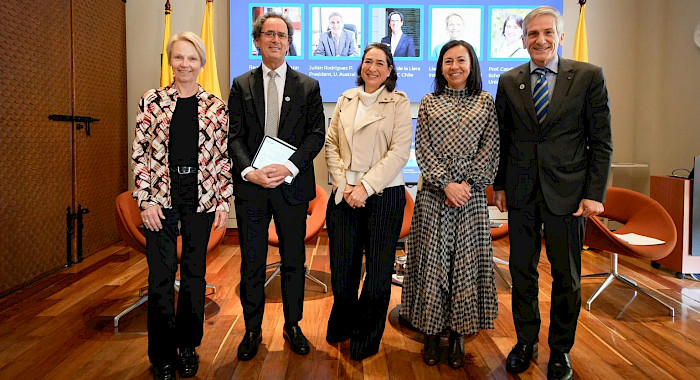
In addition to generating knowledge and addressing shared challenges, the alliance has a role to play in educating future generations. It also highlights the role of universities in training leaders with a global perspective, ready to understand different contexts and to responsibly address social, economic, and environmental challenges.
The assembly also provided an opportunity for reflection on the challenges facing the continent due to the climate crisis. The panel “A Climate Dialogue Across the Americas: Contrasting Perspectives from the Global North and South” brought together leaders from various institutions and featured the participation of UC Chile President Juan Carlos de la Llera.
“Universities are true role models for what we ultimately want society to do. They’re spaces where new generations are formed who will take these messages and all this knowledge into society, and they are ultimately the ones who will transform it,” stated UC Chile President Juan Carlos de la Llera.
A milestone of the event was the expansion of the network’s reach into North America, with the incorporation of University of California, Los Angeles, in the United States, and University of Montreal, in Canada.
Juan Carlos de la Llera highlighted these additions as key, opening doors to work with more countries, and expanding the diversity of perspectives. “We need to come together so that our continent can also be a space where knowledge and teaching play a fundamental role in the development of societies,” he stated.


