
UC Chile Research Sets Record for Publications Involving International Collaboration
During the first semester of 2026, 65.2% of academic publications affiliated with UC Chile were produced in collaboration with international partners, setting a record amid sustained growth in collaboration with researchers from international institutions. Beyond the numbers, this progress reflects deep academic ties that enable UC to address shared challenges and create new knowledge with global reach.
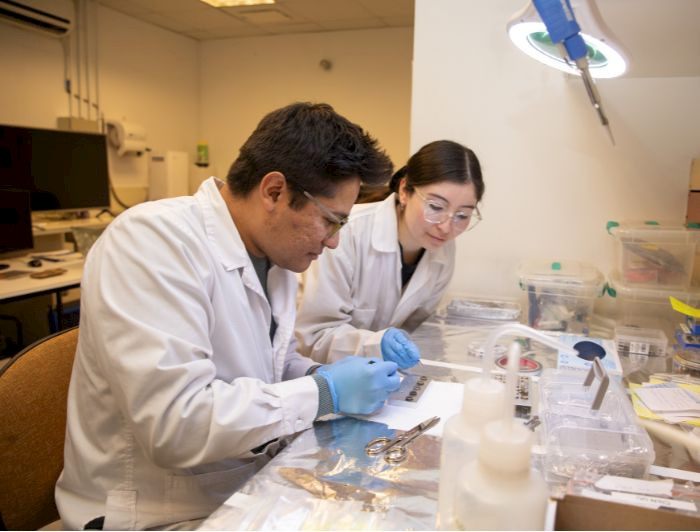
photo_camera “It is essential that knowledge at UC Chile engage in dialogue with the world’s scientific networks, integrating different disciplines, cultures, and experiences,” states UC Chile Vice President for International Affairs Maria Montt. (Photo credit: Nicole Saffie)
Today, science and innovation face challenges that transcend borders and demand increasingly close collaboration between researchers and institutions worldwide. In this context, UC Chile has reached its highest level of international collaboration.
According to data from the Office of Strategic Scientific and Technological Information from UC Chile Libraries, the university recorded 1,561 indexed publications during the first semester of 2026. Of these, 65.2& (1,017) were developed in collaboration with researchers affiliated with international institutions.
This result consolidates a trend of sustained growth: international collaboration rose from 53.1% of publications in 2015 to 61.4% in 2025, reaching an all-time high for the university.
The figures include all publications with a “published” status and an affiliation with UC Chile, corresponding to the categories Article, Review and Proceedings (Conference) Paper, indexed on Web of Science (Clarivate) or Scopus (Elsevier), which include co-authorship by one or more researchers affiliated with institutions in a country other than Chile.
Percentage of UC Chile publications with international collaboration
“It is essential that knowledge at UC Chile engage in dialogue with the world’s scientific networks, integrating different disciplines, cultures, and experiences. The sustained growth in international collaboration reflects the commitment of the entire UC Chile community to strengthening these partnerships and expanding our research beyond borders,” notes UC Chile Vice President for International Affairs Maria Montt.
The academic authority also values international collaboration as a way to make an impact in Chile and to put the university to the service of the challenges we face today. “Promoting this joint work not only enriches the science we pursue, but also helps train researchers with a global perspective and create knowledge that contributes to the development of Chile as well as to the shared challenges of humanity,” she concludes.
The importance of networks
At its core, international collaboration is built on long-term academic relationships that enrich methodologies, broaden research questions, and create new ways of generating knowledge.
More than a decade ago, a postdoctoral internship led to the collaboration between Carolina Rojas Quezada, Professor at the UC Chile Institute of Urban and Territorial Studies and Alternate Director at Centre for Sustainable Urban Development (CEDEUS, as per its acronym in Spanish); and academic Antonio Páez, Professor at the School of Earth, Environment and Society from McMaster University (Canada). Since then, the two researchers have co-authored several publications, including, “Grounding Urban Wetlands as Nature-Based Solutions: Enhancing Accessibility to Nature in Concepción, Chile,” which was published this year in NPJ Urban Sustainability.
“This experience demonstrates the importance of building and maintaining academic networks: thanks to them, over time you may be able to conduct research and publish alongside people whose work has been a reference and inspiration throughout your own career,” states Professor Rojas.
For her, working with international teams has greatly contributed to her professional development as well as her research. “International collaboration strengthens research by integrating different perspectives, experiences and methodologies. In our work on access to nature, this collaboration was particularly valuable in identifying local challenges within global scientific discussions.”
At UC Chile’s Faculty of Education, faculty member Valeria Cabello, together with researchers from Northwestern University and the University of Illinois in Chicago, led the study “Learning to Explain Environmental Crises: A Dialogic Analysis of Teacher Professional Learning Between Chile and the United States,” published in December of 2026 in the British Educational Research Journal.
Instead of comparing experiences between Chile and the United States, the team fostered an ongoing dialogue between the two research communities to understand how education can respond to environmental crises.
“The most important contribution of this article lies not only in the results, but also in the methodology. We established a horizontal, sustained dialogue between teams in Chile and the United States, which allowed us to analyze the data from different perspectives, and develop a more comprehensive teaching feedback tool than either team could have produced independently,” stated the academic.
For Professor Cabello, this experience demonstrates that international collaboration not only strengthens research outcomes but also transforms and enables innovation in the way knowledge is developed.
“International collaboration is neither mere formality nor a requirement for funding, but rather a prerequisite for generating new knowledge. When research communities with different histories, resources, and traditions share their methods of working, the result is not a simple sum of discoveries, but new analytic categories that neither had been able to build independently,” she concludes.
Collaborations that strengthen teaching
Isabel Hilliger, teacher and Director of the Engineering Unit of Design (Di-Lab, as per its acronym in Spanish), from the UC Chile School of Engineering, has been exploring artificial intelligence in her research for years. She recently collaborated on the study “Simba: A Tool for Designing Generative AI Agents for Reflective Learning and Critical Thinking,” which resulted in a tool that enriches teaching at the local level, with an international perspective.
“Today, artificial intelligence is a global challenge, but its effects are felt at the local level: in the classroom, in how a student learns to think critically and not just to get quick answers,” notes the professor.
Her research involved collaboration with various universities that tested the tool SIMBA: “In our design-based research to develop the SIMBA chatbot, a tool that enable teachers to design generative AI agents that act as Socratic tutors, we tested its use with over 270 students in different grades. We have found that the most solid advances result from collaborating with international partners,” states Hilliger.
Through this experience, the teacher has enriched her research and learned to collaborate with different partners and in different languages, challenging her own approach to conducting research. “Collaboration with teams from other universities and in different languages, as is the case with Université Paul Sabatier in Toulouse, France, not only diversifies methodological perspectives, but also allows us to compare results across different teaching environments, accelerate the design of responsible solutions, and position UC Chile in the global conversation about AI and education,” she concludes.
The value of knowledge lies in sharing it
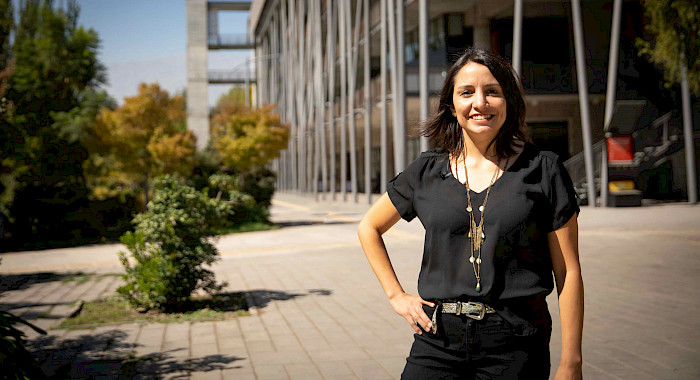
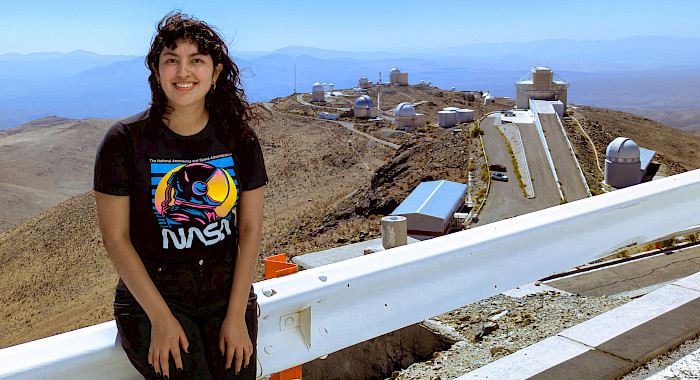
International mobility programs and networks enrich the education of students and researchers in different stages of their academic careers. One example is Jennifer Chacón Chávez, Ph.D. candidate in Astrophysics, who, during an internship in Beijing in October of 2025, strengthened a scientific collaboration with researchers from the National Astronomical Observatories of the Chinese Academy of Sciences.
Traveling to such a different country was a challenge, says Chacón, and it undoubtedly sparked hundreds of questions in her mind about what her experience would be and whether she would be able to build relationships with other researchers: “Before going to China, interacting with people from another culture and in another language seemed intimidating to me. However, I found that I had a lot in common with my fellow collaborators, and this experience strengthened the ties we were building, and opened new opportunities for joint research,” she explains.
The doctoral student envisions an even deeper relationship with her colleagues and highlights that her contribution to the article “An Archival Optical Counterpart Search For Extragalactic Fast X-Ray Transients Discovered By Einstein Probe” (2026), in The Astrophysical Journal, is the first result of a scientific collaboration that continues to grow with her counterparts. “For my education as a doctoral student, building long-term networks has been as valuable as transcending the frontiers of the universe. Because, in the end, science only makes sense when it’s shared.”
In a context where the main challenges are increasingly global, UC Chile seeks to foster collaboration with international partners through initiatives presented in the 2026-2030 Strategic Plan.
To this end, the new version of the Avanza UC call for proposals, for which applications were accepted from July 31 through September 30, will include incentives for developing projects in partnership with international institutions.
Additionally, UC Chile currently has cooperation agreements with more than 300 higher education institutions in the world and participates in 71 international networks, which enable the creation of new scientific and academic partnerships.


