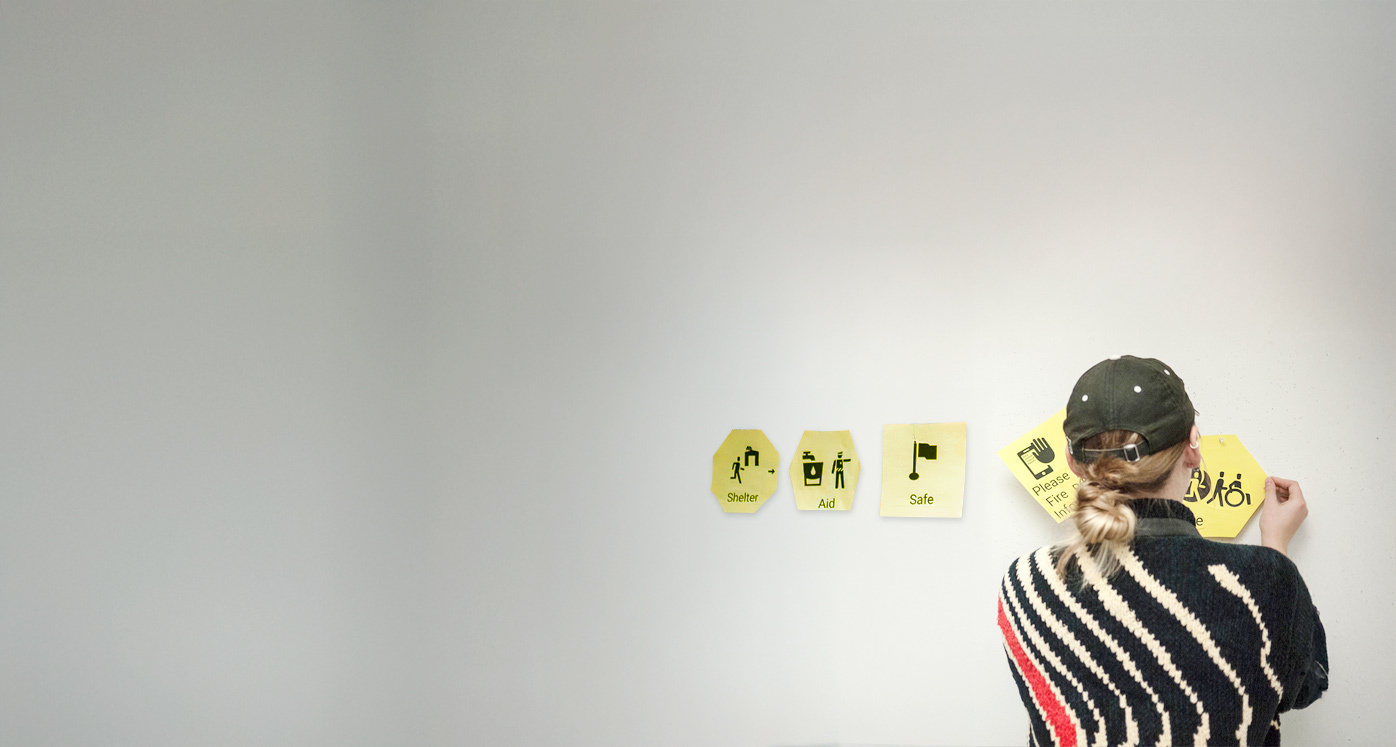
Guemil: The Visual System that Redesigns Emergency Management
This initiative, led by UC Chile School of Design professor Rodrigo Ramírez, uses iconography and community work to transform the way we prepare for disasters. From its origins after the 2010 earthquake in Chile to its new version with icons that broaden its reach while maintaining open-access, Guemil has established itself as a tool that seeks to “flip the switch” towards a culture of prevention.
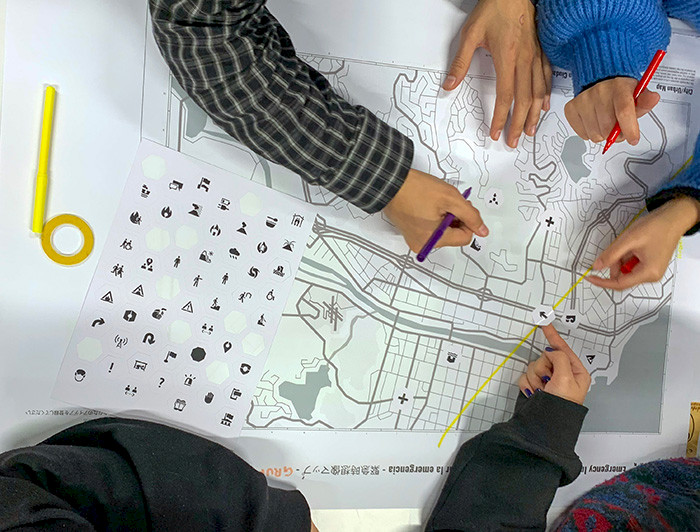
photo_camera In a country where emergencies are frequent, managing information so that people can prepare and prevent disasters is a necessity. Designing information optimized for emergencies today is a challenge. (Photo courtesy of Rodrigo Ramírez)
February 27, 2010 marked a turning point for Chile and for Rodrigo Ramírez, faculty member of the UC Chile School of Design. After the crisis, a fundamental question arose: How can design make a concrete contribution to disaster management?
Thus, what began as a need to “do something” rapidly evolved into something deeper: information management and visual communication of risk. This is how Guemil was born, an open-source library of pictograms that aims to be a model of visual communication for emergencies.
A name with roots and meaning
The term “Guemil” was not chosen at random. It comes from the Mapudungun word “ngümin” or “guemil,” which refers to the patterns and figures found in Mapuche textiles. “It is a beautiful concept that translates literally as “symbol,” but in the Mapuche worldview they have a deeper interpretation of how matter is transformed,” explains professor Ramírez.
This poetic and cultural significance, inspired by the linguistic work of Elisa Loncón, was turned into a technical tool: a visual system capable of communicating critical instructions—such as following signs to evacuate or identifying meeting points—through symbols that overcome language and cultural barriers.
From a “failed project” to a global library
Curiously, Guemil emerged from what Ramírez describes as the “by-product” of a 2015 project that initially did not succeed within the Research Center for Integrated Disaster Risk Management (CIGIDEN, as per its acronym in Spanish), which was aimed at rethinking tsunami evacuation maps.
“The original project didn’t work out, but we were left with this series of icons we had developed,” recalls the professor. In 2016, they decided to make this material available on an online platform with free access, so that any person or organization could download it and use it.
Since then, the project has taken on a life of its own. The icons have multiplied, thanks to the work of students and academics at the UC Chile School of Design, seeking to respond to various situations, from earthquakes, tsunamis, and wildfires to power outages or a pandemic.
The icons are divided into three stages according to the moment of the emergency: before, during, and after, addressing the concrete actions that must be taken during critical moments and afterward, as well as prior education and preparation.
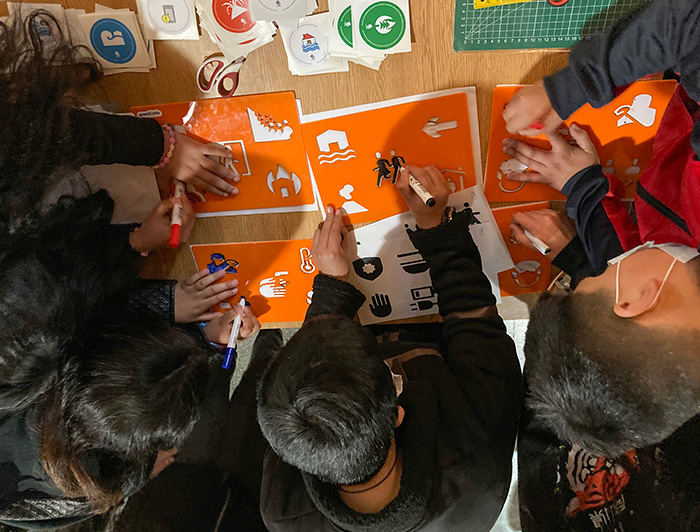
The interdisciplinary work has been interesting as well. “A joke I often tell when I present on behalf of CIGIDEN is, ‘Well, what does a designer do here besides make PowerPoint presentations?’ I would say that it’s a delightful relationship. For us, a decisive factor has been how we validate the communication of risk. We propose a graphic language based on representations of, for example, a volcano; but then a volcanologist might say—and I quote Felipe Aguilera from the Ckelar Millenium Institute— ‘The representation you did of a Strombolian (upwards) eruption is interesting, but generally, volcanoes from the Andes erupt in different ways,’ which led us to explore different representations. Thus, design and science feed off of each other, yielding more relevant proposals, which are then tested by the communities themselves.”
Social and cultural differences
When looking at the same image, not everybody understands or “reads” it in the same way. As Rodrigo Ramírez explains, “there are cultural and geographical factors, but it also depends on how familiar people are with the scenario. For example, when we tested earthquake icons in Asia, we received very different responses; people interpreted them as ‘loud neighbors’ or ‘nightclub’; whereas in Japan—a highly seismic country—people immediately respond ‘earthquake.’ We have also learned that there are different ways to name the same phenomenon: tremor, earthquake, seismic event, etc. Certain linguistic variations – interpretations of images in words – emerge depending on the place we come from.”
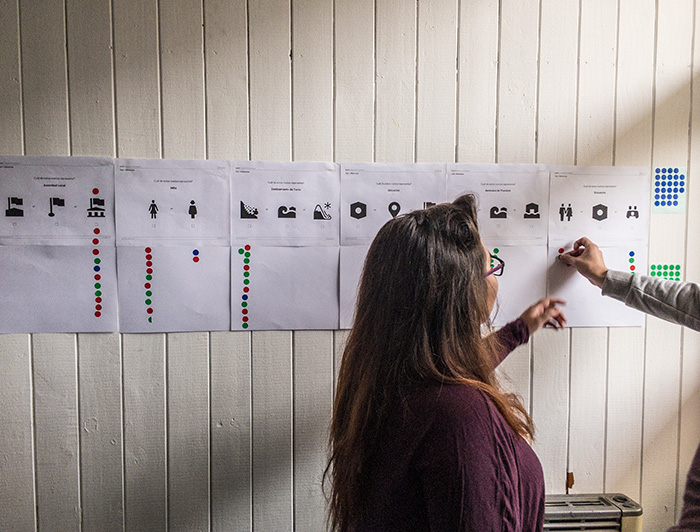
This is why each icon goes through rounds of surveys where people are asked, “What does this symbol represent?” Only when at least 200 answers are received, with a high degree of accurate interpretation, is an icon considered validated for widespread use. This iterative approach has ensured that Guemil is not a static library of symbols, but a system that is constantly being improved based on public input.
International collaboration
The relevance of Guemil has gone beyond borders. The project is part of the Design Network for Emergency Management and has created links with various institutions in Chile, such as the National Disaster Prevention and Response Service (SENAPRED, as per its acronym in Spanish), with whom they have implemented the testing method to evaluate interpretations regarding tsunami risk or volcanic threats.
One example is the collaboration with Professor Clinton Carlson from the University of Notre Dame, with whom they jointly applied for the Luksic Foundation Grant, which funded the Design for Emergencies project to develop a toolkit for community emergency management. For this initiative tested in five countries, participatory workshops have taken place in which communities, local authorities, and emergency teams like firefighters come together to identify priorities and design their own resilience strategies using the Guemil iconography. “Here, design acts as a facilitator of conversation, allowing people not only to express their wishes, but also to define priorities and develop concrete strategies,” states professor Ramírez.
Towards a design laboratory for emergency management
The project is currently celebrating the release of its version 2.0 (or, as professor Ramírez jokingly calls it, “version 20”), an updated set of 115 icons that incorporates lessons learned from nearly a decade of testing in scenarios as diverse as wildfires, heat waves, and emergency management involving pets.
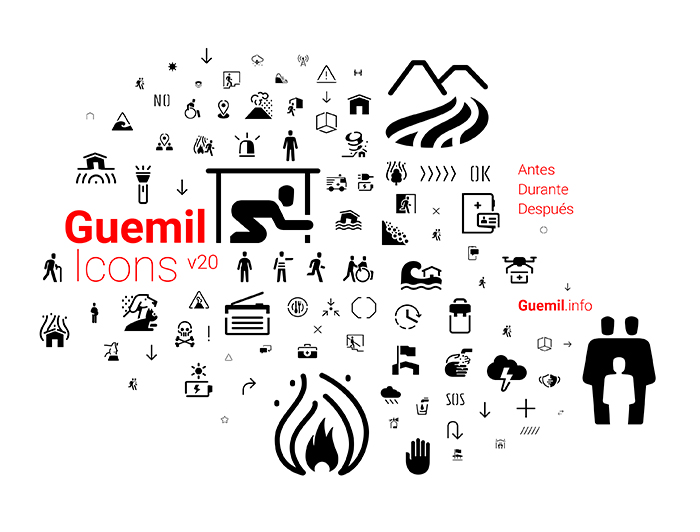
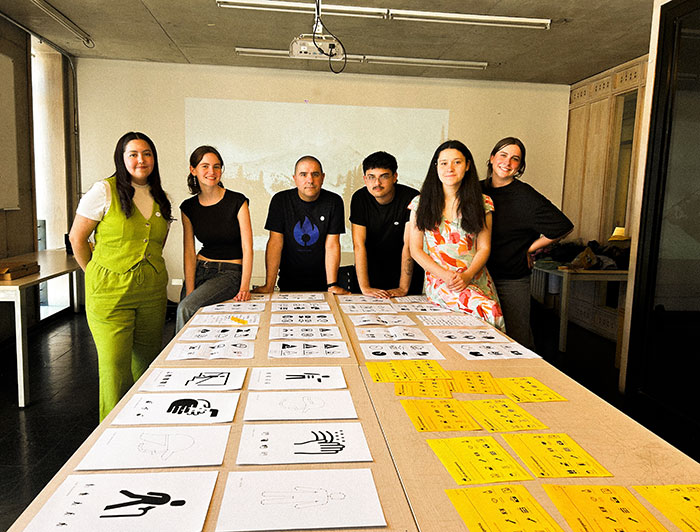
The impact of Guemil is evident in the diversity of practical applications that range from preventive graphics for domestic use, to informative kits for post-emergency volunteer management. However, the ambitions of the team—composed of students on internship and UC Chile School of Design faculty members José Allard, Patricia Manns, Felipe Cortez, and Carola Zurob—is to institutionalize this knowledge.
“My dream is for the School of Design to be equipped with a formal laboratory for emergency management,” expresses Rodrigo Ramírez. This space would enable research in not only visual communication, but also the complete experience before, during, and after a crisis: for example, from how to manage evacuation with pets or the experience in a shelter, to how a community of elderly people living in a building can prepare.
Changing the public “switch”
For professor Ramírez, the objective of Guemil is also cultural. In a country exposed to natural hazards, the focus cannot be limited to reacting to an imminent disaster. “We need to shift toward approaches that emphasize preparation and prevention,” he states. By providing clear, open-access visual tools, the Guemil system seeks to empower citizens and communities to take an active role in managing visual emergency communication.
In short, for a country where emergencies are frequent, managing information so that people can prepare and prevent disasters is a necessity. Today, designing information optimized for emergencies is a challenge with a multidimensional scope. Therefore, design—through projects such as Guemil—becomes fundamental as a public tool for actively teaching resilience.


