
How Is UC Chile Integrating AI and New Technologies Into Its Educational Model?
With the Strategic Plan already underway and the Office of the Vice President for Digital Intelligence consolidating, UC Chile is driving a roadmap to integrate AI and new technologies into academic training and the work of the entire university community. We invite you to learn what the University is doing in this area and to participate in its activities and initiatives.
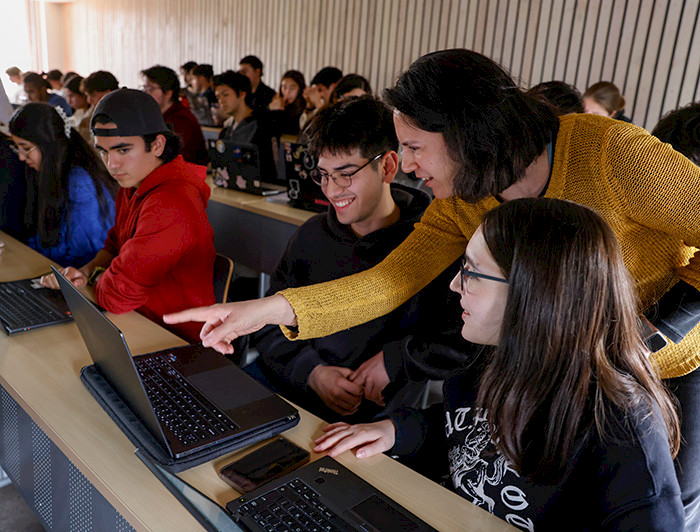
photo_camera Being a leading university in digital intelligence, centered on people and the university project, is one of the objectives of the UC Chile Strategic Plan. (Photo credit: César Dellepiane)
Globally, AI has profoundly transformed higher education. Universities worldwide are rethinking their educational, ethical, and operational models in response to advances in artificial intelligence, shifting from learning about the tools to integrating them into their educational models.
In this context, UC Chile defined becoming a leading university in digital intelligence, centered on people and the university project, as one of the pillars of its Strategic Plan. Likewise, it created the first Office of the Vice President for Digital Intelligence in the Chilean higher education system.
Through this, the University seeks to propose an innovative model: a transformation in which AI enhances teaching, drives frontier discovery, and optimizes processes, always framed by robust data governance, an ethical hallmark, and a people-centered, humanist perspective.
Hence, UC Chile dedicated November to Artificial Intelligence and digital transformation, inviting the university community to reflect on and explore new ways to integrate these technologies into education, research, and management tasks.
As Vice President for Digital Intelligence Paula Aguirre states, “At UC Chile, AI challenges us to rethink how we teach, how we research, and how we learn.” Likewise, she says, it leads us to ask about “the impacts that AI has on people and on our own intellectual and personal development.”
Integration of AI in University Teaching
Integrating artificial intelligence into the educational model constitutes one of the priority initiatives of the 2026–2030 Strategic Plan. This process includes a comprehensive curriculum update, faculty training programs, and student support systems, accompanied by clear ethical frameworks, new technological tools, and state-of-the-art pedagogical resources.
For this reason, the Office of the Vice President for Academic Affairs (VRA, as per its initials in Spanish) developed the document "Guidelines for the Use of Artificial Intelligence – Guide for UC Chile Students, 2026 Version," which establishes five principles: Centrality of the Human Person, Critical Understanding and Evaluation, Transparency and Accountability, Self-Care and Well-Being, and Safety and Protection.
As Catalina García, Director of the Office of Learning and Student Academic Support at VRA, explains, the goal is for students to “distinguish how and when to use AI so that it enhances their learning, using it strategically without replacing their own skills or having it do the work for them, which are common concerns regarding generative AI today. To that end, the guide provides them with criteria and practical tools they can apply.”
Download the Guide "Guidelines for the Use of Artificial Intelligence" (in Spanish)
To support this, the Offices of the Vice President for Academic Affairs and for Digital Intelligence organized "Pizza & Dialogues on AI," a gathering aimed at creating an open space to share and discuss AI. The event featured various stations where students, for example, formed teams to compete in a “prompt duel” or assembled a bracelet to visualize how they use AI; it also included a panel discussion and a presentation of the main conclusions.
Along the same lines, the new Director of the Office of Artificial Intelligence (AI) at the Office of the Vice President for Digital Intelligence, Marcelo Arenas, adds that “the goal should not be for students to depend on AI, but rather to know how to use it to expand their capabilities, maintaining their autonomy and responsibility over what they do. To achieve this, we need to preserve the depth and rigor of university education: learning to use these tools cannot replace the effort of understanding. AI offers us an opportunity to pose more ambitious challenges. On a solid disciplinary foundation, we can propose problems that require greater analysis, exploration, and creativity.”
Hence, one of the strategic projects is IA en el Curriculum (AI in the Curriculum), which seeks to incorporate cross-cutting training in AI, encompassing technical, ethical, and social perspectives, and integrating common foundations and disciplinary applications. Likewise, it aims to develop academic judgment, critical thinking, and the ability to use artificial intelligence responsibly across all degree programs.
The faculty member—also affiliated with the School of Engineering and the Institute of Mathematical and Computational Engineering—emphasizes that “the purpose should be to enrich the educational process, not eliminate the intellectual effort that this process requires.” He elaborates: “In that sense, incorporating AI must not mean lowering academic standards. We must continue to expect students to understand fundamental concepts and justify their decisions. A well-presented piece of work is not enough if the person submitting it cannot explain what they did. This also entails defining in which activities AI can contribute to learning and in which the student must exercise and demonstrate their abilities without that support.”
Another project of the Strategic Plan is Ecosistema IA, (AI Ecosystem) an initiative that seeks to bring artificial intelligence to the UC Chile community in an integrated and governed manner. The ecosystem is organized into three mutually complementary layers: personal AIs support the daily work of students, faculty, and staff; institutional chatbots and agents address specific needs of university units and processes; and AI-enabled platforms, such as AyudantIA and Studio IA, enable larger-scale capabilities. All of them are deployed across the areas of education, research, and management, under a common AI governance framework that defines ethical and technical criteria.
As the academic remarks, “AI can support a student with alternative explanations, practice exercises, or preliminary feedback on their work. For faculty members, it can be an aid in preparing materials, designing activities, and adapting resources to different needs.”

Training Opportunities
“Training in AI does not necessarily mean becoming a computer specialist. We must combine common training, which allows us to understand these technologies and use them with discernment, with opportunities for application and reflection specific to each discipline,” emphasizes Marcelo Arenas.
At UC Chile, concrete examples already exist, such as the General Education course Artificial Intelligence: Science and Society, which addresses its foundations and implications from various perspectives, and Artificial Intelligence Tools and Agents, open to students from all degree programs with no prior programming prerequisites. These are complementary proposals to approach both the understanding of AI and its practical use.
Another example is the digital skills training workshops offered monthly by the Office of the University Library Administration UC Chile, aimed at the entire university community in a one-hour online format.
In addition, Nodo IA UC is a strategic project that seeks to coordinate spaces for reflection, experimentation, and collaboration, as well as training opportunities for different members of the university community through Academia IA. This initiative connects training, reflection, and practice so the UC Chile community can actively participate in developing human-centered artificial intelligence.
AI Governance
To build robust, secure data and platform governance and architecture that guarantee the ethical use of information, the Strategic Plan contemplates four projects:
- Institutional Governance and Certification Framework, which prepares UC Chile for national regulatory frameworks and consolidates a robust infrastructure.
- FARO UC (Federation and Access to Data Repositories and Sources, as per its initials in Spanish), to improve information quality and consolidate data governance across the entire University.
- SINERGIA UC, which seeks to establish operational capacity to ensure the quality, security, traceability, and interoperability of data and digital resources across all institutional platforms.
- UC Nexo, which aims to accelerate technological development, improving institutional speed, reliability, and cybersecurity.

How to Get Involved?
The University invites you to explore: participate in workshops and learn new tools, reflect in various seminars and conferences, test how AI can enhance learning and improve daily tasks, or explore how to boost research and knowledge creation.
As the Director of the Office of Artificial Intelligence (AI) says, “there is no need to be an expert or arrive with a fully formed opinion: the questions, doubts, and experiences of each discipline are a contribution. We need both those who want to develop new applications and those who help us identify their limitations and think about their consequences.”
A very concrete invitation is to join Red IA UC (UC Chile AI Network), which brings together students, faculty, professionals, and administrative teams, and provides access to resources, training opportunities, and spaces for reflection and development.
As Marcelo Arenas concludes: “My invitation would be to learn, experiment, and share what has been learned, as well as to raise needs and propose projects. It is not about incorporating AI merely because it is available, but about deciding, as a community, where it can contribute to a better university and a better society.”


