New Study May Shed Light on Planet Formation
An international team of astronomers—including scientists from various institutions and UC Chile professor and CATA researcher Gijs Mulders—has published a study on the cosmic processes that influence the formation of sub-Neptunes, one of the most common types of exoplanets outside our solar system. Based on data from NASA’s TESS satellite, the research could lead to the discovery of new planets and offer valuable insights into planetary evolution within our galaxy.
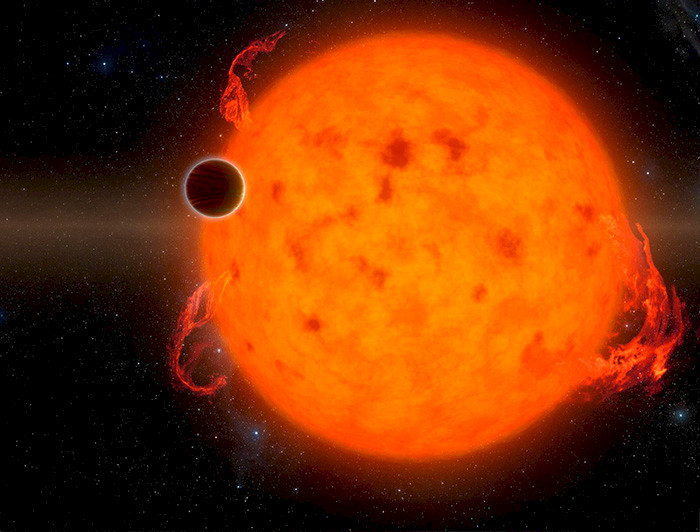
photo_camera Gijs Mulders, astronomer and associate researcher at the Center for Astrophysics and Related Technologies (CATA), and faculty member at the UC Chile Institute of Astrophysics, is part of the research team and contributed to the development of Pterodactyls, a computational tool designed to detect planets smaller than Neptune orbiting young stars. (Image: An exoplanet transiting a young, highly active star / NASA/JPL-Caltech)
The study, led by Rachel Fernandes from Penn State University in the United States, analyzed young planets that orbit closely to their host stars. The goal was to understand how these planets migrate inward within their systems and how they lose their atmospheres during the early stages of their development. The findings provide new clues about the physical characteristics of these bodies and how they evolve over time.
To support this analysis, the team created Pterodactyls, a novel computational tool tailored to detect sub-Neptune-sized exoplanets around young stars. This innovation helps overcome the challenges of studying forming planetary systems and improves the ability to identify new planets.
In Chile, Gijs Mulders through his work with the Center for Astrophysics and Related Technologies (CATA) and UC Chile’s Institute of Astrophysics, played a key role in the development of this tool.
A video created for the study illustrates a hypothetical planetary system over time, showing planets labeled b through f evolving from 10 million years (Ma) to over a billion years (Gy). The animation highlights key processes that shape planetary systems, such as atmospheric mass loss and compositional changes driven by stellar radiation and planetary interactions. (Credit: Abigail Minnich, abbyminnich.wixsite.com/film).
Studying young sub-Neptunes is no easy task. Early-stage stars are highly active, producing variability and intense radiation that make it difficult to detect surrounding planets.
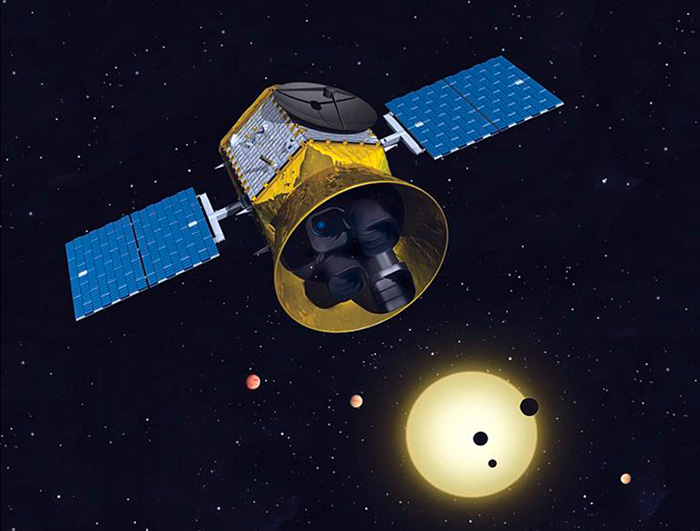
Astronomers typically rely on the transit method, which involves detecting a dip in starlight when a planet passes in front of its host star. However, the variability of young stars makes this method especially challenging. To overcome this, the researchers developed Pterodactyls, an open-source software tool designed to enhance the detection of exoplanets using data from NASA’s TESS mission.
“Pterodactyls is named after the pterodactyl dinosaur and was made possible by the astronomical community, which has developed advanced algorithms for exoplanet data analysis,” explains Mulders.
Another key factor in the detection of young sub-Neptunes is their size: larger planets are easier to detect via the transit method because they block more starlight. Over time, many of these planets shrink, so studying them in their early stages is essential to understanding their long-term evolution.
New Questions Arise
Each exoplanet discovery raises new questions about the formation and evolution of our solar system. “We’re constantly rethinking our hypotheses about how the solar system formed, because exoplanets reveal an incredible diversity. Many stars host types of planets that don’t exist in our system—like sub-Neptunes—which suggests that planet formation can lead to very different outcomes,” says Professor Mulders.
“Understanding what kinds of planets are formed helps us answer a fundamental question: Are Earth-like planets rare, or are there many more out there in the universe?” the astronomer concludes.


