The Quantum Computer Being Built by UC Chile and the Challenges of its Industrial Application
In collaboration with Federico Santa María Technical University, UC Chile was awarded the 2025 grant Research Rings Competition in Specific Thematic Areas from the National Agency for Research and Development (ANID, as per its acronym in Spanish) to begin building this computer that will work with multiple iterations of a problem simultaneously, efficiently finding an optimal solution.
photo_camera The quantum computer project is just starting, following the award of a grant from the National Agency for Research and Development (ANID, as per its acronym in Spanish)
A quantum computer is used to solve a decision-making problem. It can quickly find the most efficient solution, since it analyzes every possible path simultaneously, which takes it directly to all possible solutions in real time.
“For example, a truck delivering supplies has different routes to visit 20 cities, and from every possible combination of routes, the quantum computer determines which is optimal, in terms of minimizing time, distance travelled, or fuel consumption,” says Dardo Goyeneche, faculty member from the UC Chile Institute of Physics. “A traditional computer can do this as well, but it tests each route one by one, while the quantum computer explores all routes at once, and selects the optimal one, making it much faster.”
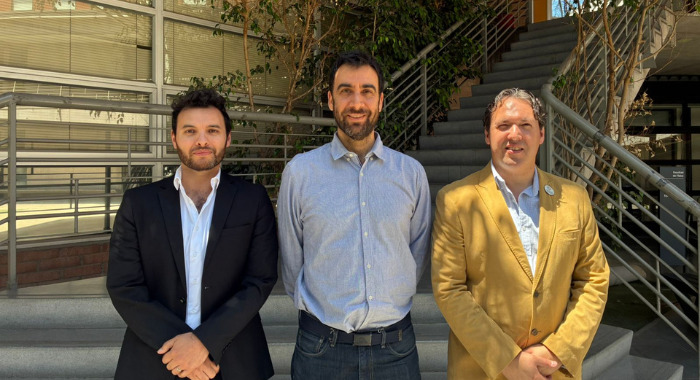
Goyeneche, along with Jerónimo Maze, faculty member from the UC Chile Institute of Physics, and Ariel Norambuena, professor from Federico Santa María Technical University, are working in building Quantü, a computer that uses the laws of quantum mechanics for data processing, with the aim of contributing to the long-term resolution of scientific, technological, and industrial challenges in Chile.
The initiative was awarded by the National Agency for Research and Development (ANID, as per its acronym in Spanish) in the 2025 version of the grant Research Rings Competition in Specific Thematic Areas, in the category of Artificial Intelligence and Quantum Computing, and was one of the three selected projects nationwide.
On January 26 a ceremony was held, attended by more than 90 people, to mark the start of the project’s development, a milestone that links basic science and technology transfer. “This project we won to begin the construction of the quantum computer is just the start. It is a three-year-long project, and represents the foundation of Quantü’s construction,” says Goyeneche.
Multiple options, a single computer
A quantum computer differs from other computers primarily because of the basic units of information they use: traditional computers use bits, while quantum computers use qubits.
Goyeneche, who leads the project, explains that qubits “not only work with zeroes and ones, but they also allow superpositions between zero and one. This advantage provided by quantum mechanics can be used to solve highly relevant problems that are very difficult or impossible to solve with current computers.”
This allows exploring multiple paths at the same time — the academic notes — and encode each one of them as a possible solution to a real problem.
“This can be applied to the problem of having 17 planes and 30 gates at an airport, where the goal is to minimize the time it takes for each aircraft to reach a gate. This type of problem is highly non-trivial and difficult to solve. A traditional computer may find a good solution, but given that there are as many possibilities as there are grains of sand in the planet, it cannot find an optimal solution,” he states.
What is a superposition?
The UC Chile professor adds that quantum computers, in contrast to traditional ones, “allow superpositions between zero and one.” He compares the concept of superposition to waves on water: “If you throw a stone into a calm pond, a wave forms. If you throw two stones, the waves overlap, and the resulting wave does not have the shape of the first or the second one but is a collective phenomenon that occurs only by the superposition of the waves.”
Exploring the idea further, the academic explains that “if you have two possible states of matter, for example, a coin with heads and tails, in quantum mechanics both states can coexist in superposition. That is to say, you can have a coin that is neither on 0 nor 1, but is 50% on 0 and 50% on 1 simultaneously.”


