The Two Hemispheres of Maria Montt
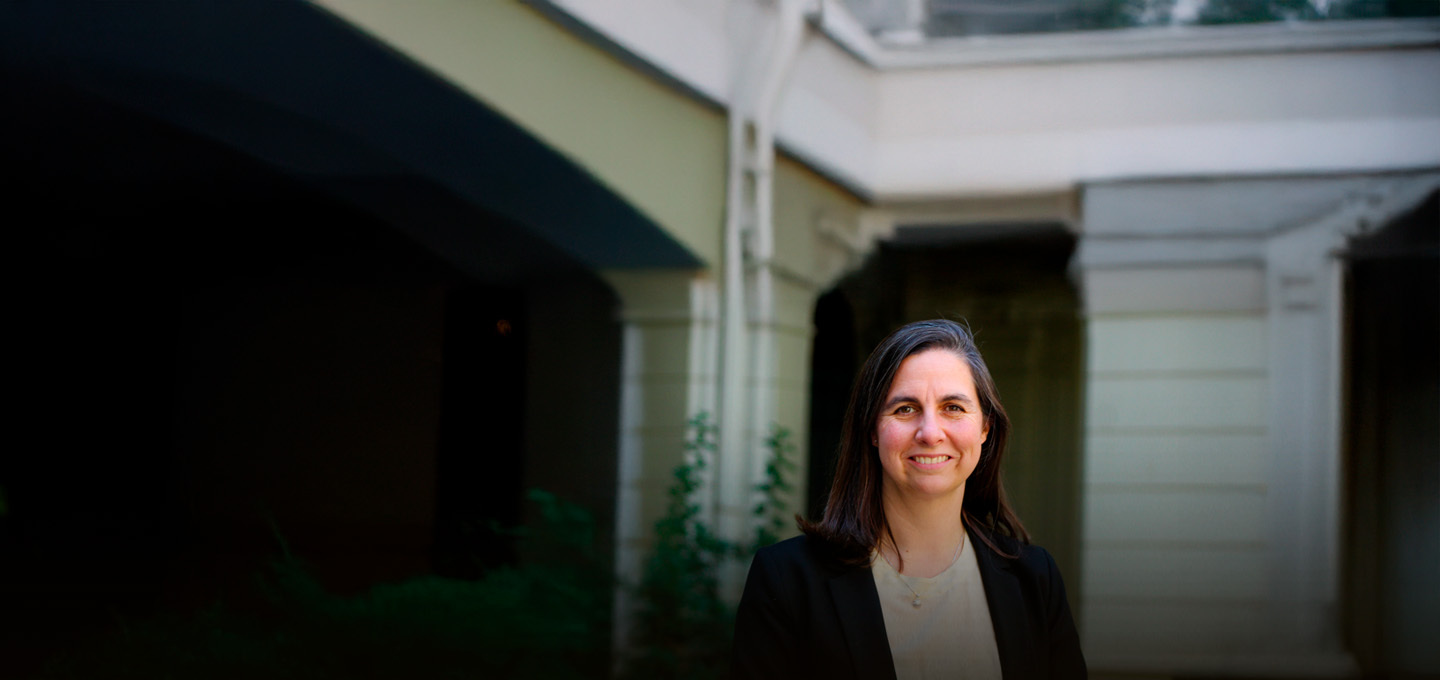
The new Vice President for International Affairs has been associated with UC Chile for nearly half her life. And although she has spent most of her time between Santiago and Chiloé, her curiosity about Asia, and specifically China, has led her on an intellectual quest across that continent. Her postgraduate studies have taken her to London and Manchester as well.
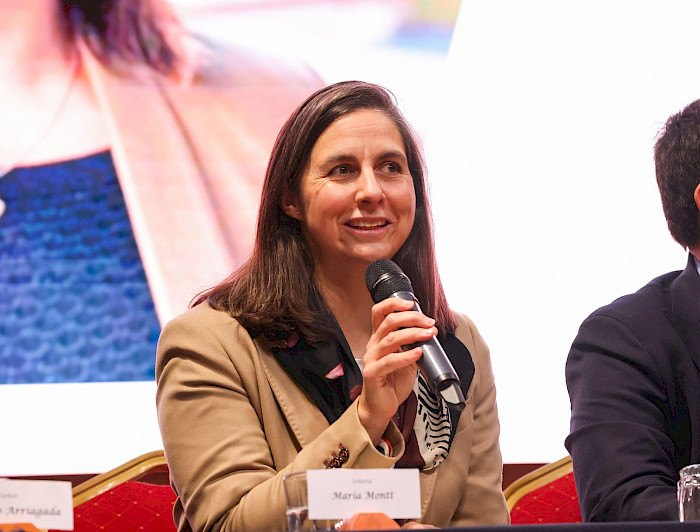
photo_camera At the end of 2018, Montt became a member of the academic staff of the Institute of History UC Chile, participating in projects related to Asian studies such as the Millennium Nucleus on the Impacts of China in Latin America and the Caribbean (ICLAC as per its initials in Spanish.) Photo credit: Office of Communication, UC Chile.
“When I first came to Santiago, there was no Google Maps,” remarks Maria Montt, academic, historian, and now Vice President for International Affairs at UC Chile, the position she has just assumed upon the arrival of Juan Carlos de la Llera as the new President of UC Chile.
This new challenge at the helm of the Office of the Vice President for International Affairs (VRAI, as per its initials in Spanish) has made the new Vice President reflect on her career at UC Chile, marking 17 years since she first joined the Institute of History as a student: “I came directly from Chiloé in 2001, to study History. And, as I mentioned, travelling by bus was very difficult in Santiago. That’s why I became accustomed to always carrying the map that came in the back of the phone book.”
The Vice President moved to Santiago to study at UC Chile after living the first three years of her life at Caldera, then moving to Dalcahue, where she lived until completing secondary school. Although she was born in Santiago, she has always had a connection to the sea due to her father's job in the fishing industry. Despite not being as good a swimmer as her grandmother, it was her grandmother who inspired her to study history: “She was a history teacher and that inspired me, but also I always liked to read – my family has always been surrounded by books. And I thought that studying history would be a way to keep on reading,” she explains.
Asia, UC Chile in the world, and its challenges
Maria Montt remembers her first class in 2001, “Introduction to History,” and emphasizes the importance of the reception her teachers gave her, including the then professor, now director of the Institute of History, Claudio Rolle, for whom she worked as a teaching assistant: “I started studying history and I liked it from day one,” she recalls. However, during her studies, she encountered a turning point that had a deep impact on her interests: “as an undergraduate student I took the Contemporary World History class by Professor Joaquín Fermandois, who gave us the assignment to follow a story from the international news. I chose one about China. It caught my attention how little was known about this country and how difficult it was to find information about it,” she explains.
She laughs as she recalls her attempt to learn Mandarin, but “it was difficult in Santiago back then: there were very few hours of class, and it’s still a debt I owe to myself.” This made her develop a deep intellectual interest in Asia, but with her feet still firmly planted in Chile: “As an undergraduate, I completed a Diploma in Asian Studies and started working as a teaching assistant at the UC Chile Center for Asian Studies, CEA-UC. Then I received the Presidential Scholarship awarded by the Chilean Government and obtained my Master’s degree in Chinese Studies in London. After that I wanted to travel to China, but due to the terms of the scholarship I had to return, so I joined UC Chile in a new project that is now the UC Chile Confucius Institute.”
Following this, Montt returned to England to complete a PhD in Latin American Studies at the University of Manchester. In late 2018 she became a member of the academic staff of the UC Chile Institute of History, participating in projects related to Asian Studies, such as the Millennium Nucleus on the Impacts of China in Latin America and the Caribbean (ICLAC as per its initials in Spanish) with a focus on Public History: how history is thought of and practiced through dialogue, not exclusive to the academic context. “All this was always done with a deep interest in interdisciplinarity and the impact of UC Chile beyond its borders. I’m very interested in how the university is perceived from the outside. I grew up in Chiloé, where UC Chile was considered distant and at the same time admired. So, I have always been interested in continuing to integrate that perspective of how the University is perceived from other places,” she explains.
Dialogue
This is why the position Montt has just assumed is seen as a synthesis of her experiences: “How do we dialogue from UC Chile with the world, and how can the University become a bridge to create these links? It’s a big challenge but can be even bigger if we consider the challenges in which we find ourselves today at an international level. We, as University, can contribute to this discussion and find solutions,” Montt explains.
Likewise, she highlights the importance of connecting with universities and institutions across the globe, and particularly in Latin America and within Chile: “we must think of the international in its relation to the local context, calling together different actors and society in its diversity.” This challenge reflects the mark she hopes to give to the Office of the Vice President for International Affairs during her administration: “The more dialogue exists with different perspectives, the richer the dissemination becomes, and the more we can contribute to solutions."
Asian presence in Latin America
Maria Montt is an outstanding researcher whose areas of study focus on the cultural and diplomatic relations between China and Latin America, as well as between Asia and Latin America, addressing topics such as cultural history and public history. Currently, her work focuses on the perception, representation, and imagery of China and Asia in the region, as well as studying the Chinese diaspora and Asian communities in Latin America, along with travels and travelers to China, from an interdisciplinary perspective.
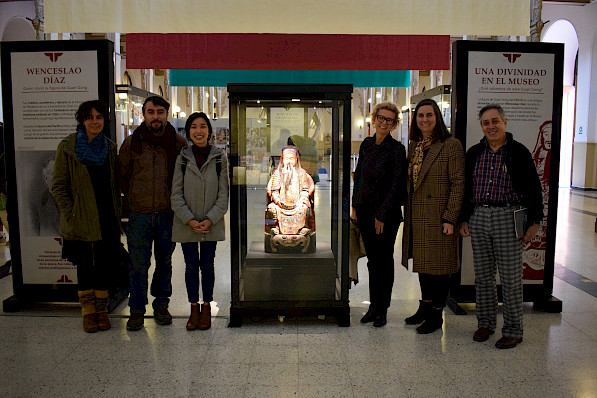
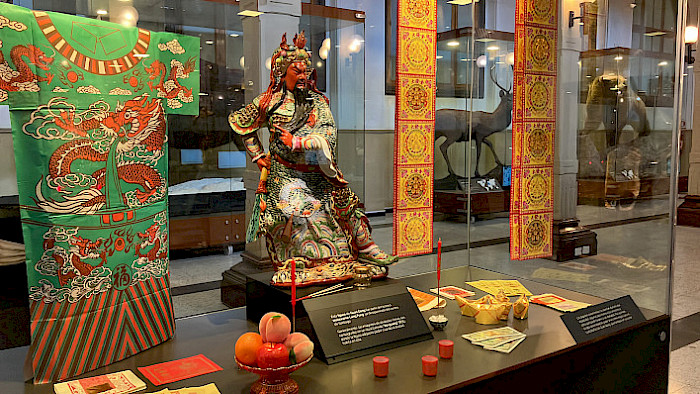
Among the initiatives Montt has led to draw attention to the cultural diversity of Asian immigrants in Chile was the exhibition “The Journey of Guan Gong,” for which Montt was part of the curatorial team. This exhibition, carried out along with Carol Chan, researcher from ICLAC, and Francisco Garrido, archaeology curator from the Chilean National Museum of Natural History, addressed Chinese migration in Latin America and Chile through the discovery of a wooden figurine of the Chinese deity Guan Gong which dates back to the 19th century and is preserved in the museum. The exhibition served to showcase the history and presence of the Chinese community in the region, highlighting its cultural diversity and historical legacy.