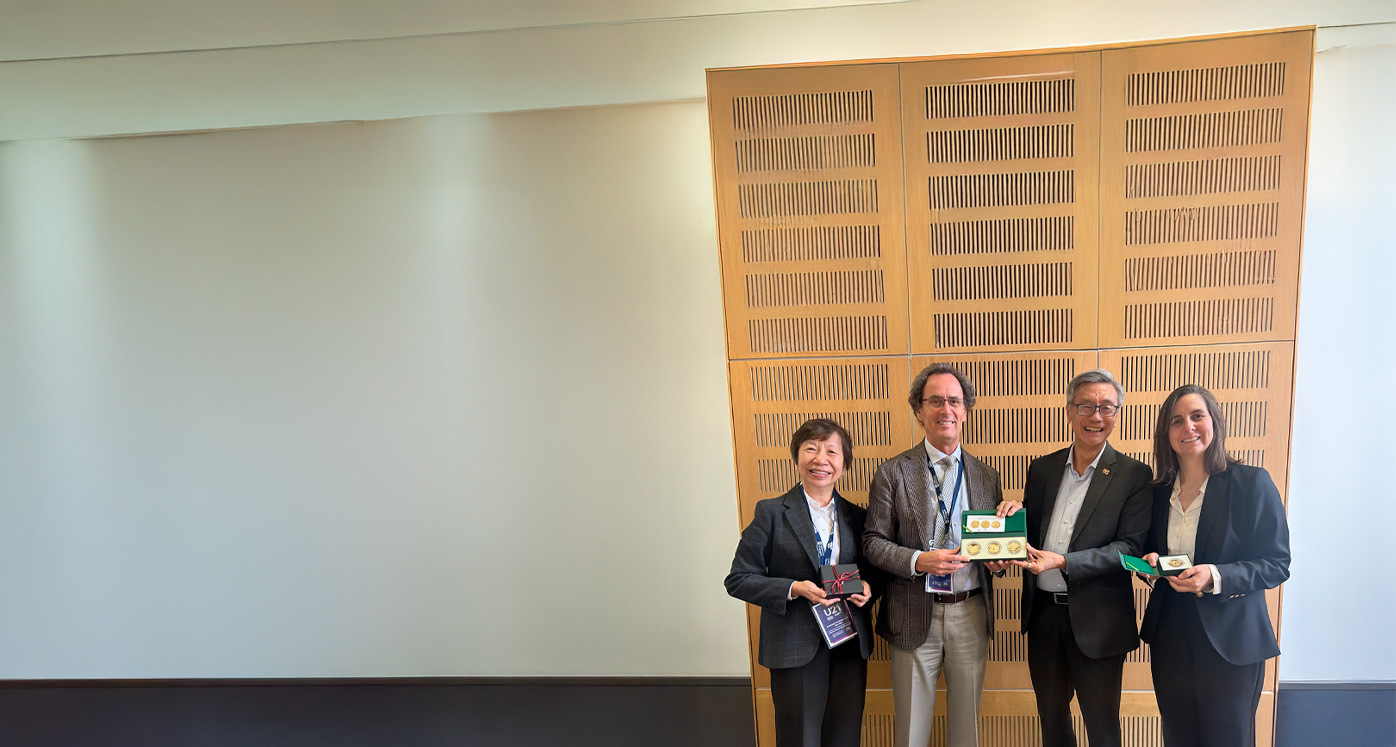
UC Chile Authorities Visit Universities in Scotland With a Focus on AI and Data Science
For a week, the delegation led by UC Chile President Juan Carlos de la Llera explored models of interdisciplinary research, strengthened strategic partnerships—especially through its participation in the annual summit of the Universitas 21 international network—and gathered insights in areas such as artificial intelligence regulation, supercomputing, doctoral training, and university life.
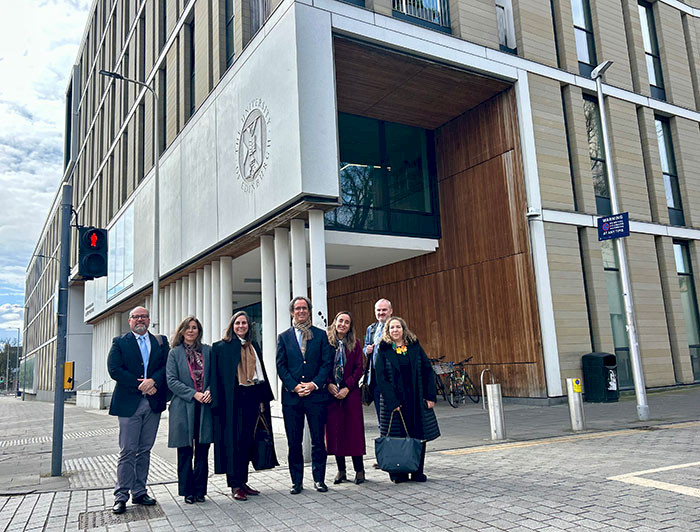
photo_camera UC Chile President Juan Carlos de la Llera alongside Vice President for Research, María Angélica Fellenberg; Vice President for International Affairs, María Montt; Vice President for Digital Intelligence, Paula Aguirre; and Executive Director for the Office of the Vice President for International Affairs, Dalinda Pérez-Álvares. (Photo credit: UC Chile delegation.)
From a visit to one of the main supercomputing centers in the United Kingdom to a meeting with UC Chile students and alumni in Edinburgh; from private meetings with presidents from leading universities to global discussion forums on the future of higher education. These were some of the highlights that marked the agenda of the UC Chile delegation in its recent visit to Scotland. During one week in Edinburgh, Glasgow, and St Andrews, the delegation led by UC Chile President Juan Carlos de la Llera explored models of interdisciplinary research, strengthened strategic alliances, and gathered insights in fields such as artificial intelligence regulation, supercomputing, doctoral training, and university life.
The visit also included the participation in Universitas 21 (U21), a global network that brings together 31 of the world’s leading research universities, of which UC Chile is the only member from South America. Through this space of exchange and collaboration, the institutions share best practices and address common challenges in higher education. The agenda concluded with meetings with UC Chile students and alumni in the United Kingdom, with a cross-cutting objective: to identify how these experiences can translate into concrete abilities to make a difference in Chile.
Concrete models for addressing AI with rigor and responsibility
One of the key priorities identified by UC Chile in its 2026-2030 Strategic Plan—promoting interdisciplinary collaboration and innovation through the responsible use of data and artificial intelligence—was the focus of the opening day of the UC Chile authorities’ visit to Scotland. Led by UC Chile President Juan Carlos de la Llera, the delegation met on Monday April 20 with University of Edinburgh Principal, Sir Peter Mathieson, and university authorities, with whom there has been an agreement for over 20 years.
Founded in 1852, the University of Edinburgh is recognized, among other things, for its work in AI. “The best way to reap the benefits of artificial intelligence, and to understand its risks and how to mitigate them, is to work across all disciplines, meaning, with a multidisciplinary approach that involves lawyers, philosophers, and social scientists, as well as IT specialists. That’s something we’ve been doing in Edinburgh for several years, even before generative AI had gained such importance,” mentioned Principal Mathieson.
Principal Mathieson explained that through this model they seek to anticipate the challenges posed by this technology, which is advancing faster than its regulation. “In recent years, we have been working extensively on ethics and regulation,” he affirmed.
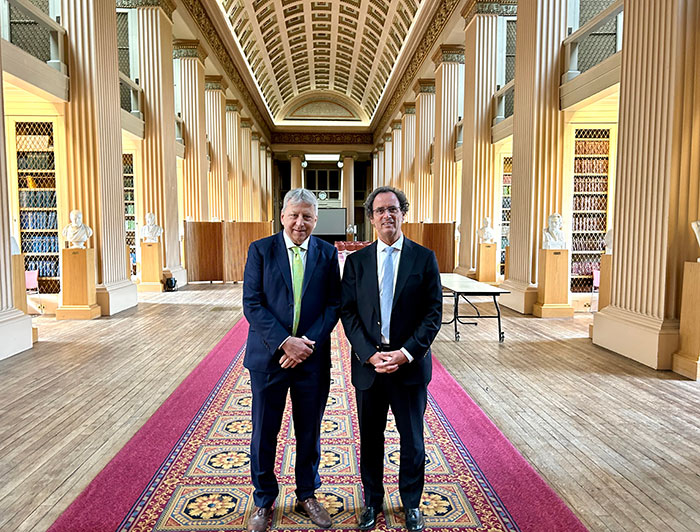
UC Chile President Juan Carlos de la Llera recognized the importance of the Scottish institution in this field and highlighted the need to establish partnerships to meet the goals of the Strategic Plan. “They have put a great deal of emphasis in the regulatory framework and the ethical aspects of artificial intelligence, and I believe we have a lot to learn,” he stated.
He added, “What concerns me the most is not the speed of technological adoption, but that we adopt it recklessly. That efficiency displaces humanity. The conversations we’ve held in Scotland this week help us think more clearly about that challenge and bring back to Chile concrete models to address it with rigor and responsibility.”
Likewise, the authorities highlighted the potential this institutional relationship brings for both sides. “The strategy we are planning at UC Chile and what the Principal from the University of Edinburgh presented align greatly,” commented UC Chile President. For his part, Mathieson stated that, despite both universities being thousands of miles apart, they have a longstanding association and many common interests. “Over 40% of students at the University of Edinburgh come from other countries, and in this context our connection with UC Chile has many opportunities for collaboration,” he remarked.
Visit to the Bayes Centre
A highlight of the day was the visit to the Bayes Centre of the University of Edinburgh, home to the Edinburgh Parallel Computing Centre (EPCC), the United Kingdom’s leading supercomputing center and a global leader in high-performance computing, data science, and parallel computing. The technology supports cutting-edge research in areas that range from climate modelling to the discovery of new pharmaceuticals.
This visit, which enabled the UC Chile delegation to learn how this infrastructure operates, how it trains computer scientists, and how it supports innovation in the industry, is aligned with the mission of the new Office of the Vice President for Digital Intelligence. This experience is linked to one of the most innovative projects of the Strategic Plan: the development of capabilities in advanced computing, data governance, and trustworthy research environments.
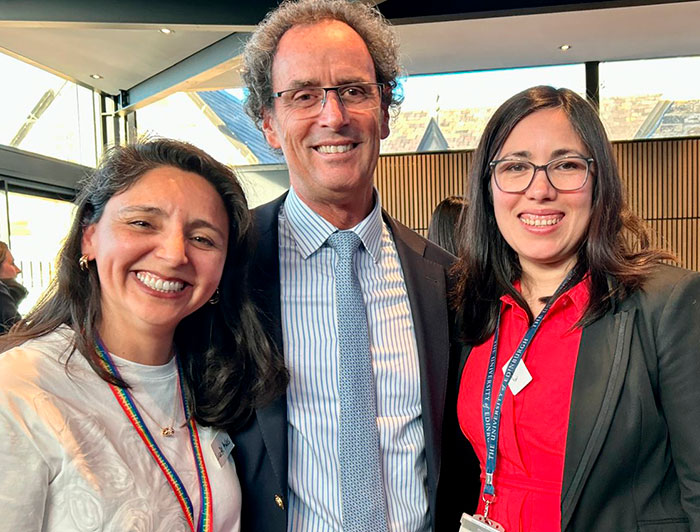
The director of EPCC, Professor Mark Parsons, was clear at identifying common ground: “There are many areas in which both universities, and the EPCC in particular, have opportunities for collaboration. In health and engineering there are many opportunities for joint work between the Bayes Centre and UC Chile.”
Paula Aguirre, UC Chile Vice President for Digital Intelligence, described the reach of the visit. “This center is a great model for the initiatives we want to promote at UC Chile, in terms of building data science capabilities and, in particular, with a secure computing environment. It enables working with sensible data that facilitate research in areas such as health, social sciences and other that work with data that have special safeguarding and protective measures.”
UC Chile put on the spotlight one aspect that, according to him, is highly developed in Scotland but not in Chile: engagement with the industry. Scottish universities are known for their ability to coordinate academia and the public sector, industry and society, focusing their work towards solving concrete challenges. This is a model that UC Chile aspires to strengthen. “There is a great deal of interaction with the industry and with industries today that are pushing the boundaries of knowledge about areas on artificial intelligence and data science. We must find the way to, perhaps, partner with them and with other universities, to gain access to the kinds of engagement they have with the industry,” Paula Aguirre added.
Glasgow and U21
Edinburgh was the starting point of a week that then continued in Glasgow. UC Chile President De la Llera and the delegation attended the Universitas 21 (U21) summit. The most significant moment was the participation of President De la Llera in the U21 Presidents’ Peer Round Table, a closed, exclusive space for exchange between the leaders of the network’s universities. President De la Llera was one of the three presidents invited to open the discussion on how to lead universities in times of volatility and a shifting global order.
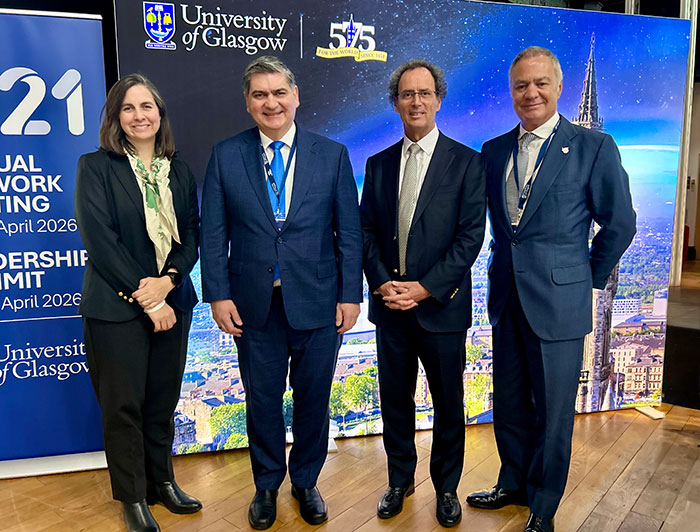
In his intervention, Juan Carlos de la Llera shared his vision on the multiple crises that countries and their institutions currently face. Social, geopolitical, technological, and cultural tensions no longer arrive in sequence but simultaneously, leaving little space for traditional planning, he explained. Then he stated that university leadership in this context demands a combination that is hard to balance: the firmness of someone with clear conviction and the agility of someone who knows the ground is shifting.
He shared the experience in UC Chile about the development of the 2026-2030 Strategic Plan through a process of widespread listening, and his conviction that universities must be coordinators of the development of their countries, connecting more directly with society and addressing real problems on the ground. “When society doesn’t understand what a university is for, the university loses legitimacy. And without legitimacy, it is very hard to lead, to innovate, or sustain any reform,” he told his peers.
St Andrews: tradition, community, and university life
The schedule also included a visit to the University of St Andrews, the oldest university in Scotland, founded in 1413, where the UC Chile delegation met their authorities and learned about the experience of a university community closely tied to the place where it is located.
The delegation also toured the campus, which included meetings with students to experience firsthand the university culture at one of the oldest institutions in the United Kingdom.
“We learned a lot about the community and the sense of community that develops among students, faculty members, and staff members. We were able to chat and see that there are many opportunities for collaboration for academics in terms of the Avanza UC competition, also in terms for student exchange at the graduate level, at the undergraduate level,” mentioned Vice President for International Affairs Maria Montt.
President De la Llera highlighted how the University of St Andrews fosters the personal development of its students beyond the classroom, and how campus community life is an essential part of the education it provides. “I am convinced that investing in the university experience is not a luxury: it is a requirement for forming people of integrity. St Andrews has been doing this for 600 years. We have for 138. But we share the same basic question: What kind of person do we want someone to become after attending this university? This is a question that guides the 2026-2030 Strategic Plan, and this trip makes this clearer,” he stated.
This visit also prompted concrete reflections on infrastructure and university life. Knowing how university residences shape campus life and strengthen the sense of community reaffirmed the UC Chile President’s commitment to move forward with the university residence hall project for San Joaquín campus. “What we saw here confirms that this is the way forward. A university that wants to transform the life of its students cannot limit itself to the classroom: it must offer a place where they can live this experience to the fullest,” he stated.
Edinburgh: research, doctoral students, and alumni
Back in Edinburgh, the agenda focused on the academic sphere. The delegation started with a meeting with Nevile Wylie, Senior Deputy Principal International of the University of Stirling and Co-Chair of the Universities UK International PVC network, where they addressed models of international collaboration and the role of university networks in the current global landscape.
Next, the delegation visited the Edinburgh Futures Institute, one of the most advanced research and innovation centers of the University of Edinburgh, focused on addressing the great challenges of the 21st century from an interdisciplinary perspective. Then, they visited the King’s Building Campus, where they held meetings with the internationalization team and the College of Science and Engineering, touring the Fire Safety Labs. That same day, the delegation met with the Joint PhD and Research Office, in a conversation led by Rupert Lezemore, from Social Sciences and Humanities, and Tom Bruce, from Science and Engineering, where they explored models for joint doctoral programs and advanced research collaboration.
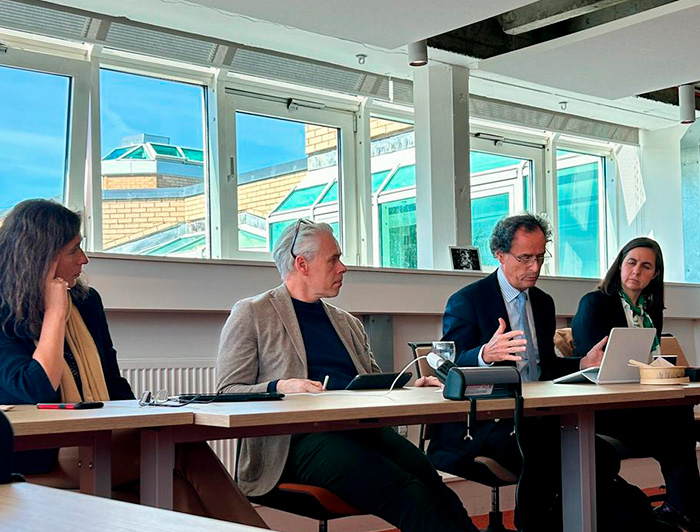
One of the most memorable moments was the meeting with UC Chile doctoral students, who are currently studying in the University of Edinburgh. This conversation provided a firsthand look at the experience of young Chilean researchers in one of the most demanding academic ecosystems of the world, and enabled exploring how UC Chile can strengthen this alliance and better support the careers of its early-career researchers.
The day concluded with a meeting with 40 UC Chile students and alumni who live in the United Kingdom, which took place at Teviot in Edinburgh. This was the most intimate moment of the week: a community of UC Chile students and alumni that build connections and projects from different parts of the world, and that reaffirms that belonging to this university goes beyond the boundaries of the campus and the country.
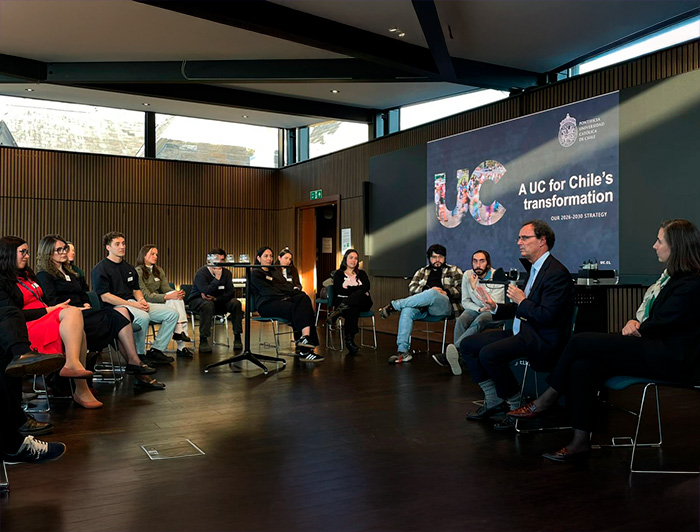
At the end of the visit, President De la Llera gave his concluding statement: “UC Chile returns from Scotland with stronger relationships, concrete learning, and the refreshed certainty that selective and strategic internationalization is one of the strongest platforms to achieve the goal we have set for ourselves: help transform Chile. We did not come to represent ourselves. We came here to seek meaningful collaborations for what we are building at home.”
This first international trip under the 2026-2030 Strategic Plan marks the beginning of a stage in which the University seeks to make its mark on the world not as an end in itself but as a means to broaden its capacity for impact in Chile and its people.


