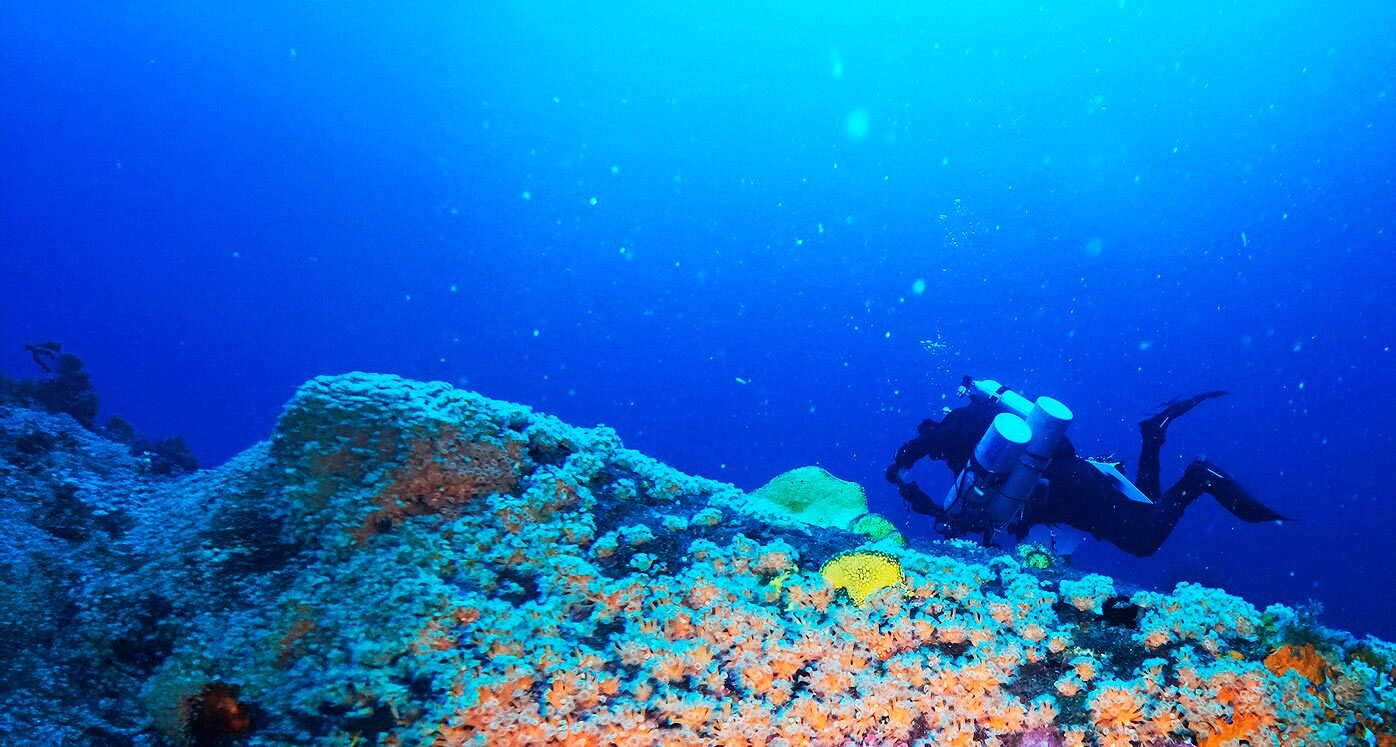
UC Chile Researchers Expand Understanding of Deep Sea Reefs
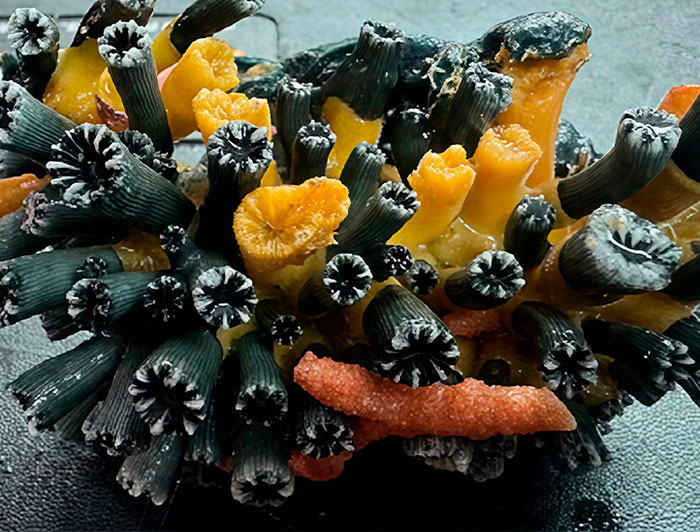
After almost 20 years, a group of researchers from UC Chile, University of Florida, and the Charles Darwin Foundation found the Wellington’s solitary coral (Rhizopsammia wellingtoni), a species endemic to the Galápagos islands and listed as critically endangered. This discovery is the result of research conducted by researchers Alejandro Pérez Matus and Vladimir Garmendia from the Faculty of Biological Sciences in deep sea zones such as Monterey Bay in California, Roatán in Honduras, and Chañaral de Aceituno in Chile.
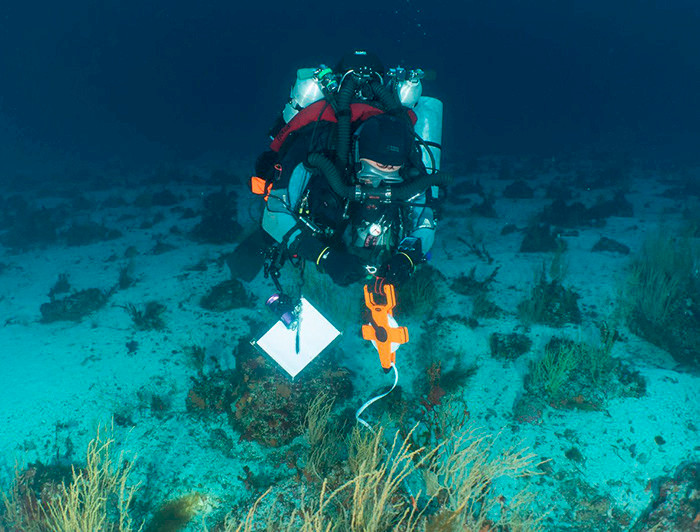
photo_camera This discovery reinforces the hypothesis that reefs located at depths of more than 30 meters become a refuge for species that are threatened at shallower depth, for example, by fishing. (Photo credit: Javier Mahauad)
“We were diving at 62 meters of depths and we found this coral. It looked very different, I had never seen anything like it. After I managed to collect it and bring it abroad our boat, we all immediately realized that it was a unique species,” recalls Alejandro Pérez Matus, academic from the UC Chile Faculty of Biological Sciences and director of the Millenium Nucleus for Ecology and Conservation of Temperate Mesophotic Reef Ecosystems (NUTME).
The marine ecologist, who specializes in research on temperate and semitropical subtidal ecosystems in the South Pacific, is referring to Wellington’s solitary coral (Rhizopsammia wellingtoni), a species endemic to the Galápagos islands. It was last documented was in 2006: its population had suffered a dramatic decline between 1976 and 1999, a period that included two extreme El Niño events (1982-1983 and 1998-1999.)
However, after 20 years, the species declared as critically endangered by the International Union for Conservation of Nature (IUCN) was found in the mesophotic zone of the archipelago by a group of researchers from UC Chile, the University of Florida, United States, and the Charles Darwin Foundation, Galápagos islands, among them, academic Alejandro Pérez Matus, and Vladimir Garmendia, a PhD student in Biological Sciences at UC Chile, specializing in ecology.
“It was during one of our last dives of that 2024 expedition. Alejandro collected the colony and brought it to the boat. The first one of us who realized and said, ‘This is the Rhizopsammia coral that was thought to be extinct’ was professor Jon Witman, who has been working for decades at the Galápagos island, so it was perfect,” recalls Vladimir Garmendia, who, along with the academic from the UC Chile Faculty of Biological Sciences, has been conducting deep technical dives over the past two years, as part of a collaborative research project aimed at addressing the effect of environmental variability and climate change on the fish and invertebrate communities in the archipelago.
Thus, during the 2024 cold season expedition, the team of scientists sampled 12 sites in the Galápagos to depths of approximately 60 meters, finding in three of them colonies and solitary individuals of this coral, always at depths of over 50 meters where temperatures remain below 17 degrees Celsius.
Based on this evidence, the discovery of this species, historically described as inhabiting shallow waters, suggests that semi-deep reefs may have acted as refuge for this coral which is sensitive to temperature fluctuations, providing new and relevant insights for biodiversity conservation strategies in the Galápagos islands.
Mesophotic ecosystems as refuges
Mesophotic reefs, characterized by very limited light availability and being distributed at depths of 30 to 150 meters, can be crucial to the functioning of coastal ecosystems due to their potential function as refuges for species that have suffered from disturbances, threats, or overexploitation in shallow environments.
In this sense, the presence of populations of Wellington’s solitary coral in the mesophotic zone of the Galápagos “highlights the importance of these semi-deep reefs, because they allow species threatened by these extreme events in shallower waters to survive. This is the refuge hypothesis that these reefs provide,” explains researcher Alejandro Pérez Matus.
He adds: “Temperature changes and other threats, such as storm surges, do not occur at these depths or are less pronounced, which suggests that species can thrive under more stable conditions.”
In terms of conservation, the resilience of this coral, which has migrated to these deeper rocky outcrops, poses as a challenge the need to safeguard these ecosystems. Existing protection measures do not explicitly contemplate zones deeper than 30 meters. “Thus, it is important to employ, on one hand, monitoring strategies and, on the other hand, conservation strategies,” the academic asserts.
For Vladimir Garmendia, this also represents a valuable contribution to our understanding of marine ecosystems. This is because “in reef ecology, studies have been limited to the first 20 meters of depth, and only in recent decades has the interest in exploring these adjacent semi-deep reefs increased,” he highlights.
“Finding this coral supports the idea of refuges in deeper zones and also encourages us to explore these ecosystems that are right there ‘just a few meters below’ and whose diversity we had been unaware of. I believe we are expanding our ecological understanding of reef ecosystems through this type of research and discovery,” highlights the doctoral student.
Like this coral, other species have migrated toward mesophotic reefs to avoid threats, which are not only environmental, but also anthropogenic. In their research and expeditions across the country, Professor Pérez Matus and Vladimir have been able to observe this phenomenon in places like Chañaral de Aceituno in the Atacama Region.
“In Chile, we have implemented the same sampling design and there are places such as Chañaral de Aceituno, where we have documented that the biomass and diversity of rocky-reef fishes increased in these deeper zones. This is interesting, because it suggests that fish species affected by fishing cease to be easy prey past depths of 40 or 60 meters,” explains Vladimir Garmendia, whose doctoral research from NUTME has focused on studying patterns in biodiversity and describing the ecological processes that shape fish communities in mesophotic reefs in Chile and the Galápagos, with the goal of understanding whether these ecosystems can function as refuges for species affected by human and environmental disturbances in shallow environments.
The importance of exploring semi-deep ecosystems
Despite their significance as unique reserves of biodiversity and refuges for endangered species, mesophotic reefs remain largely unexplored and unmonitored ecosystems. The reason: they are difficult to access, as they are located at depths of over 30 meters.
Although reaching those zones is a challenge, it is also an opportunity. This is why, since its creation in 2019, NUTME has worked to answer scientific questions about temperate mesophotic reefs in Chile. Through its research, the group has sought to understand their structure, behavior, and potential connectivity with shallow ecosystems.
“At the NUTME Millenium Nucleus, we have been able to create a program not only for exploration but also for monitoring the mesophotic reefs using a variety of both direct as well as indirect technologies,” states NUTME Director, Alejandro Pérez Matus.
Among the methods and technologies they use are scientific-technical diving with closed circuit rebreathers, as well as Autonomous Reef Monitoring Structures (ARMS) and baited remote underwater video cameras (BRUVs), among others.
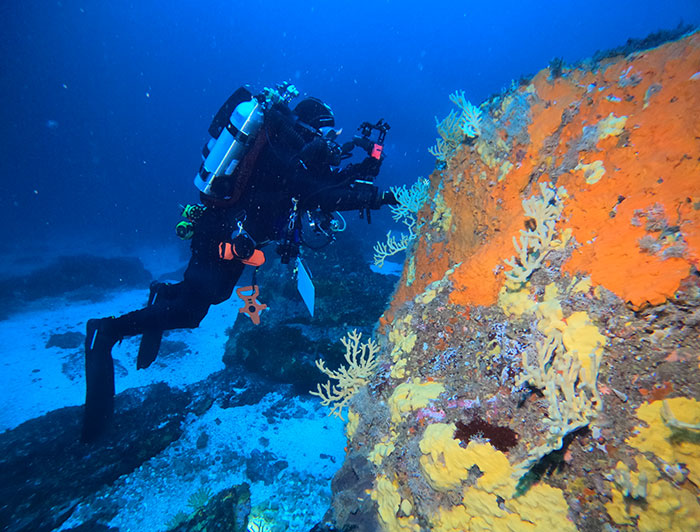
“We dive using closed circuit systems, which enable us to access ranges of depth that would otherwise be more expensive or more dangerous. In this sense, Alejandro has been a visionary and took a chance on training a group of divers. He and I were the first ones, and now three more colleagues from the Nucleus are being trained to continue this program of diving and scientific exploration in mesophotic reefs,” mentions Vladimir.
From his perspective as a field ecologist, the NUTME researcher emphasizes the importance of diving to access study sites, understand them, and appreciate them in situ: “In fact, beyond the data one could collect, there are also audiovisual records, which help us raise awareness and share with people what we see during these special diving sessions.”
Alejandro Pérez Matus and Vladimir Garmendia have dived with this equipment along the coast of Chile, from Iquique in the north to the north of Patagonia at Melimoyu Bay. They have also dived at Monterey Bay (California), Roatán (Honduras), and Galápagos, where they have taken part in four expeditions.


