
UC Chile Strengthens Global Role at Hemispheric University Consortium Meeting
University leaders from across the Americas and the Caribbean, all members of the Hemispheric University Consortium (HUC), convened at the Universidad Estatal de Campinas (Unicamp) in Brazil to advance academic collaboration on global challenges and shape the consortium’s future. Representing UC were University President Juan Carlos de la Llera, Vice President of International Affairs María Montt, and Vice President of Communications Eduardo Arriagada.
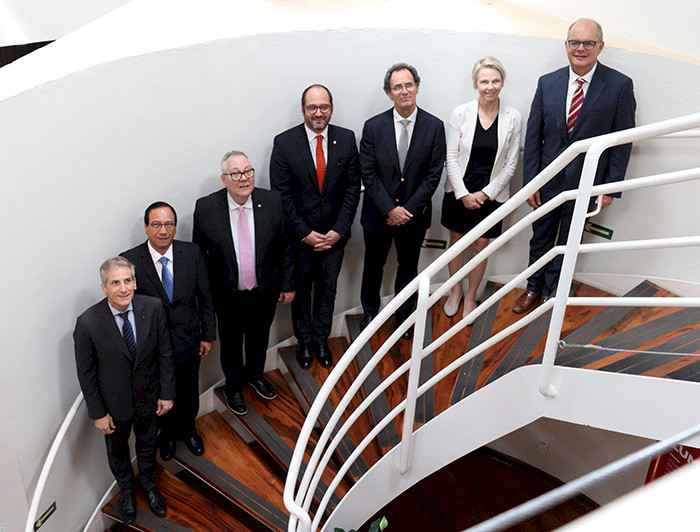
photo_camera Over the course of two days of work, presidents, vice-presidents, and institutional representatives from the HUC network, comprising universities from 12 countries in the Americas, addressed the main global challenges affecting our societies. (Photo credit: Unicamp)
On September 29–30, Universidad Estatal de Campinas (Unicamp) hosted the general assembly of the Hemispheric University Consortium (HUC), a network of 13 universities from 12 countries across the Americas. Pontificia Universidad Católica de Chile (UC Chile) played an active role, reaffirming its commitment to international cooperation in higher education.
Over two days of dialogue, presidents, vice presidents, and institutional representatives tackled urgent global challenges in research, education, public engagement, and artificial intelligence, among others. Their shared objective: to strengthen HUC as a strategic platform for developing academic solutions with cross-border impact.
As President Juan Carlos de la Llera, who attended the meeting, explained: “Our participation in the Hemispheric University Consortium has been a key forum for sharing long-term perspectives with universities across the Americas—especially now, when the challenges facing higher education are so clearly global.” HUC adds strategic value to UC Chile by fostering collaboration, shared learning, and innovation, reinforcing our role as a leading Latin American institution in teaching, research, critical thought, knowledge creation, and public engagement.”
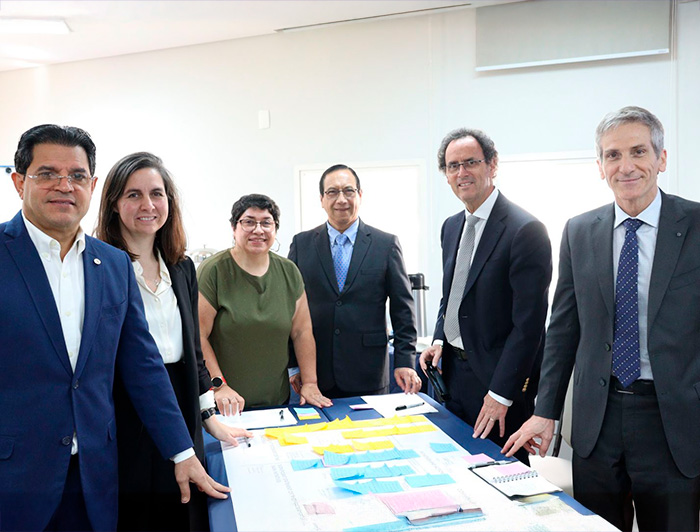
Shared Vision, Hemispheric Outlook
The consortium is evolving into a global forum for universities to exchange ideas on common challenges while expanding its research agenda. Members also discussed broadening participation—particularly from North America—to strengthen regional representation.
As HUC president and head of Universidad Austral, Julián Rodríguez, noted: “HUC is unique in bringing together a select group of leading universities from Canada to Argentina to collaborate on issues that affect us all. We are grateful to hold our first meeting here in Campinas.”
Currently, HUC’s work is organized into five priority areas supported by four strategic pillars:
- Teaching: Launch of the Global Competence Quiz alongside student dialogues—among them, five in 2025 on climate change, sustainability, and resilience, hosted by Austral, USFQ, and UC.
- Research: USD 144,000 in seed funding awarded to collaborative project—four in artificial intelligence, four in sustainability, two in public health, and two in inclusion. The virtual research internship program will also relaunch for 2025–2026.
- Libraries: 20 academic requests processed through SISHUC, an integrated system linking member universities’ library networks. Plans include expanding use and improving interoperability.
- Public Engagement: The Social Ideas Challenge connected hundreds of students and startups across the Americas. This year, seven universities and nearly 200 students are expected to participate, culminating in a finalist team.
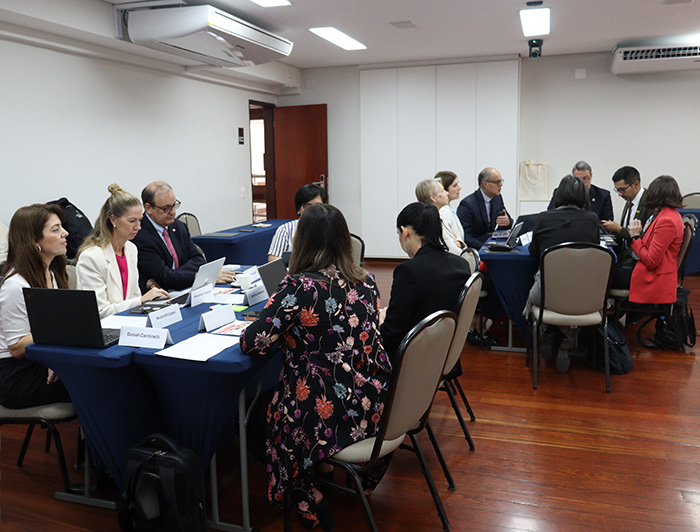
On the governance front, the consortium strengthened its network of institutional representatives, advanced the formalization of its statutes, and set clearer criteria for admitting new members, including proven academic collaboration and institutional commitment.
Paulo Cesar Montagner, head of the host institution Unicamp, highlighted the consortium’s broader mission: “Unicamp has long been active in major consortia like this because of the urgent challenges we face—such as democracy, climate change, and economic issues. These are key topics as we think about the future, which is our main mission.”
Looking Ahead
“HUC represents a unique opportunity to strengthen internationalization across the Americas,” said UC Chile Vice President of International Affairs Maria Montt. “Through collaborative initiatives in teaching, research, and public engagement, we are creating spaces where students, faculty, and academic communities can collaborate to address shared challenges. UC Chile contributes with both energy and commitment.”
The consortium’s value lies in its ability to unite institutions from Canada to Tierra del Fuego, addressing hemispheric challenges that no university could tackle alone. UC Chile reaffirmed its dedication to the network, - which was chaired by UC Chile between November 2023 and the end of 2024- advancing student mobility, collaborative research, and global perspectives in education.
For UC Chile Vice President for Communications Eduardo Arriagada, the consortium also creates practical opportunities: “HUC has enormous potential to expand mobility for our students and faculty. After leading HUC’s communications for a time, UC Chile transferred this responsibility to Universidad Austral. At the same time, we offered to support communications for a new initiative focused on developing joint projects in artificial intelligence.”
President De la Llera reflected on UC Chile’s role: “This was a meaningful opportunity to reaffirm UC Chile’s global vision for training leaders and generating knowledge to build a more just and sustainable society. The renewal of HUC’s strategic framework will allow us to continue to advance scalable, networked academic projects—such as virtual internships, seed funds, and this year’s strong focus on artificial intelligence—further enriching our students’ experience and strengthening UC Chile’s international presence.”
Founded in 2018, the Hemispheric University Consortium (HUC) promotes collaboration in higher education and supports the United Nations’ Sustainable Development Goals (SDGs).
Its members include institutions in Canada, the United States, Mexico, the Dominican Republic, Costa Rica, Colombia, Ecuador, Brazil, Peru, Argentina, and Chile.
HUC initiatives span social entrepreneurship, global learning experiences, collaborative research, communications, library resources, and innovation.
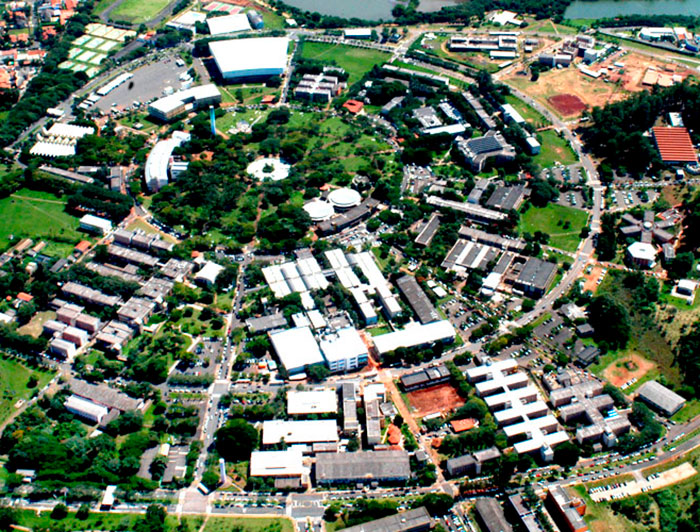
The State University of Campinas (Unicamp), founded in 1966 by the State of São Paulo, has grown into one of Brazil’s leading centers of academic excellence and research.
Undergraduate education is tuition-free for its 16,700 students and fully funded by the State of São Paulo. The university offers 66 programs in medicine, dentistry, engineering, natural and social sciences, applied sciences, teaching, and the arts. Unicamp also operates a major teaching and research hospital complex in Campinas and manages several community hospitals in surrounding cities.
About 10% of all indexed scientific articles from Brazil include a Unicamp co-author, and since 2002 the university has filed more than 50 patents annually—making it the country’s leading institution for technological output.


