International Students Arrive at UC Chile to Address the Challenges of Climate Change
In January, UC Chile welcomed international students from South Korea, Slovakia, Japan, and Australia, who joined UC Chile students in an immersive program focused on the challenges of climate change and sustainability.
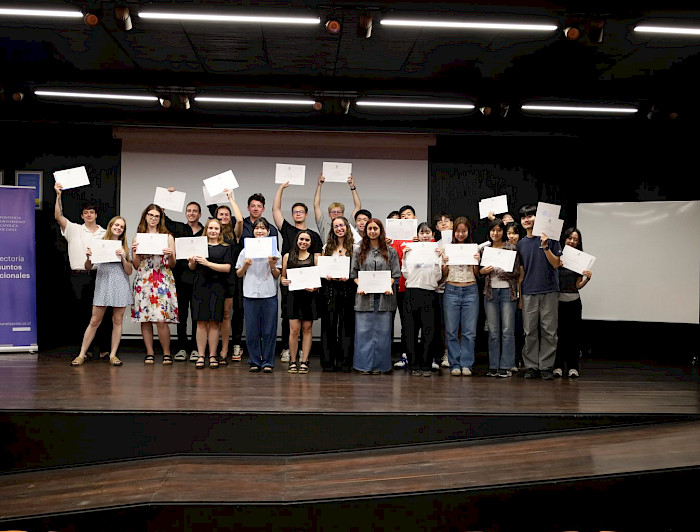
photo_camera UC Chile students and international students at the graduation ceremony of the course “From Climate Risk to Sustainability.” (Photo credit: Samuel Díaz, Office of the Vice President for International Affairs.)
This new edition of the course “From Climate Risk to Sustainability” combined lectures on theory, hands-on experiences, and field work, bringing together students from Europe, Asia, and Oceania at UC Chile to address urgent global socio-environmental challenges from a critical and interdisciplinary perspective.
This year, the program included 21 international participants from six different universities: University of Tokyo (UTokyo), University of SydneyUniversity of Sydney (USYD), Slovak University of Technology in Bratislava (STU), Kookmin University (KMU), and Hanyang University (HYU). They shared classrooms in January with 3 students from the UC Chile School of Agriculture.
During their stay in Chile, the students had an experience that changed their lives: they opened themselves up to a new culture, created friendships, and marveled at the extraordinary natural beauty of our country:
“I would tell my friends from university that if they have an opportunity to come study in Chile, say yes, you must: it will be the best experience of your life,” recommends Emma Garčarová, a student from STU.
The program, organized jointly by the Faculty of Agricultural and Natural Systems and the Office of the Vice President for International Affairs and led by Professor Erika Cortés Donoso (from the Faculty of Agriculture), included field trips to agricultural and coastal areas, where participants could observe sustainable production practices and analyze specific territorial issues.
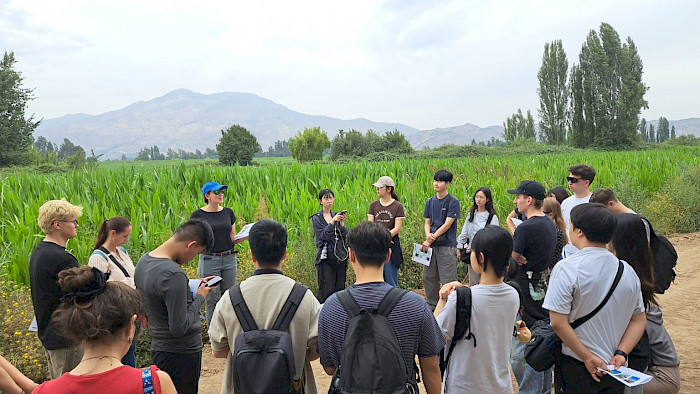
The students explored the connections between science, production, territories, and sustainability when they visited the UC Chile Pirque Experimental Station, and observed the production of organic wines at a vineyard in Casablanca Valley. The closing activity consisted of a visit to UC Chile Estación Costera de Investigaciones Marinas (Coastal Marine Research Station), where they were welcomed by its director, Professor Sylvain Faugeron, from the UC Chile Faculty of Biological Sciences.
“Before coming to Chile, I was very interested in sustainability, but it was here that I was able to broaden my perspective and it was a very in-depth course,” states Park Jihyeon, a student from Hanyang University.
In their final projects, the students addressed diverse topics ranging from the circular economy in construction, floods, agricultural pests, food waste, water scarcity, and urban green areas, highlighting common challenges and the need for complex solutions to similar problems in various countries. This experience fostered interdisciplinary learning based on applied science, strengthening university internationalization and the protection of our country’s ecosystems, with the Chilean sea at the forefront.
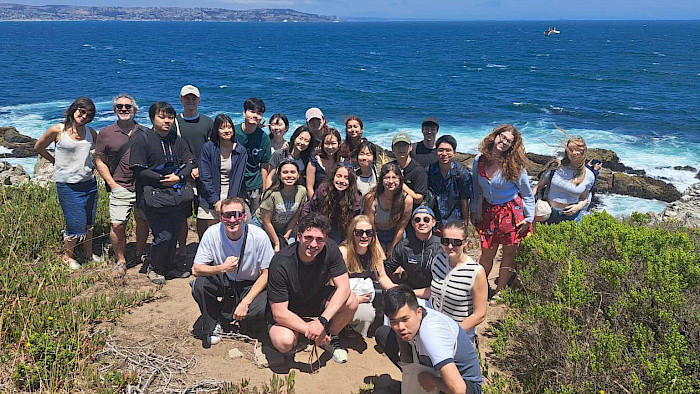
Following this comprehensive examination of climate risks through the Latin American experience – and the Chilean experience in particular – both UC Chile students and those returning to their home universities take with them acquired knowledge, new ideas, perspectives, and friendships that will enrich their education and future projects.
Thus, this experience leaves a mark that transcends the classroom, with lessons shared in various contexts around the world and fostering a new generation of collaborations with a broad vision of the ways we direct our economic development and its global effects.